Key Takeaway
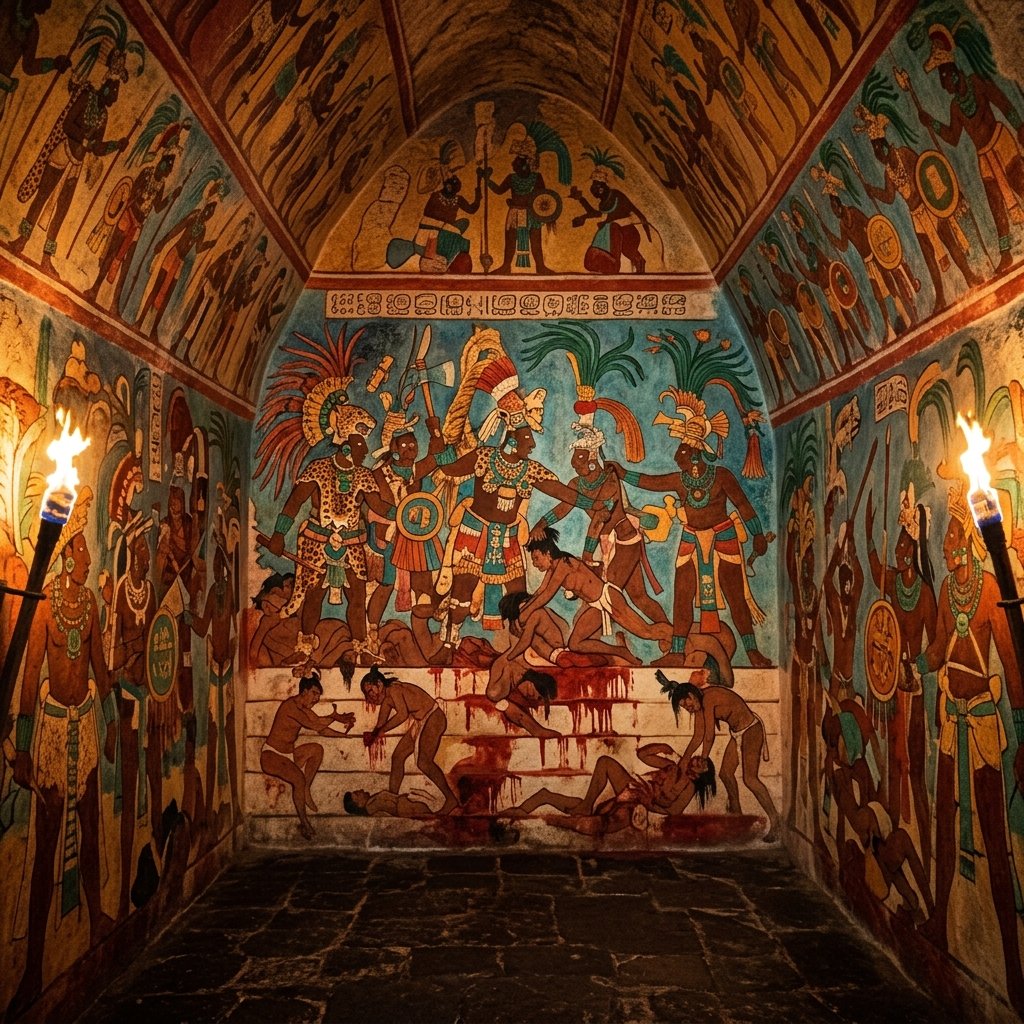
The Bonampak murals cover the walls, ceilings, and door jambs of three rooms in Structure 1 at the site of Bonampak, Chiapas, Mexico. Painted around 790 AD, they depict a continuous narrative across approximately 112 square meters of wall surface — from the preparation for battle to the presentation of captives to a bloodletting ritual and celebratory dance. The murals forever changed our understanding of Classic Maya society, revealing it as politically complex, militarily aggressive, and artistically sophisticated.
Discovery
In February 1946, two Lacandón Maya men — Chan Bor and Acasio Chan — led American photographer Giles Healey to a ruined temple deep in the Chiapas rainforest. What Healey found inside stunned the archaeological world: three rooms whose walls were covered floor-to-ceiling in brilliantly colored murals depicting scenes of warfare, ritual, and courtly life — the most extensive surviving Maya paintings ever found.
The site was named Bonampak, which in Yucatec Maya means "painted walls." The murals dated to approximately 790 AD — the twilight of the Classic Period — and were created for the local ruler Yajaw Chan Muwaan II to commemorate a military victory and the designation of his heir.
The Three Rooms
Room 1 — The Preparation
The narrative begins with the robing of the king and his nobles in elaborate battle costumes — jade earflares, quetzal-feather headdresses, and jaguar-skin capes. A band of musicians plays drums, trumpets, and rattles. The scene establishes the political hierarchy and the ritual preparation for war — not a spontaneous raid but a carefully orchestrated military-religious campaign.
Room 2 — The Battle and Captives
The central room displays a violent battle scene — warriors grasping captives by the hair (the universal Maya iconographic symbol of defeat), weapons raised, bodies tumbling. Below, the aftermath: captives are presented on the steps of a pyramid before the victorious king. One captive has his fingernails torn out and drips blood onto strips of bark paper. This room destroyed the prevailing "peaceful Maya" thesis championed by archaeologist Sylvanus Morley and his contemporaries (Miller, The Murals of Bonampak, 1986).
Room 3 — The Celebration
Dancers in elaborate costumes perform on a stepped pyramid. The king and his family perform an autosacrificial bloodletting ritual — piercing their tongues with stingray spines and letting the blood flow onto bark paper, which is then burned as an offering to summon the Vision Serpent. The heir to the throne — a young child — is presented to assembled nobles.
Artistic Achievement
Art historian Mary Ellen Miller — whose 1986 monograph remains the definitive study — describes the Bonampak murals as revealing "an artistic tradition of extraordinary sophistication," comparable in ambition and narrative complexity to major fresco programs of the Italian Renaissance, though predating them by seven centuries.
Technical analysis reveals remarkable skill:
- True fresco technique — pigments applied to wet lime plaster, chemically bonding with the wall surface (Magaloni Kerpel, Studies in Conservation, 1995)
- Color palette: at least 28 distinct color values achieved from mineral and organic pigments — including Maya Blue, hematite red, carbon black, lime white, and iron-ochre yellows
- Foreshortening and perspective: figures are depicted with convincing three-dimensionality and overlapping — sophisticated pictorial conventions independently developed by Maya artists
- Individual portraiture: faces show distinct individual features rather than generic types — suggesting these are portraits of real, identifiable people
The "Peaceful Maya" Myth
Before Bonampak, the dominant scholarly narrative — promoted most influentially by Sylvanus Morley and J. Eric S. Thompson — portrayed the Classic Maya as peaceful philosopher-priests devoted to astronomy and calendar-keeping. This view held that the Maya were fundamentally different from the "warlike" Aztec.
Room 2 at Bonampak demolished this interpretation. The imagery of organized warfare, captive-taking, torture, and public sacrifice was unambiguous. Subsequent epigraphic advances confirmed that Maya inscriptions record hundreds of wars, captures, and political assassinations across the Classic Period (Webster, The Fall of the Ancient Maya, 2002).
"Bonampak forced us to acknowledge that the Classic Maya were not merely stargazers and calendar priests — they were political actors in a violent, competitive world."
— David Webster, The Fall of the Ancient Maya, 2002
Conservation Challenges
Since their discovery, the Bonampak murals have faced severe conservation challenges. The opening of the sealed rooms introduced humidity fluctuations, biological growth, and calcium carbonate deposits that have progressively obscured the paintings. Major conservation campaigns have been undertaken by Mexico's INAH (National Institute of Anthropology and History) and the Getty Conservation Institute, including:
- Photographic documentation under multiple lighting conditions (1990s–present)
- Removal of calcium carbonate veils using controlled chemical treatments
- Environmental monitoring and humidity-control systems installed in the rooms
- Digital reconstruction of the original colors using spectral analysis (Magaloni Kerpel, 2014)
Frequently Asked Questions
Can you visit the Bonampak murals?
Yes, but access is controlled. Bonampak is located in the Lacandón Jungle of Chiapas, Mexico, accessible via a paved road from the town of Frontera Corozal. The murals can be viewed through protective glass, and visit times inside the rooms are limited to prevent humidity damage. The site is open daily and can be visited as a day trip from Palenque.
Are the colors really that vivid?
In their original state, the colors were extraordinarily vivid. Today, calcium carbonate deposits have muted some areas, though recent conservation work and digital reconstructions reveal the original brilliance. The use of Maya Blue — an almost indestructible pigment — means that the blue tones have survived particularly well. Full-color digital reconstructions are available in Miller's 1986 monograph and Magaloni Kerpel's 2014 study.
References & Further Reading
- Miller, M. E. (1986). The Murals of Bonampak. Princeton University Press.
- Magaloni Kerpel, D. (1995). "Methodology for the study of Maya Blue pigment at Bonampak." Studies in Conservation, 40(3), 192–200.
- Magaloni Kerpel, D. (2014). The Colors of the New World: Artists, Materials, and the Creation of the Florentine Codex. Getty Research Institute.
- Webster, D. (2002). The Fall of the Ancient Maya: Solving the Mystery of the Maya Collapse. Thames & Hudson.
- Houston, S. D. (2004). "The Archaeology of Communication Technologies." Annual Review of Anthropology, 33, 223–250.