Sayil at a Glance
The Largest Puuc Palace
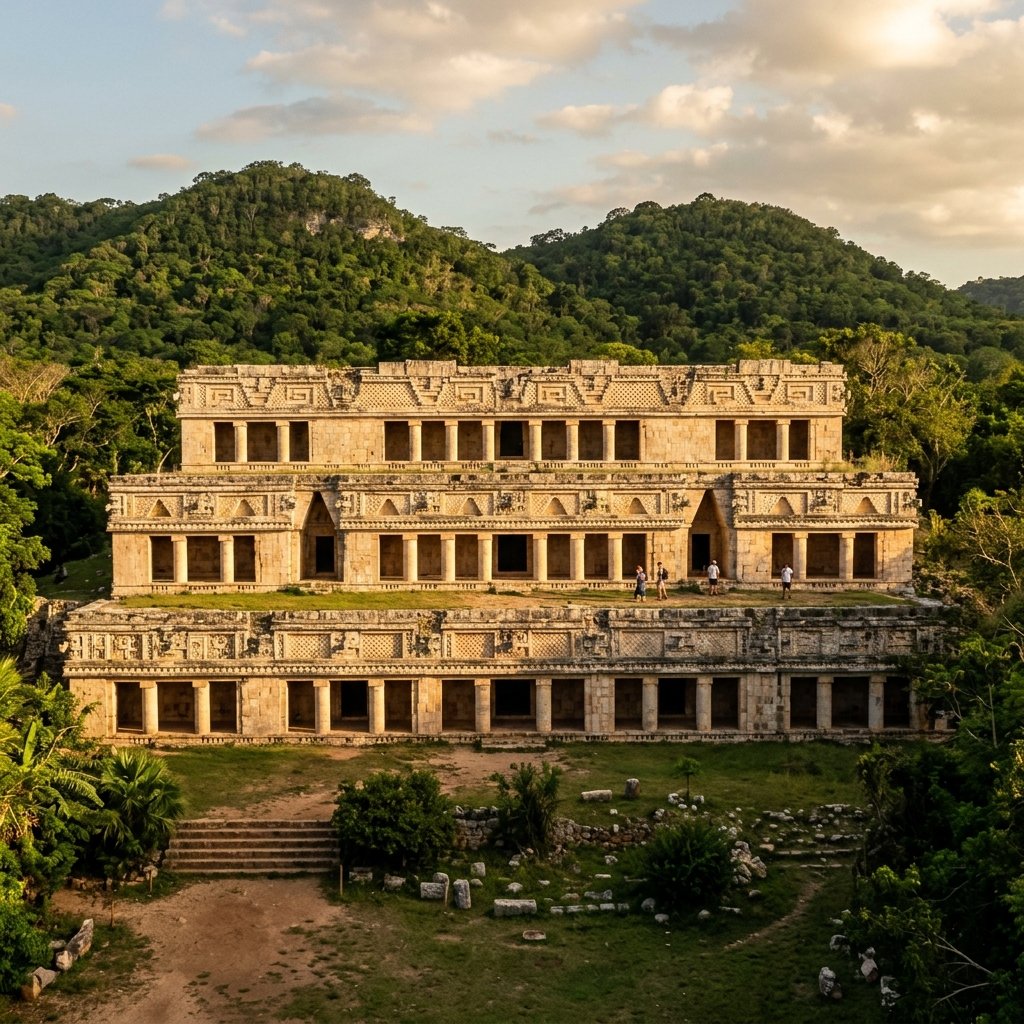
The Great Palace at Sayil is the largest residential structure in the Puuc region — a massive three-story building with over 90 rooms arranged on three terraces that step down the hillside. The palace's facade features the elegant colonnaded style characteristic of Sayil: round columns alternating with flat wall sections, creating a rhythm of light and shadow that gives the building a remarkably modern, almost Greco-Roman feel.
Each story is set back from the one below, creating a cascade effect that makes the structure appear to grow organically from the hill — a masterful integration of architecture and landscape. The upper story features elaborate Chaak masks and geometric fretwork, while the lower levels are restrained and elegant. This contrast between plain lower walls and ornate upper facades is the signature of the Puuc style (Andrews, G.F., Architecture of the Puuc Region, 1995, pp. 85–112).
Living in the Dry Hills
Sayil's greatest achievement may not be architectural but hydrological. The Puuc hills lack the cenotes and rivers that supply water elsewhere in the Yucatán. Sayil's population of approximately 10,000 people depended entirely on chultunes — bottle-shaped underground cisterns carved into the limestone bedrock. Hundreds of these cisterns have been identified at the site, each sealed with plaster to prevent seepage. Rainwater was channeled from building roofs and plaza surfaces into these reservoirs, providing water through the dry season.
This invisible infrastructure — literally beneath the feet of every visitor — represents one of the most sophisticated water management systems in the pre-Columbian Americas. When the system worked, Sayil thrived. When prolonged drought struck in the Terminal Classic, Sayil — like all Puuc cities — was abandoned within decades.
The Fertility God
One of the most famous sculptures at Sayil is a phallic stela found near the site's south group — a standing figure with exaggerated fertility symbolism. This sculpture connects to a broader Maya tradition of fertility worship linked to agricultural success. In the dry Puuc hills, where every season's crop depended on unpredictable rainfall, appeals to fertility and rain deities were not abstract theology but survival strategy.
Visiting Sayil
- Access: On the Puuc Route, 33 km south of Uxmal. Reached via a scenic road through the Puuc hills.
- Time needed: 1–1.5 hours. The Great Palace is the main attraction, with a secondary path to the south group.
- Combine with: Kabah, Labná, and Xlapak (all within 20 minutes' drive).
- Tip: Climb to the top of the Great Palace for spectacular views over the Puuc forest canopy.
Frequently Asked Questions
What is Sayil famous for?
The Great Palace — a massive three-story Puuc building with 90+ rooms arranged on terraces. Its colonnaded facades represent the height of Puuc architectural elegance and it is the largest residential structure in the region.
How many people lived at Sayil?
Approximately 10,000 at peak, supported entirely by chultunes (underground cisterns) carved into the limestone — one of the most sophisticated water management systems in the ancient Americas.
Where is Sayil located?
On the Puuc Route in Yucatán, Mexico, 33 km south of Uxmal. Easily combined with Kabah, Labná, and Xlapak in a single day trip.
Scholarly References
- Andrews, G.F. Architecture of the Puuc Region. Labyrinthos, 1995.
- Sabloff, J.A. & Tourtellot, G. The Ancient Maya City of Sayil. Middle American Research Institute, Tulane University, 1991.
- Sharer, R. & Traxler, L. The Ancient Maya. Stanford University Press, 6th ed., 2006.