Labná at a Glance
The Arch
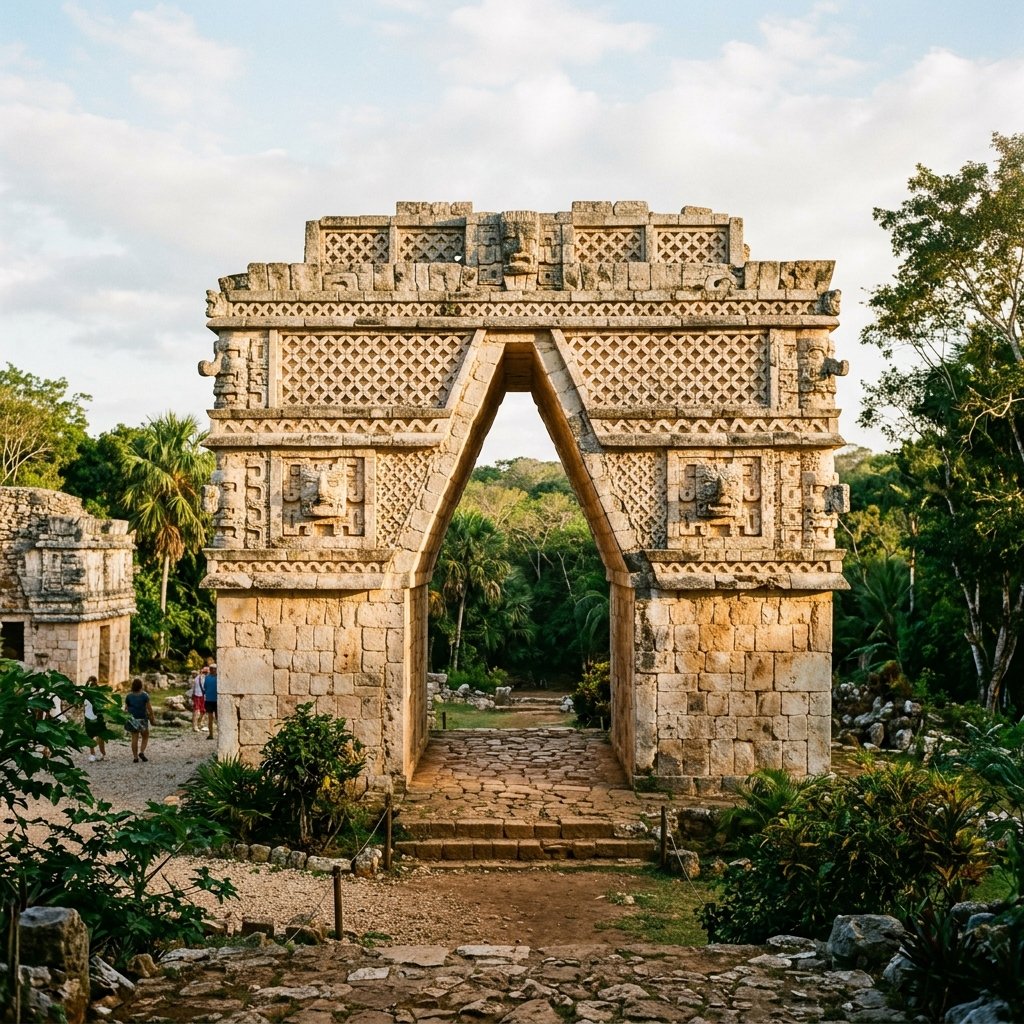
The Labná Arch is universally regarded as the most beautiful corbel arch in the Maya world. Standing approximately 6 meters tall, this freestanding gateway originally connected two courtyards of a palace complex. Its two faces are decorated in contrasting styles:
- Eastern face: Features elaborate stone mosaic lattice-work, geometric stepped frets, and miniature representations of Maya thatched-roof houses (na) — a charming decorative element that preserves in stone the form of everyday Maya domestic architecture that has otherwise disappeared.
- Western face: More restrained, with Chaak masks and serpentine motifs framing the passage.
The arch was not merely structural — it was a ceremonial threshold. Passing through it marked a transition from one sacred space to another. In Maya cosmology, arches and doorways were liminal spaces — passages between worlds (Andrews, G.F., Architecture of the Puuc Region, 1995).
El Palacio
Labná's Palace is a long, multi-room structure with one of the most striking decorative details in Puuc architecture: a corner Chaak mask whose enormous hooked nose doubles as a rain spout. When rain falls on the building's roof, water channels through the mask's nose and cascades off — the rain god literally weeping water. It's engineering and theology fused into a single architectural element.
Visiting Labná
- Access: The last major stop on the Puuc Route, 42 km from Uxmal.
- Time needed: 45 min–1 hour. The site is compact and easily walked.
- Why visit: The quietest Puuc site — you may have the Arch entirely to yourself, especially in the morning.
- Combine with: Kabah, Sayil, and Xlapak — all within a 30-minute drive.
Frequently Asked Questions
What is Labná famous for?
Its magnificent freestanding corbel arch — considered the finest in the Maya world. Decorated with lattice mosaic, Chaak masks, and miniature stone houses, it served as a ceremonial gateway between palace courtyards.
Where is Labná?
On the Puuc Route in Yucatán, Mexico, 42 km south of Uxmal. The most remote main Puuc site — typically the quietest and most atmospheric to visit.
Scholarly References
- Andrews, G.F. Architecture of the Puuc Region. Labyrinthos, 1995.
- Kowalski, J.K. The Art of Uxmal. University of Oklahoma Press, 1994.
- Coe, M.D. The Maya. Thames & Hudson, 8th ed., 2011.