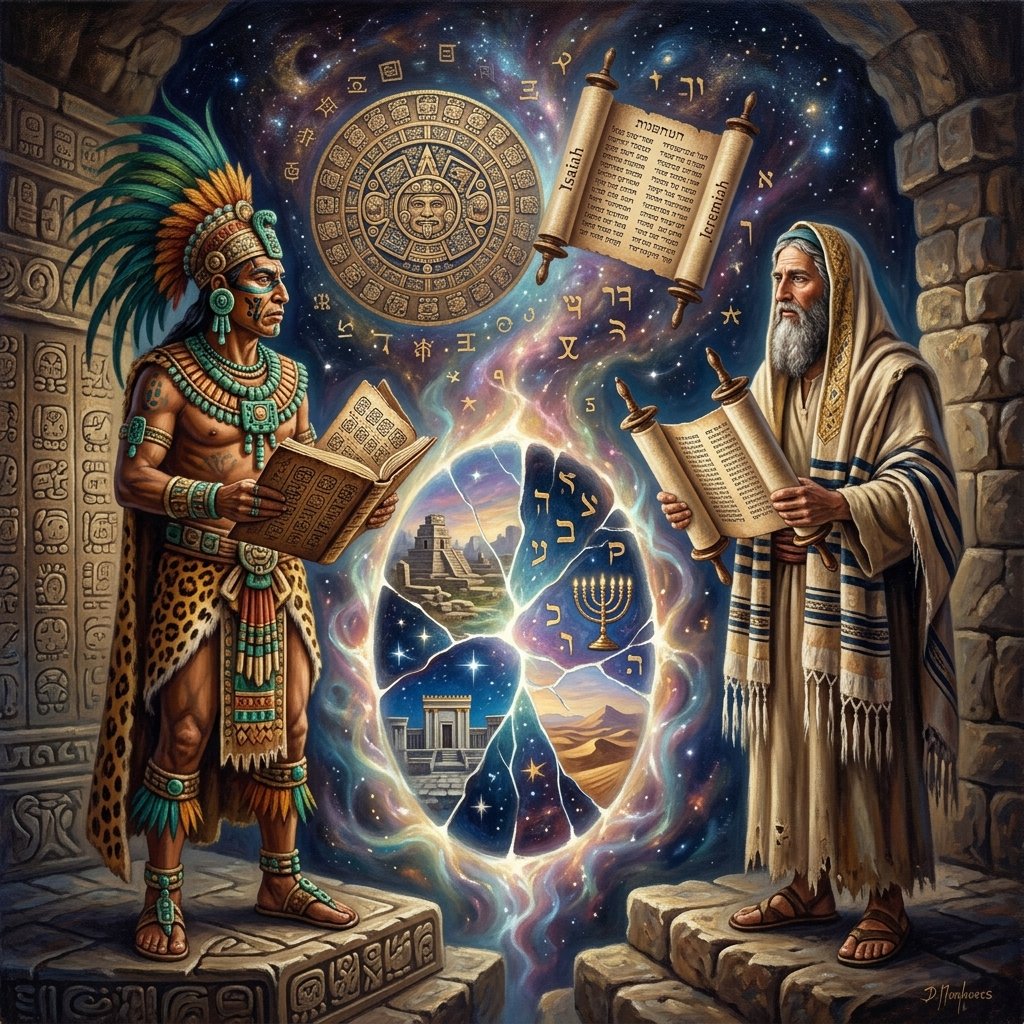
What This Article Explores
This is an exercise in comparative religion and mythology — a discipline that examines structural parallels between unrelated traditions without assuming direct contact. The parallels documented here are well-attested in both the Mesoamerican and Biblical scholarly literature. Whether they reflect universal human psychology, shared archaic inheritance, or something else is left for the reader to consider.
The Flood
Both traditions contain a narrative of world-destroying deluge — one of the most widely distributed mythic motifs on Earth.
Maya: The Flood of the Popol Vuh
The gods destroy an imperfect race of wooden people with a great flood and a rain of burning resin. The Dresden Codex's final page depicts water pouring from the mouth of a celestial serpent — a cosmic inundation marking the end of a world-age. The Maya conceived of multiple creation-destruction cycles, with the current world being the fourth or fifth attempt.
Biblical: The Flood of Genesis
God destroys a morally corrupt humanity with a worldwide flood, sparing only Noah's family and paired animals. The narrative emphasizes divine judgment, covenant, and renewal — a righteous remnant preserved to restart civilization. Similar flood narratives appear in Sumerian, Akkadian, and Greek traditions as well.
Folklorist Alan Dundes documented over 200 flood myths worldwide and argued that their near-universal distribution suggests either a shared proto-myth predating human migration out of Africa or common psychological responses to real flooding events during post-glacial sea-level rise (Dundes, The Flood Myth, 1988).
Cyclical Time vs Linear Time — Or Both?
A common oversimplification holds that Maya time is "cyclical" while Biblical time is "linear." The reality is more nuanced.
- Maya: The Long Count calendar is fundamentally linear — it counts forward from a fixed creation date (August 11, 3114 BC) without repeating. But within this linear framework, nested cycles (the 260-day Tzolk'in, the 52-year Calendar Round) create a structure where patterns recur predictably. Maya prophecy drew on both — using cyclical patterns to predict events while tracking a linear historical narrative through royal inscriptions (Rice, Maya Political Science, 2004).
- Biblical: While often described as purely linear (creation → fall → redemption → end), the Hebrew prophetic tradition also contains deep cyclical structures — the Sabbath cycle (7 days), the Jubilee cycle (7 × 7 years), and the prophetic pattern of apostasy → judgment → repentance → restoration that repeats throughout the books of Judges, Kings, and the prophets.
The Prophet's Role
| Function | Maya Tradition | Biblical Tradition |
|---|---|---|
| Speaks for the divine | The chilam (prophet) channels divine messages during ritual trance | The nabi (prophet) speaks God's words: "Thus saith the LORD" |
| Warns of destruction | Katun prophecies warn of famine, war, and foreign invasion | Isaiah, Jeremiah warn of conquest if the nation doesn't repent |
| Predicts return/renewal | Kukulkán/Quetzalcoatl will return | The Messiah will come (or return) |
| Persecuted by authority | Children of Balam Chilam faced political marginalization | Prophets imprisoned, exiled, killed (Jeremiah, Elijah) |
The Tree of Life
Perhaps the most visually striking parallel: both traditions feature a cosmically significant Tree of Life at the center of their symbolic universe.
- Maya: The Wakah Kan (World Tree / Raised-Up Sky) connects the underworld (Xibalba), the earth, and the thirteen celestial layers. It appears on Pakal's sarcophagus lid, on painted pottery, and in the Popol Vuh. It is often depicted as a ceiba tree with a celestial bird perched at its crown.
- Biblical: The Tree of Life appears in Genesis (the Garden of Eden), Proverbs (wisdom literature), Ezekiel's temple vision, and the Book of Revelation's New Jerusalem. It represents eternal life, divine presence, and cosmic order.
Comparative mythologist Mircea Eliade documented the axis mundi (world axis) as a near-universal archetype — a vertical connection linking heaven, earth, and underworld — found in traditions from Norse Yggdrasil to Hindu Mount Meru to the Maya World Tree (Eliade, The Sacred and the Profane, 1959).
What Should We Make of This?
Responsible scholarship offers several frameworks for interpreting these parallels:
- Universal archetypes (Jung/Eliade): Certain symbols — the flood, the world tree, the dying-and-rising god — emerge independently in all human cultures because they reflect universal structures of the human psyche or shared experiences with the natural world.
- Diffusionism: Some scholars propose that myths and cultural practices were transmitted across continents through ancient contacts — maritime or overland — that are poorly documented or undocumented.
- Religious interpretation: Believers in various traditions see the parallels as evidence that a single divine source communicated with all civilizations — a position that cannot be tested scientifically but cannot be dismissed philosophically.
- Convergent development: Similar ecological and social pressures produce similar cultural responses — floods threaten all river civilizations, trees are universal symbols of growth, and societies under stress produce prophetic voices.
Frequently Asked Questions
Do these parallels prove a connection between the Maya and ancient Israel?
No single parallel constitutes proof. Comparative mythology documents hundreds of similar motifs across unrelated cultures. However, the density and specificity of the Mesoamerican-Biblical parallels have been noted by scholars in both camps as warranting further study. The responsible position is acknowledging the parallels while remaining cautious about causal claims.
Is comparative mythology a legitimate academic field?
Yes. Comparative mythology and comparative religion are established academic disciplines with journals, university departments, and peer-reviewed research. The field includes figures like Mircea Eliade, Joseph Campbell, and Claude Lévi-Strauss. The methodological challenge is distinguishing meaningful parallels from superficial resemblances — a challenge that applies to all cross-cultural comparison.
References & Further Reading
- Dundes, A., ed. (1988). The Flood Myth. University of California Press.
- Eliade, M. (1959). The Sacred and the Profane: The Nature of Religion. Harcourt Brace.
- Rice, P. M. (2004). Maya Political Science: Time, Astronomy, and the Cosmos. UT Austin Press.
- Christenson, A. J. (2007). Popol Vuh: The Sacred Book of the Maya. University of Oklahoma Press.
- Campbell, J. (1949). The Hero with a Thousand Faces. Pantheon Books.