The Paddler Gods at a Glance
Ferrymen of the Dead
In Maya cosmology, death is not an ending but a voyage. When the Maize God dies — slain by the Lords of Xibalba — his body must be transported across the cosmic waters to his place of resurrection. He cannot make this journey alone. He needs ferrymen.
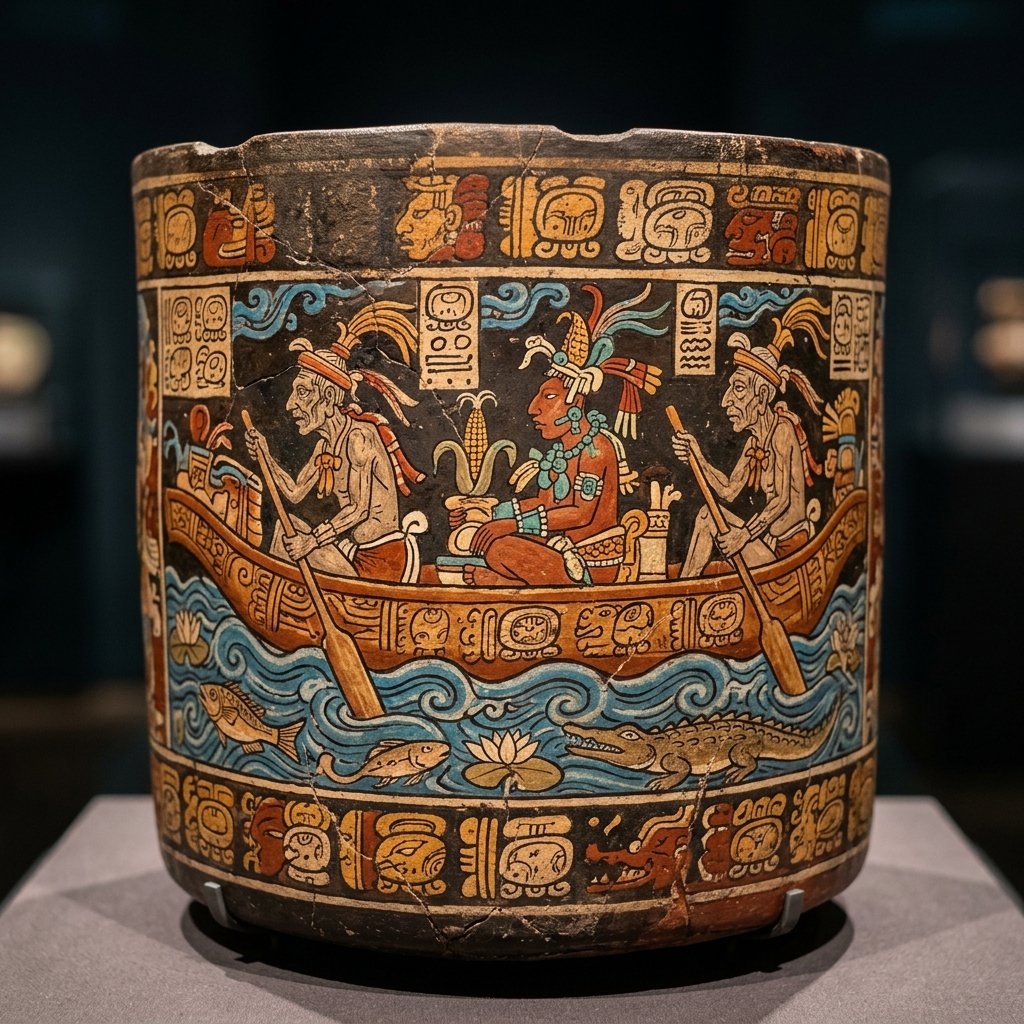
The Paddler Gods are those ferrymen: two aged, otherworldly figures who row a dugout canoe through the waters of the underworld, carrying the dead Maize God toward his eventual rebirth. The Jaguar Paddler, with his jaguar-spotted body and night-time associations, sits at the stern. The Stingray Paddler, with a stingray spine piercing his nose (connecting him to bloodletting) sits at the bow. Together they embody the passage from night to day, death to life (Schele, L. & Miller, M.E., The Blood of Kings, 1986, pp. 270–275).
The Canoe Scene
The "Canoe Scene" is one of the most iconic compositions in Maya art. The Maize God sits upright in the center of the canoe, serene and beautiful even in death. Around him are supernatural passengers — a dog (guide to the underworld), a parrot, a spider monkey, and sometimes an iguana. The canoe glides across featureless water — the primordial sea from which the world was created and into which it will eventually dissolve.
The most famous depiction comes from Tikal Burial 116 — the tomb of the great king Jasaw Chan K'awiil I (r. 682–734 AD). Carved bone fragments from this burial show the Canoe Scene in exquisite detail, with the Maize God's body beginning to sink below the waterline — an indication that the canoe is about to descend into the underworld, taking the god (and the dead king who identified with him) into the realm of death from which he will be reborn.
Day and Night, Life and Death
The two Paddlers represent a complementary duality that pervades Maya thought:
- Jaguar Paddler = Night — darkness, the underworld, the hidden world.
- Stingray Paddler = Day — light, the surface world, the visible world.
Together, they encompass all of time. Their joint paddling represents the passage of the sun through the complete cycle — rising (day/Stingray Paddler), setting (night/Jaguar Paddler), and rising again. The Maize God's canoe journey is therefore a journey through the complete cycle of existence — and the promise that the cycle continues.
Frequently Asked Questions
Who are the Paddler Gods?
Two elderly gods who ferry the Maize God through the underworld in a dugout canoe. The Jaguar Paddler (night/stern) and Stingray Paddler (day/bow) represent the complete cycle of time, carrying the dead god toward resurrection.
What scene do they appear in?
The "Canoe Scene" — one of Maya art's most iconic images. The Maize God sits serene in a canoe with supernatural animal passengers, gliding across cosmic waters between death and rebirth. Best known from Tikal Burial 116 carved bones.
Scholarly References
- Schele, L. & Miller, M.E. The Blood of Kings. Kimbell Art Museum, 1986.
- Taube, K.A. "The Jade Hearth." In Function and Meaning in Classic Maya Architecture. Dumbarton Oaks, 1998.
- Miller, M.E. & Martin, S. Courtly Art of the Ancient Maya. Thames & Hudson, 2004.