Goddess O at a Glance
The Most Powerful Goddess
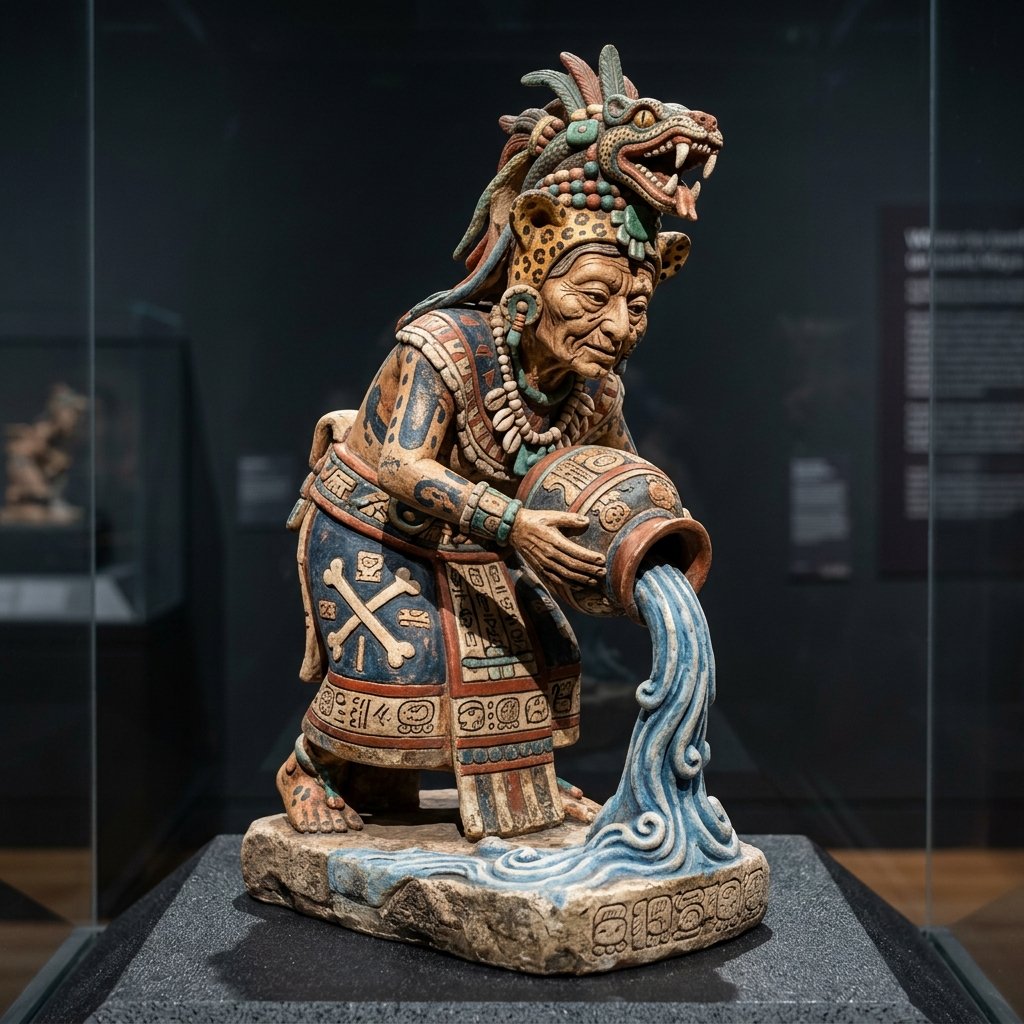
Goddess O is not gentle. She is not nurturing. She is terrifying. An aged woman with jaguar ears, clawed hands, a writhing serpent coiled on her head, and a crossbones skirt that marks her as a creature of the underworld. She appears in Maya art pouring water from overturned jars to flood the earth, wielding spindle whorls as weapons, and presiding over scenes of cosmic destruction.
Yet she is also the patroness of weavers, midwives, and healers — the deity who brings children into the world, who teaches the sacred art of the backstrap loom, and who knows the medicine that cures illness. This duality — creator and destroyer, healer and killer — is fundamental to the Maya understanding of the feminine divine. Goddess O embodies the truth that the same force that gives life can take it away (Taube, K.A., The Major Gods of Ancient Yucatan, 1992, pp. 64–69).
The Flood
In the Dresden Codex (page 74), Goddess O appears in one of the most dramatic scenes in all of Maya art: she stands above the earth, overturning a massive water jar from which a torrent of water pours down to flood the world. A celestial caiman-monster vomits additional water from the sky band above. This is the Maya apocalypse — the destruction of the current world age through flood.
The scene illustrates a core principle of Maya cosmology: destruction precedes creation. The flood that Goddess O unleashes is not random cruelty but cosmic renewal — clearing the way for the next creation. She is not evil; she is necessary. (See The Five Creations for the full cosmological context.)
Weaving and the Cosmos
For the Maya, weaving was not mere craft — it was cosmic creation in miniature. The backstrap loom recreated the structure of the universe: warp threads represented the cosmic columns, weft threads represented the horizontal layers, and the act of weaving mirrored the gods' act of creating the world. Goddess O, as patroness of weaving, was therefore a creator goddess — she who weaves the fabric of reality.
Maya women invoked Goddess O before beginning complex weaving projects, during difficult childbirth, and when preparing medicinal remedies. She was the divine grandmother — old, wise, fierce, and indispensable.
Frequently Asked Questions
Who is Goddess O?
Chak Chel — the old moon goddess. An aged, fearsome figure with jaguar ears and serpent headdress, she governs weaving, midwifery, medicine, and floods. One of the most powerful deities in the Maya pantheon.
What is Goddess O's role?
Creator and destroyer. She brings children into the world and teaches weaving, but also unleashes the cosmic flood that ends world ages. She embodies the Maya understanding that creation and destruction are inseparable.
Is Goddess O the same as Ix Chel?
Current research distinguishes them: Goddess I is the young moon goddess (beauty, sexuality), while Goddess O is the old moon goddess (power, weaving, floods). They may represent the moon's waxing (young) and waning (old) aspects.