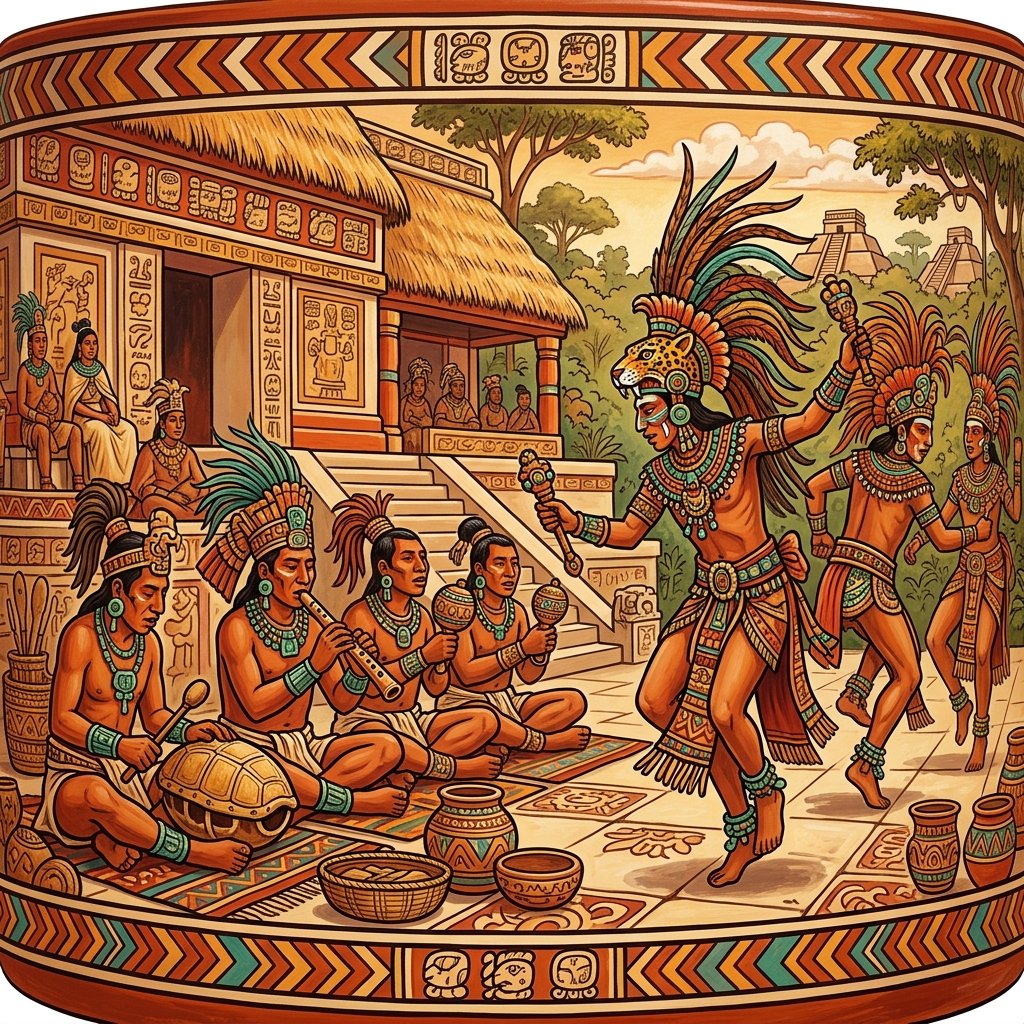
Maya Music & Dance at a Glance
Sound as Sacred Power
Maya music was not entertainment. It was technology for summoning the supernatural. The rhythmic pounding of drums, the piercing wail of conch trumpets, and the haunting melodies of ceramic flutes were understood to attract the attention of gods and ancestors, creating an acoustic environment in which supernatural communication could occur.
The most vivid depiction of Maya music comes from the Bonampak murals (Room 1), painted around 790 AD. The scene shows a full court orchestra performing during a celebration: musicians beating turtle shells with deer antlers, shaking gourd rattles, playing large standing drums, and blowing long trumpets. Elaborately costumed dancers weave among them, transformed through costume and performance into supernatural creatures (Miller, M.E., The Murals of Bonampak, 1986).
The Instruments
Drums
The pax was a large upright drum, often played by a standing musician. The tunkul was a horizontal log drum with a slit cut in the top — a Maya xylophone that produced deep, resonant tones. Most dramatically, turtle shell drums — actual turtle carapaces struck with deer antlers — produced a sharp, distinctive sound that the Maya associated with thunder and the rain god Chaak.
Wind Instruments
Ceramic flutes range from simple tubular forms to elaborate zoomorphic and anthropomorphic figures — flutes shaped as jaguars, birds, gods, and supernatural creatures. Some are genuine works of art that also produce complex tonal ranges. Conch shell trumpets produced a deep, carrying tone used to signal the beginning of ceremonies and the approach of the king.
The King's Dance
Dance was one of the primary duties of a K'uhul Ajaw. Maya inscriptions use the phrase "he danced" as a formal record of royal activity, alongside "he made war" and "he dedicated [a monument]." Dance was not recreation — it was cosmic performance:
- The king danced in elaborate costume as a specific deity — becoming that god through the act of performance.
- Dances were timed to calendar period endings, accessions, and military victories.
- The act of dance, combined with music and incense, created the ritual conditions for supernatural manifestation.
Frequently Asked Questions
Did the Maya have music?
Yes — music was central to ritual life. Instruments included drums (pax, tunkul, turtle shell), flutes, ocarinas, conch trumpets, rattles, and rasps. No stringed instruments. Music accompanied virtually every major ceremony.
What role did dance play?
Dance was a primary royal obligation — kings danced as gods, ancestors, and supernatural beings. "He danced" appears in inscriptions as a formal record alongside warfare and monument dedication.
Scholarly References
- Miller, M.E. The Murals of Bonampak. Princeton University Press, 1986.
- Houston, S. & Stuart, D. "Of Gods, Glyphs, and Kings." Antiquity, vol. 70, 1996.
- Sharer, R. & Traxler, L. The Ancient Maya. Stanford University Press, 6th ed., 2006.