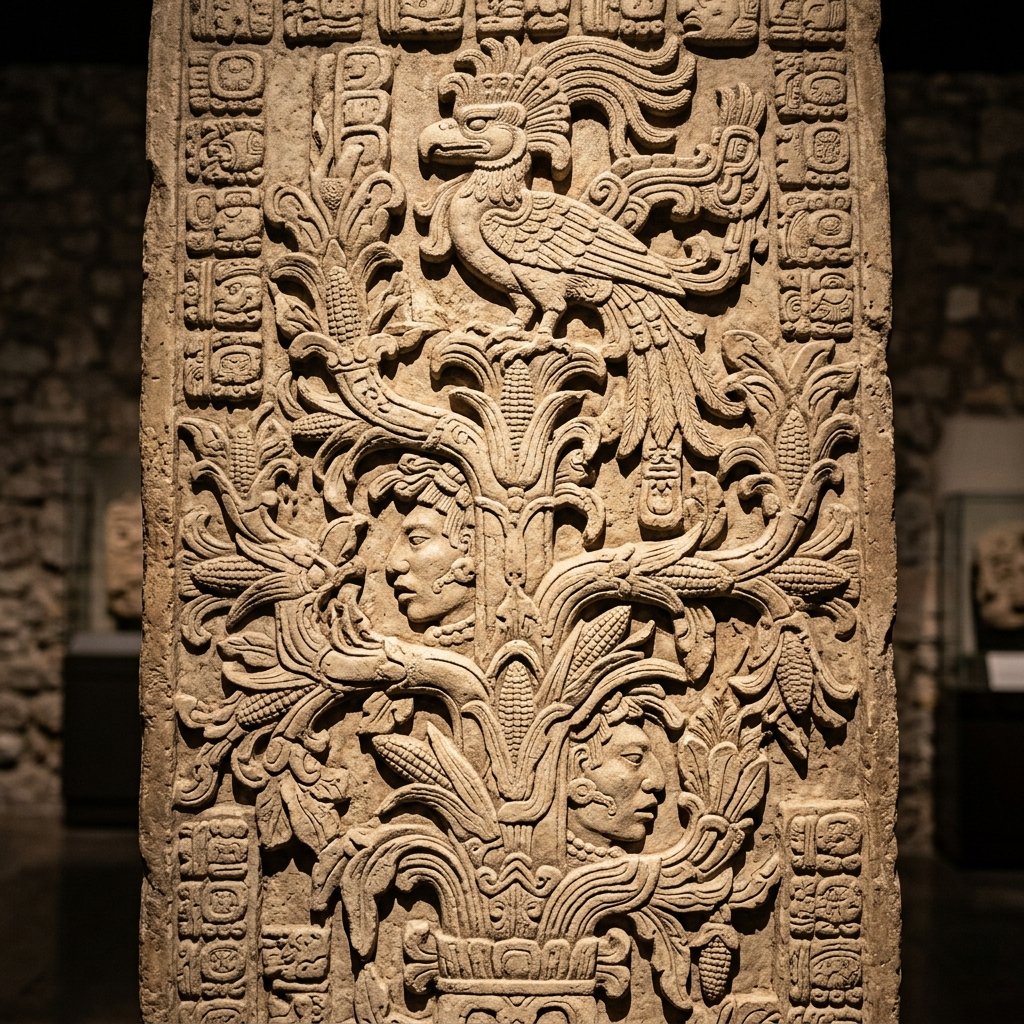
The Maya Cross at a Glance
The Shock of the Spanish
When Spanish priests and conquistadors first penetrated the jungles of the Yucatan and Chiapas in the 16th century, they were stunned by a specific visual discovery. Scattered among the 'pagan' ruins and inside active religious shrines, they found prominent carvings of crosses.
Unable to believe that an indigenous group could have invented such a holy symbol independently, early Spanish chronicles hypothesized that Saint Thomas the Apostle had secretly crossed the ocean centuries earlier to preach the Gospel to the Maya.
It took modern archaeological decipherment to correct this misunderstanding. The Maya cross had absolutely nothing to do with the crucifixion. For centuries before contact with Europe, the cruciform shape was one of the most sacred symbols in Maya theology—but it represented a plant, not an execution device.
The Cross as the Maize Tree
The Maya cross is fundamentally an agricultural symbol. It represents a highly stylized Maize Plant (corn), which in turn serves as a variation of the World Tree concept.
In Maya cosmology, maize was the most sacred substance on Earth; the gods had literally crafted the first successful humans from corn dough (masa) according to the Popol Vuh creation epic. The cross shape simply mirrors the natural botany of a mature cornstalk: a straight vertical stem with horizontal leaves sprouting outward in opposing directions.
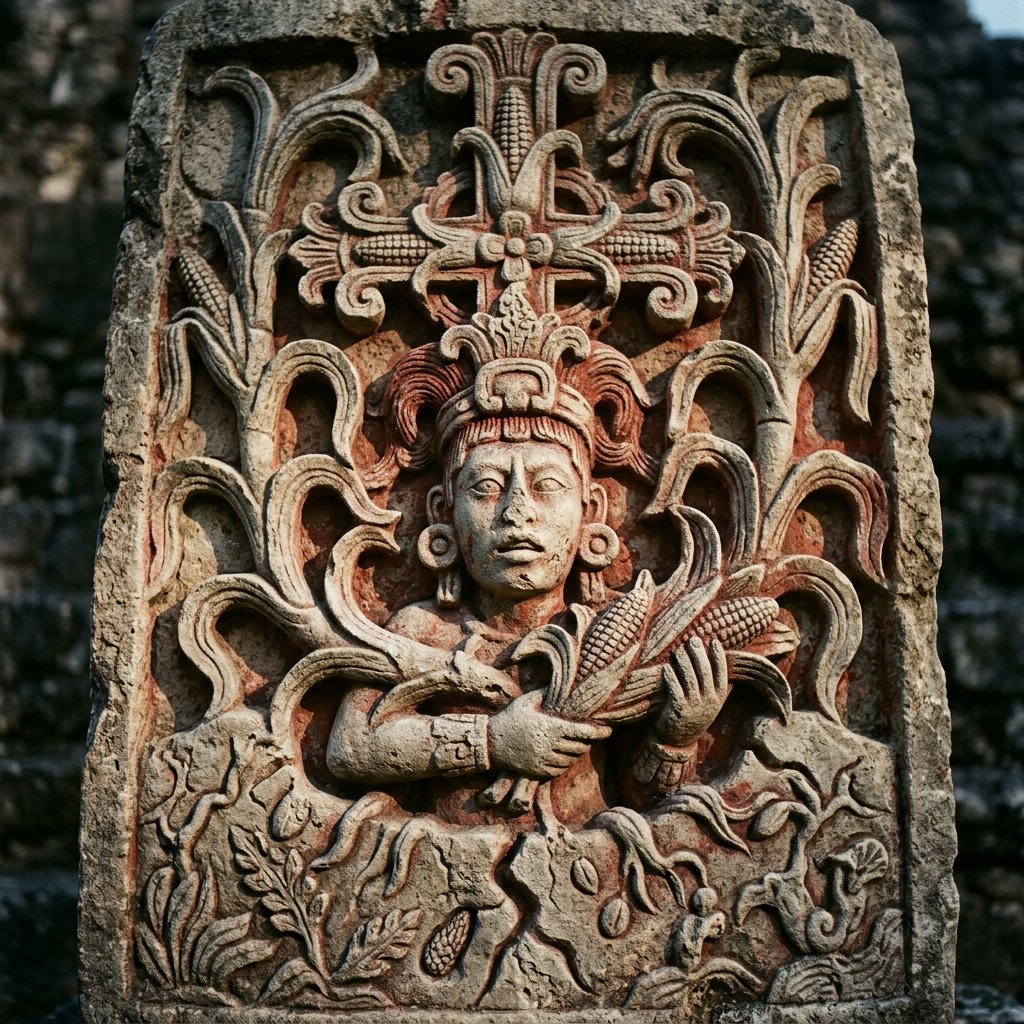
The Temple of the Foliated Cross
The most famous example of this symbol is found at the Classic period site of Palenque, dedicated in AD 692 by King K'inich Kan B'alam II. Inside the inner sanctuary of the Temple of the Foliated Cross is a massive, exquisitely carved limestone tablet.
At the center of the tablet is the cross. However, instead of stark right angles, the arms of this cross droop and curl beautifully, ending in stylized ears of corn that resemble human heads. At the base of the cross is a banded water-lily monster (representing the watery underworld), and perched squarely on top is a massive, supernatural bird.
This incredible carving is a theological manifesto. It states that royal succession (represented by the king making offerings on either side) is tied to the cosmic cycle of maize. The king dies and is planted in the earth, but through sacred rituals, he will sprout and rise again, sustaining the universe just as corn sustains the human body (Schele, L. & Freidel, D., A Forest of Kings, 1990).
The Syncretic "Talking Crosses" of the Caste War
Because both the ancient Maya and the incoming Spanish Catholics revered the cross shape (albeit for entirely different reasons), the symbol became a perfect vehicle for syncretism (the blending of religions).
When indigenous Maya groups converted to Catholicism, they easily accepted the cross, but they often "Mayanized" it by dressing it in embroidered clothing (huipiles) or painting it green (the color of jade and fresh corn leaves).
This syncretism took a militant turn during the 19th-century Caste War of Yucatan (1847–1901), when indigenous Maya rebels rallied around the Cult of the Talking Cross. A wooden cross carved at a remote cenote began "speaking" to the Maya leaders (likely via a ventriloquist), ordering them to resist European dominance. The cross became a terrifying symbol of indigenous resistance, blending the Christian instrument of suffering with the ancient Maya emblem of supernatural power and world-making.
References
- Schele, L. & Freidel, D. A Forest of Kings: The Untold Story of the Ancient Maya. William Morrow, 1990.
- Schele, L. & Mathews, P. The Code of Kings: The Language of Seven Sacred Maya Temples and Tombs. Scribner, 1998. (Contains specific analysis of the Palenque tablets).
- Reed, N. The Caste War of Yucatan. Stanford University Press, 1964. (For details on the Talking Cross).
- Taube, K. The Major Gods of Ancient Yucatan. Dumbarton Oaks, 1992.
Frequently Asked Questions
Did the ancient Maya have the Christian cross before the Spanish arrived?
They had the cross shape, but it had no connection to Christianity or the crucifixion. The Maya cross is an agricultural symbol representing a stylized maize (corn) plant, which served as a variation of the World Tree connecting the underworld to the heavens.
What is the Foliated Cross at Palenque?
It is a famous limestone tablet carved in AD 692. It depicts a cross whose horizontal arms are covered in leaves ("foliated") that terminate in ears of corn shaped like human heads. It serves as a visual metaphor linking the king’s divine right to rule with the eternal death-and-resurrection cycle of the Maize God.
Why did the Maya dress crosses in clothing?
After the Spanish conquest, the Maya blended their ancient beliefs with Catholicism (syncretism). Because the ancient Maya viewed their version of the cross (the World Tree) as a living, pulsating entity rather than dead wood, they treated the Christian cross similarly, dressing it in traditional clothing or painting it green to honor its life-force.