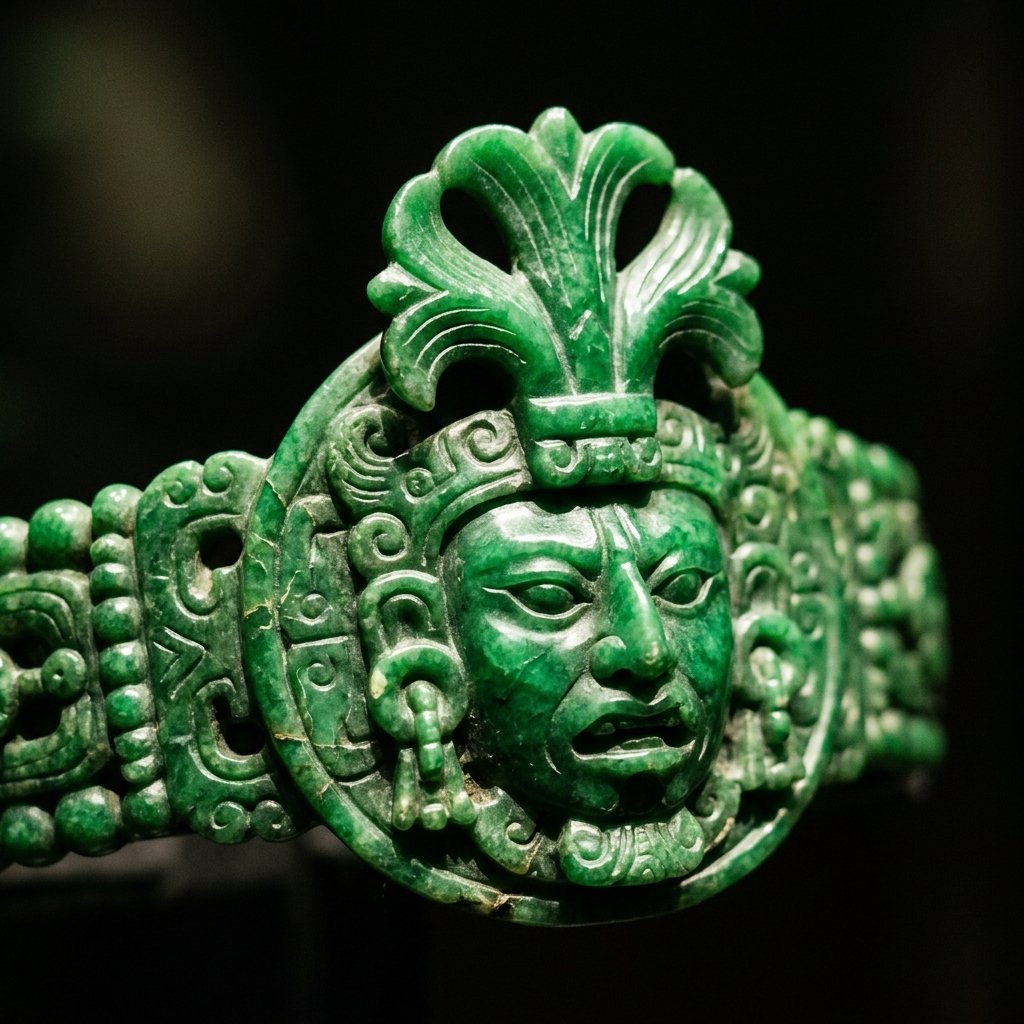
The Jester God at a Glance
The Maya Crown
When a new monarch ascends the throne in Britain, the Archbishop of Canterbury places the heavy, jewel-encrusted St. Edward's Crown upon their head. The act of coronation is what mathematically solidifies the transition of power.
The ancient Maya had an exact equivalent to this ceremony, but instead of a heavy gold crown, the newly anointed k'uhul ajaw (Divine Lord) was presented with a white woven headband of bark paper or cotton, tied at the back of the head. Fixed to the front of this headband, resting squarely on the forehead, was a specific jade jewel: The Jester God.
To put on the headband (the sak huun) was to become king. In Maya hieroglyphic inscriptions, the verb for ascending to the throne literally translates as "he tied the headband."
Why the "Jester"?
The name "Jester God" is an unfortunate archaeological nickname coined by early 20th-century scholars.
When early Mesoamerican archaeologists first encountered the symbol, they noticed that the top of the deity's head split into three long, curved, floppy points. To western eyes, this looked exactly like the three-pointed bell-cap worn by medieval European court jesters. The nickname stuck, even though the symbol has absolutely nothing to do with comedy, foolishness, or entertainment.
Rather than a floppy hat, the three-pointed trefoil element actually represents sprouting maize leaves. By wearing the Jester God jewel, the king was visually linking his own body to the World Tree and the life-giving resurrection of the Maize God (Schele, L. & Miller, M.E., The Blood of Kings, 1986).
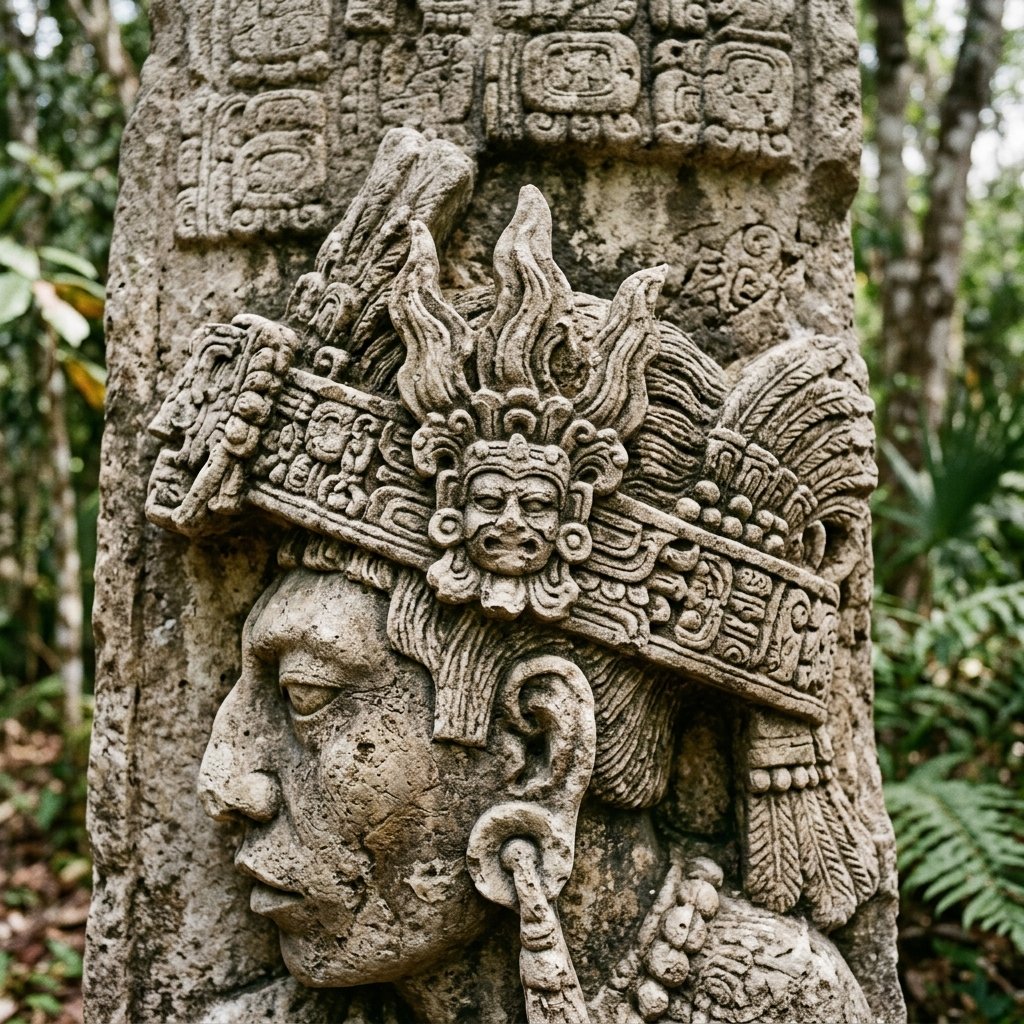
Deep Antiquity: The Olmec Roots
The Jester God was not a Classic Maya invention. It is one of the oldest symbols of political authority in all of Mesoamerica, predating the rise of the great Maya city-states by centuries.
The earliest examples of the trefoil headband jewel were found at the Olmec site of San Lorenzo, dating back to 900 BC. The Olmec carved massive stone heads and exquisite jade figures wearing early versions of the Jester God. When the Maya civilization began to coalesce in the Preclassic period, they inherited the symbol from the Olmec and formalized it into the absolute marker of their own divine kingship (Fields, V.M., The Iconographic Heritage of the Maya Jester God, 1989).
The God Huunal
Despite being worn as jewelry, the Jester God was considered a living deity, often referred to by epigraphers as Huunal (the patron deity of the headband).
As a living deity, the Jester God was an active participant in Maya myth. On the famous sarcophagus lid of King Pakal at Palenque, the Jester God is not just a jewel; it is depicted as an independent deity helping to usher the dead king along the World Tree toward resurrection. It is a symbol that the king's authority did not end with death; it was an eternal, cosmic mandate.
References
- Fields, V.M. The Iconographic Heritage of the Maya Jester God. In Sixth Palenque Round Table, University of Oklahoma Press, 1989.
- Martin, S. & Grube, N. Chronicle of the Maya Kings and Queens. Thames & Hudson, 2nd edition, 2008.
- Schele, L. & Miller, M.E. The Blood of Kings: Dynasty and Ritual in Maya Art. Kimbell Art Museum, 1986.
- Taube, K.A. Olmec Art at Dumbarton Oaks. Dumbarton Oaks, 2004.
Frequently Asked Questions
What was the Maya equivalent of a crown?
The Maya equivalent of a European royal crown was the sak huun—a white woven headband worn around the forehead. While the band itself was made of perishable materials like bark paper or cotton, the central jewel affixed to the front of the headband was the Jester God, typically carved from precious jade.
Is the Jester God a comedian or trickster?
Absolutely not. The name is an unfortunate 20th-century archaeological nickname based on the fact that the symbol's three-pointed top vaguely resembles a European court jester's hat. In reality, it was an incredibly solemn symbol of divine royal authority and maize agriculture.
What do the three points of the Jester God represent?
The trefoil (three-pointed) design represents the three sprouting leaves of a young maize plant. By wearing it, the king demonstrated that he was the agricultural guarantor of his people, visually linking himself to the resurrection cycle of the Maize God.