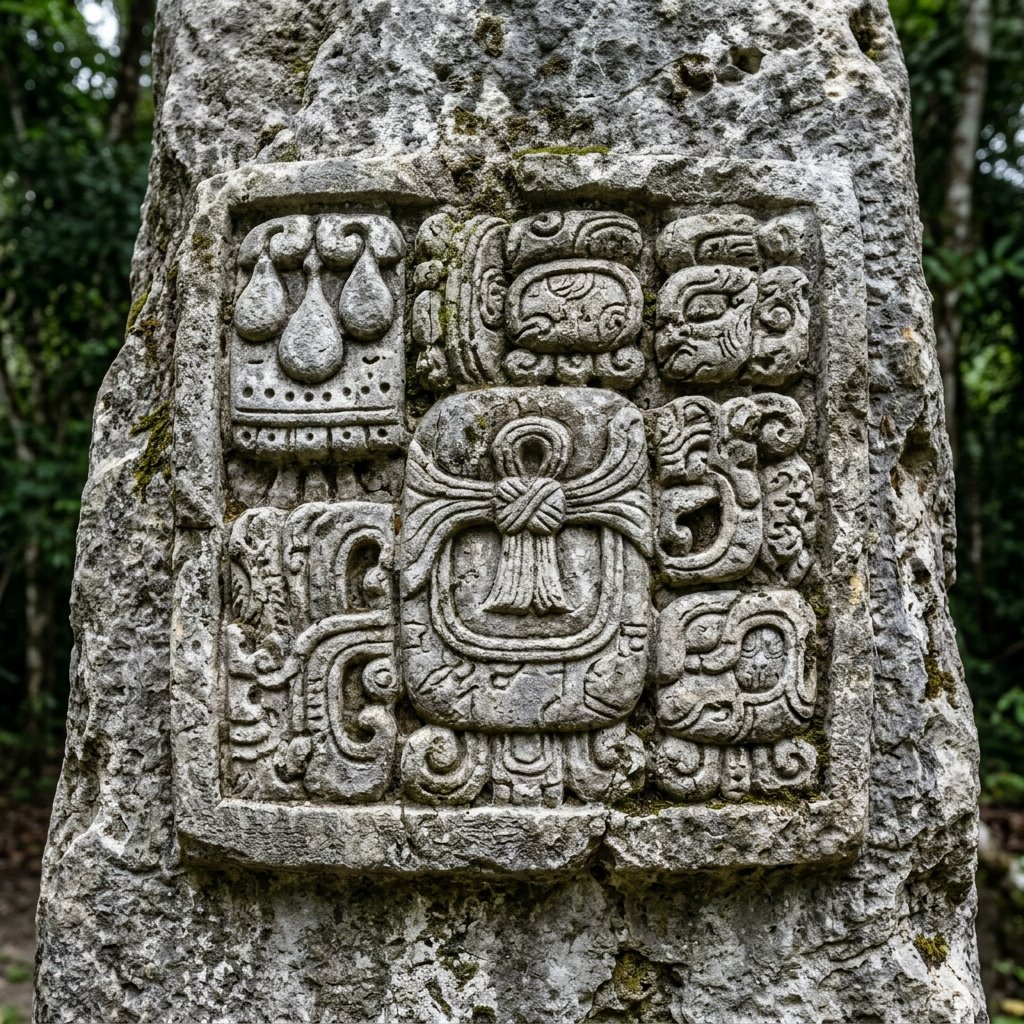
The Emblem Glyph at a Glance
The Discovery that Changed History
Before 1958, Western scholars believed that the ancient Maya were peaceful astronomers who only carved mathematics, calendars, and stargazing data into their stone monuments. They believed the inscriptions contained no historical information whatsoever.
This paradigm shattered when a researcher named Heinrich Berlin noticed a pattern. While studying inscriptions from the site of Tikal, he saw a specific glyph that appeared constantly. When he went to Palenque, the Tikal glyph vanished, replaced by a different, unique glyph. At Copán, yet another distinct glyph dominated the texts.
Berlin had discovered the Emblem Glyph. He correctly deduced that these symbols acted as the name or "logo" of specific Maya city-states. In an instant, the Maya went from anonymous stargazers to a continent of deeply political, competing city-states with recorded histories.
The Anatomy of an Emblem Glyph
While every Emblem Glyph has a unique central core, they all share a standard grammatical structure consisting of three primary elements:
- The Water Group (K'uhul): A prefix composed of dots (representing water droplets or blood). It translates to "Holy" or "Divine."
- The Ajaw Superfix: A sign placed on top of the main glyph, translating to "Lord" or "King."
- The Main Sign (Toponym): The central, largest part of the glyph block. This is the unique identifier for the specific city, kingdom, or dynasty.
Read together, an Emblem Glyph does not just name a place; it is a royal title. It translates to: "The Divine Lord of [X]." Only the highest-ranking independent kings could claim an Emblem Glyph.
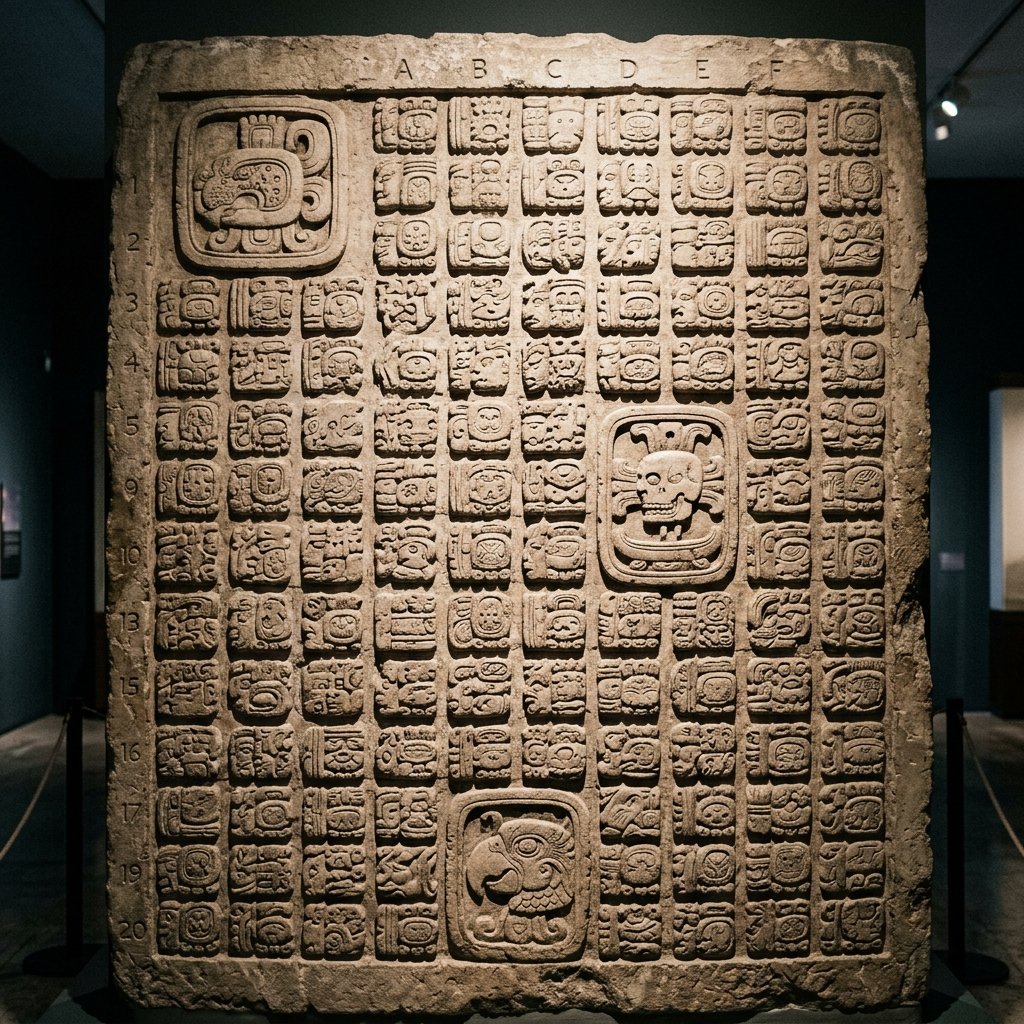
The Superpowers: Tikal vs. Calakmul
The tracking of Emblem Glyphs across the Maya world allowed archaeologists to uncover a geopolitical "Cold War" that dominated the Classic Maya period.
The Emblem Glyph for Tikal (Mutal) features a hairless bundle of tied sticks. The Emblem Glyph for their sworn enemy, Calakmul (Kan), features the head of a stylized snake.
By plotting where the Snake glyph and the Bundle glyph appeared on monuments at dozens of smaller, surrounding cities, epigraphers Simon Martin and Nikolai Grube reconstructed a massive, continent-spanning network of alliances. They proved that almost every Maya city was aligned with either the Tikal superpower or the Calakmul superpower, fundamentally rewriting our understanding of Maya statecraft (Martin, S. & Grube, N., Chronicle of the Maya Kings and Queens, 2008).
Over-Kings and Vassals
The Emblem Glyph also revealed the strict hierarchy of Maya politics. A king with an Emblem Glyph (a k'uhul ajaw) was independent. However, inscriptions often feature the phrase yajaw ("the lord of").
If a monument states that King A is the yajaw of King B (who holds the Emblem Glyph), it means King A is a subordinate vassal. This grammar of dominance and submission allowed archaeologists to map exactly who answered to whom across the dense Mesoamerican jungles.
References
- Berlin, H. "El Glifo Emblema en las Inscripciones Mayas." Journal de la Société des Américanistes, 1958.
- Coe, M.D. Breaking the Maya Code. Thames & Hudson, revised edition, 2012.
- Martin, S. & Grube, N. Chronicle of the Maya Kings and Queens. Thames & Hudson, 2nd edition, 2008.
- Stuart, D. The Order of Days: Unlocking the Secrets of the Ancient Maya. Harmony Books, 2011.
Frequently Asked Questions
What is a Maya Emblem Glyph?
It is a specific hieroglyphic compound that functioned as the name and royal title of a specific independent Maya city-state (e.g., Tikal, Palenque, Copán). It translates roughly to "The Divine Lord of [City Name]."
Who discovered the Emblem Glyph?
The concept was discovered by researcher Heinrich Berlin in 1958. This discovery was critical because it proved for the first time that Maya writing contained political geography and historical information, rather than just astronomical math.
Did every Maya city have an Emblem Glyph?
No. Only fully independent, supreme city-states claimed the full k'uhul ajaw (Divine Lord) Emblem Glyph. Smaller, subordinate cities (vassals) were ruled by lords who answered to the kings holding the great Emblem Glyphs.