Why This Museum Matters
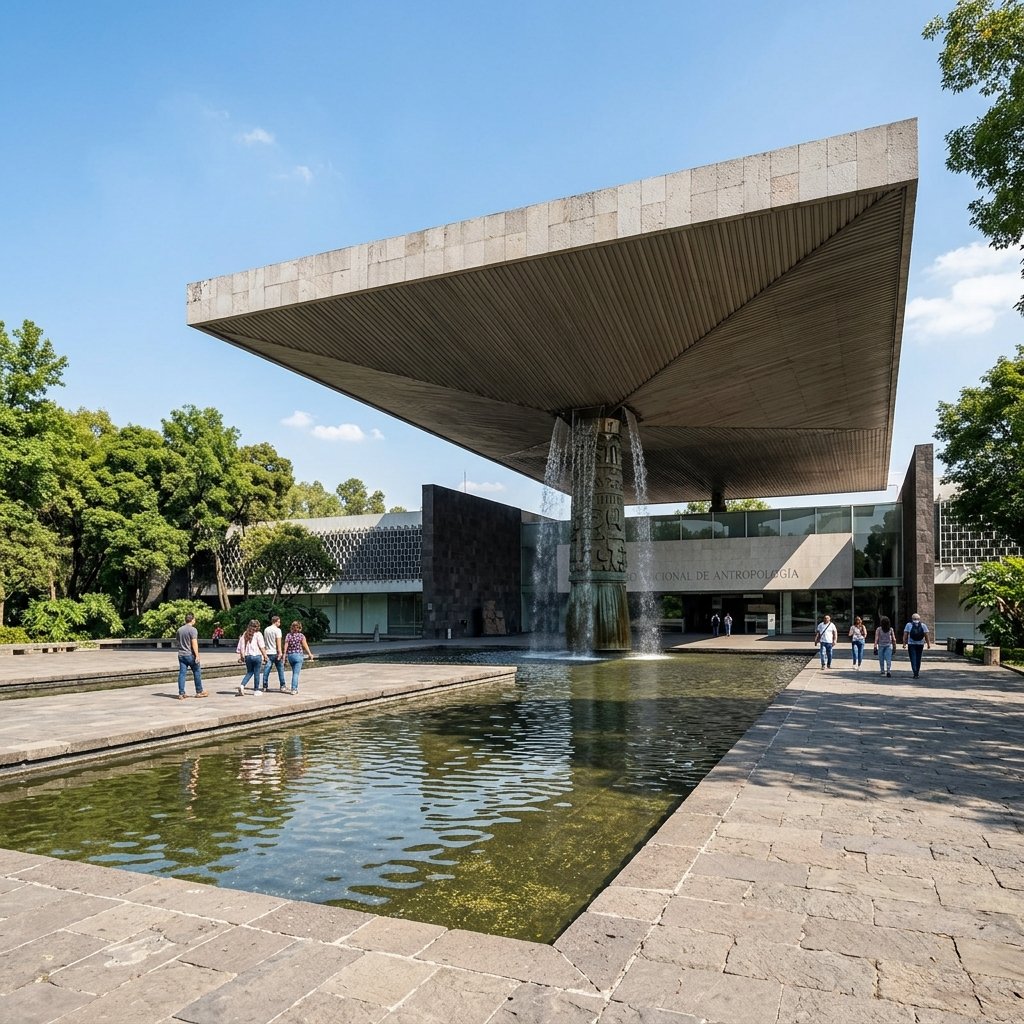
The Museo Nacional de Antropología is not just a museum — it is the single most important repository of Mesoamerican artifacts on Earth. Opened in 1964 and designed by architect Pedro Ramírez Vázquez, the building itself is a masterpiece: a massive cantilevered "umbrella" roof supported by a single carved column with water cascading down its surface. Inside, 23 exhibition halls house over 600,000 objects spanning every civilization that flourished in what is now Mexico — Olmec, Zapotec, Mixtec, Aztec, and Maya. The Maya Hall alone would justify a trip to Mexico City.
The Maya Hall (Sala Maya)
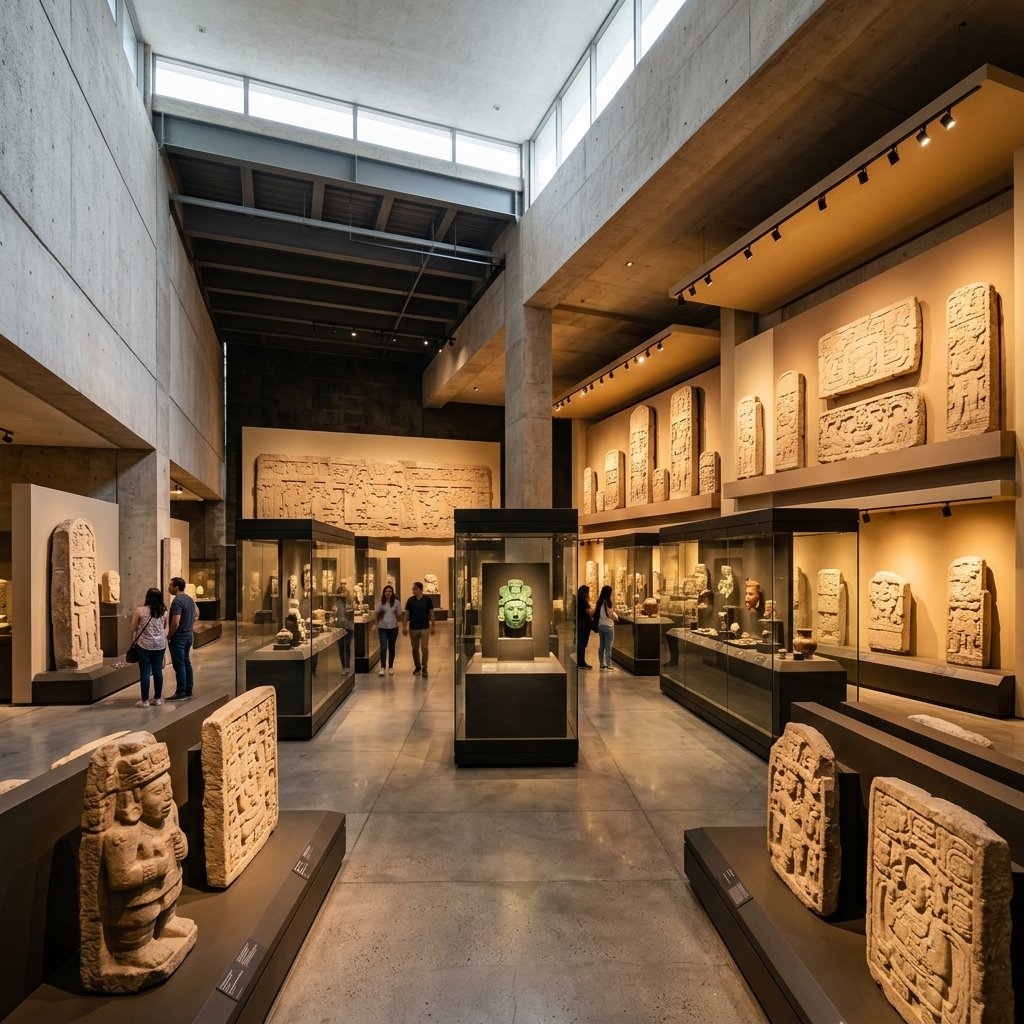
The Sala Maya occupies one of the museum's largest halls, dedicated entirely to the ancient Maya civilization. The gallery is organized chronologically and thematically, covering:
- Preclassic origins — early settlement, the rise of cities, Olmec-Maya connections
- Classic Period brilliance — the dynasties of Palenque, Calakmul, Tikal, and Copán
- Writing and mathematics — the logo-syllabic script and the concept of zero
- Religion and cosmology — the Popol Vuh, the underworld, the World Tree
- Post-Classic transformations — Chichén Itzá, the Toltec influence, the arrival of the Spanish
Signature Artifacts
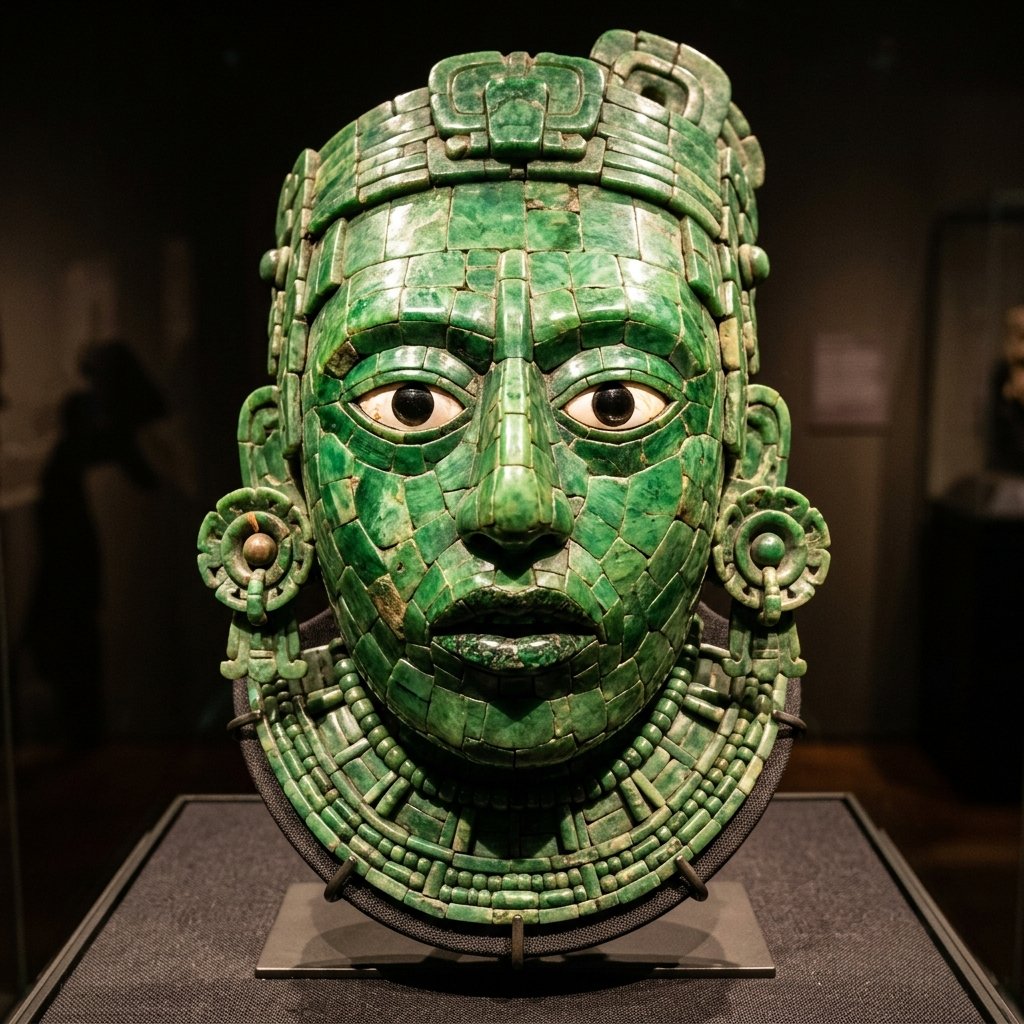
Pakal's Jade Death Mask
The most iconic Maya artifact in existence. This mosaic mask — assembled from over 200 pieces of jade, with shell and obsidian eyes — covered the face of K'inich Janaab Pakal, ruler of Palenque, when he was entombed in the Temple of the Inscriptions in AD 683. The mask was discovered by Mexican archaeologist Alberto Ruz Lhuillier on June 15, 1952, after four years of excavating through the temple's interior staircase. Ruz later described the moment as "the most extraordinary archaeological discovery in the Americas."
Acquired: Excavated 1952 by Alberto Ruz Lhuillier at Palenque; transferred to MNA at the museum's 1964 opening. Never left Mexico.
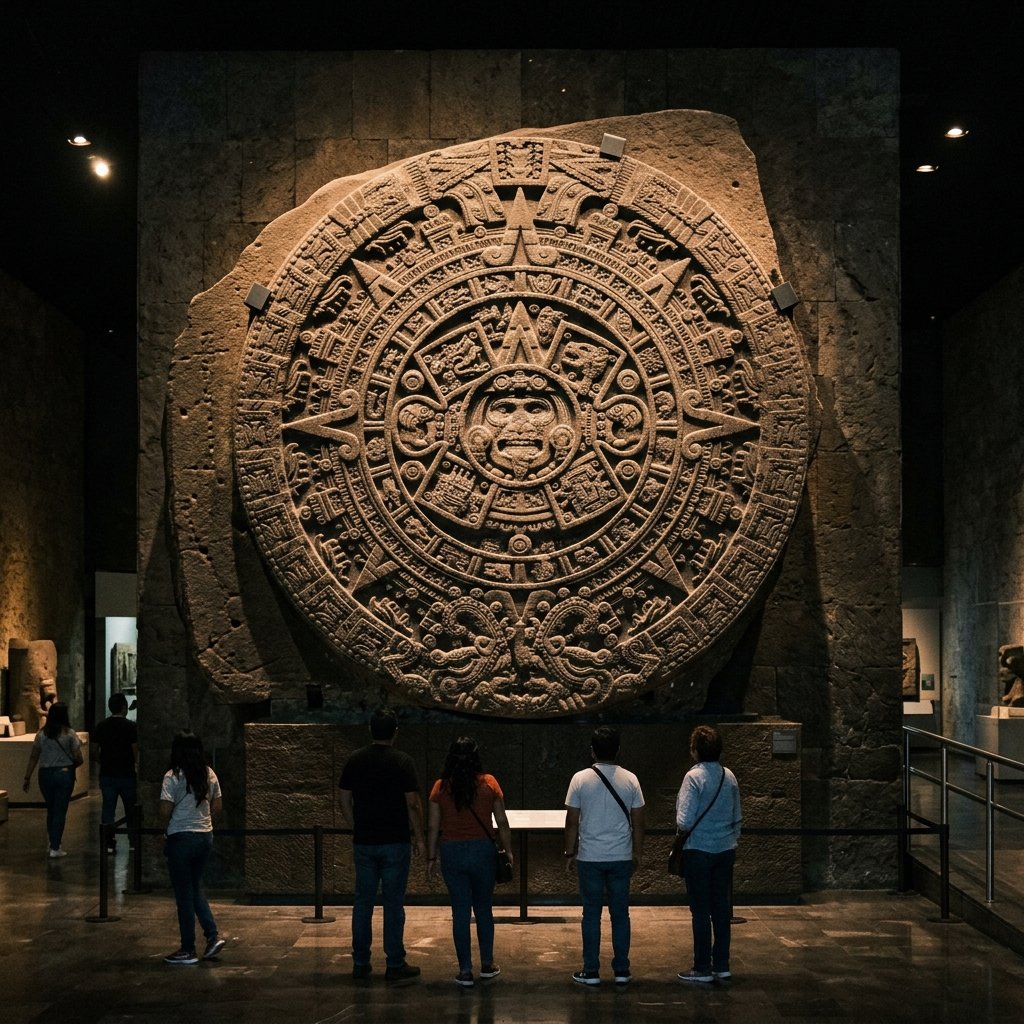
The Aztec Sun Stone
While technically Aztec rather than Maya, the Piedra del Sol is the museum's most famous single object — a 24-ton basalt disc, 3.6 meters in diameter, carved with the five Aztec world ages and the face of the sun god Tonatiuh at its center. It was rediscovered buried beneath Mexico City's Zócalo on December 17, 1790, during colonial-era renovations. The stone demonstrates the deep calendrical knowledge shared across Mesoamerican civilizations — including concepts that the Maya developed independently and, in many cases, more precisely.
Acquired: Rediscovered 1790 beneath Mexico City's main plaza; displayed at the Metropolitan Cathedral until transferred to MNA in 1964.
Pakal's Sarcophagus Lid — Full-Scale Replica
The museum displays a full-scale replica of Pakal's sarcophagus with its famous carved lid — one of the most analyzed and debated images in all of Mesoamerican art. The lid shows Pakal at the moment of death, falling into the open jaws of the earth monster, flanked by the World Tree connecting the underworld, earth, and sky. The celestial bird (Itzamnaaj) perches atop the tree. Visitors can descend into a reconstruction of the burial chamber itself — walking the same corridor that Ruz discovered in 1952.
Original location: Temple of the Inscriptions, Palenque. The original sarcophagus remains in situ.
Additional Maya Highlights
- Stucco head of Pakal — a life-size portrait in modeled stucco, found beneath his sarcophagus. One of the finest Maya portrait sculptures surviving.
- Jade pectoral from Calakmul — an exquisite chest ornament from Tomb 1 of Structure II, representing a seated ruler.
- Bonampak mural reproductions — full-scale painted reproductions of the famous battle and court scenes from Bonampak Room 1.
- Jaina figurines — a collection of the celebrated hollow clay figurines from the island of Jaina, Campeche, depicting Maya nobles, warriors, and women with extraordinary detail and personality.
- Carved lintels from Yaxchilán — limestone panels depicting royal bloodletting rituals and warfare, with accompanying hieroglyphic text.
Scholarly References
- Ruz Lhuillier, A. (1973). El Templo de las Inscripciones, Palenque. INAH. (Discovery of Pakal's tomb)
- Schele, L. & Freidel, D. (1990). A Forest of Kings: The Untold Story of the Ancient Maya. William Morrow.
- Miller, M. E. & Martin, S. (2004). Courtly Art of the Ancient Maya. Thames & Hudson.
- Stuart, D. & Stuart, G. (2008). Palenque: Eternal City of the Maya. Thames & Hudson.
- Martin, S. & Grube, N. (2000). Chronicle of the Maya Kings and Queens. Thames & Hudson.
- Solís, F. (2004). National Museum of Anthropology: Mexico. CONACULTA-INAH. (Official museum guide)
The Building Itself
The MNA building, designed by Pedro Ramírez Vázquez and opened on September 17, 1964, is considered one of the masterpieces of mid-20th-century museum architecture. Its most famous element is the paraguas (umbrella) — a massive cantilevered concrete roof covering the central courtyard, supported by a single carved stone column with water flowing down its surface. The museum was purpose-built to house Mexico's archaeological heritage, and its 23 halls cover 79,700 square meters (857,000 sq ft) of exhibition space — making it one of the largest museums in the Western Hemisphere.
Practical Information
Contact & Location
- 📍 Av. Paseo de la Reforma y Calzada Gandhi s/n, Col. Chapultepec Polanco, C.P. 11560, Mexico City
- 📞 +52 (55) 4040-5300
- ✉️ atencion.mna@inah.gob.mx
- 🌐 mna.inah.gob.mx
Visitor Information
- 🕐 Tuesday – Sunday: 9:00 AM – 6:00 PM
- 🚫 Closed Mondays
- 💰 General: $210 MXN (~$12 USD) | Mexican residents: $105 MXN
- 🆓 Free Sundays for Mexican nationals and residents
- 🆓 Free for children under 13, seniors (INAPAM), students, teachers
- 🚇 Metro: Chapultepec (Line 1) or Auditorio (Line 7)
Tips for Your Visit
- Allow at least 4 hours. The museum is enormous. Most visitors who try to see everything in 2 hours leave frustrated. The Maya Hall alone deserves 45–60 minutes.
- Go early. The museum is least crowded from 9:00–11:00 AM on weekday mornings. Weekends and free Sundays can be overwhelming.
- Start with the Maya Hall. Turn right from the main entrance and head to the far end of the ground floor. You'll find the Sala Maya after passing through the Oaxaca and Gulf Coast galleries.
- Don't skip the ethnography floor. The second floor has galleries dedicated to living indigenous cultures — including contemporary Maya communities — providing essential context for the archaeological collections below.
- Bring water and snacks. There's a café inside, but lines can be long. The museum is in Chapultepec Park, which has food vendors and picnic areas outside.
- Photography is allowed (no flash, no tripod). Video recording requires a separate permit.
Frequently Asked Questions
Is Pakal's original jade mask on display?
Yes — the original jade death mask of K'inich Janaab Pakal is permanently displayed in the Maya Hall. It is one of the museum's most treasured objects and has never left Mexico. The mask is displayed in a climate-controlled case under carefully controlled lighting.
How much time do I need for the Maya Hall alone?
Plan for 45–60 minutes minimum. The hall is large and densely packed with artifacts, interpretive panels, and a walk-through reconstruction of Pakal's tomb. If you're interested in reading the accompanying text and studying individual artifacts, 90 minutes is more realistic.
Can I buy tickets online?
Yes — online ticket purchase is available through the INAH website. This is recommended during high season (December–March and July–August) to avoid long entry queues, which can reach 45 minutes on busy weekends.