Caracol at a Glance
"Buried deep in the Chiquibul Forest Reserve lies a metropolis so vast that it dwarfs modern urban centers in the region. For a century, Caracol was the undisputed master of the southern lowlands, a superpower that brought the mighty city of Tikal to its knees and changed the course of Maya history."
The Discovery of the Three Water Hill
Caracol was completely lost to the modern world until 1937 when a native logger named Rosa Mai stumbled upon its massive stone ruins while searching for mahogany. The archaeological commissioner at the time named the site "Caracol" — Spanish for "snail" or "shell" — due to the abundance of snail shells found scattered across the site, and perhaps reflecting the winding road required to reach it.
Thanks to epigraphic decipherment, we now know the ancient Maya called the city Oxwitza', meaning "Three Water Hill." For decades, archaeologists assumed Caracol was a relatively minor site. But extensive mapping using LiDAR (Light Detection and Ranging) technology in the 21st century revealed a shocking truth: Caracol was a staggering megacity spanning nearly 200 square kilometers (Chase et al., Journal of Archaeological Science, vol. 38, 2011).
Caana: The Sky Palace
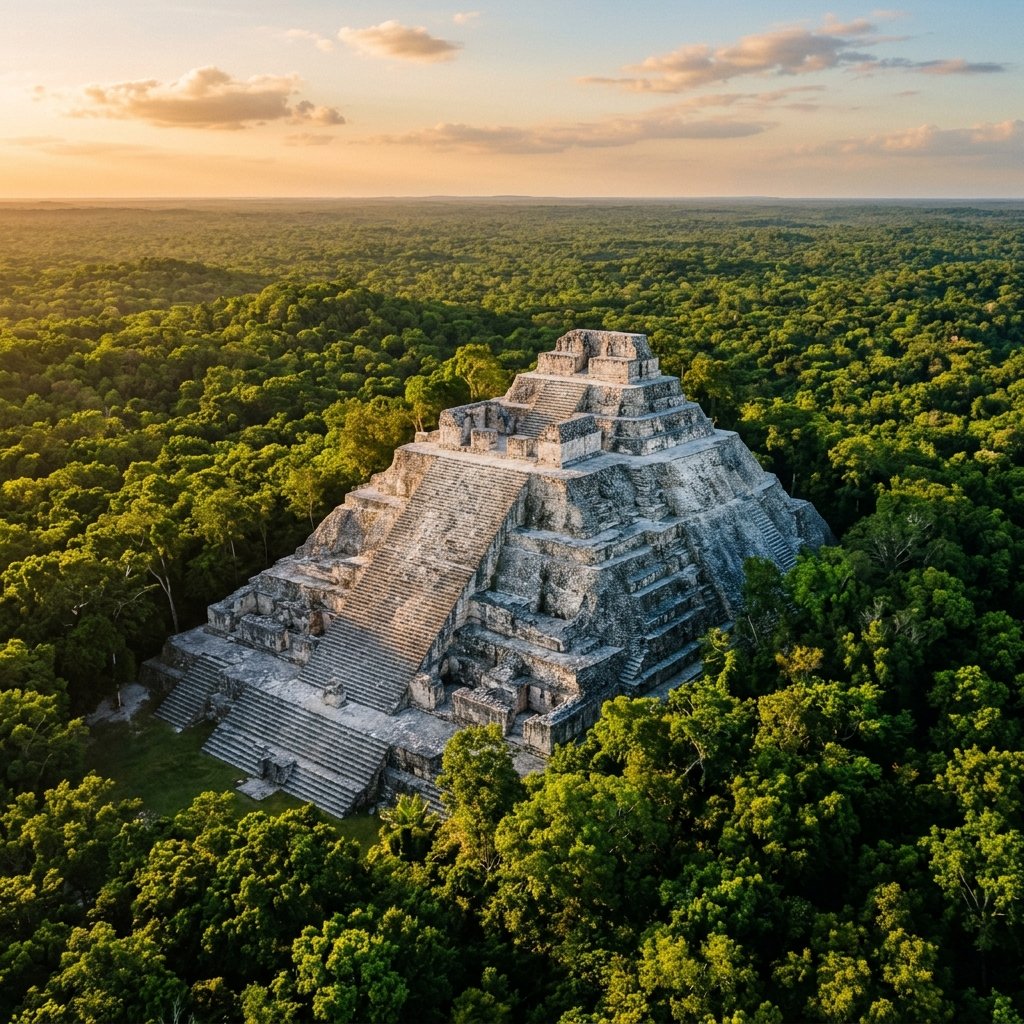
The monumental scale of a Classic Maya pyramid rising above the jungle canopy. Caracol's Caana ("Sky Palace") stands 43 meters tall — still the tallest man-made structure in the modern nation of Belize. The triadic complex contained temples, administrative rooms, and elite royal residences.
The undisputed centerpiece of Caracol is Caana, or the "Sky Palace." Rising 141 feet (43 meters) above the plaza floor, it remains the tallest man-made structure in the modern nation of Belize — taller than any modern building in Belize City.
Caana is not a simple pyramid; it is an incredibly complex triadic architectural complex — a massive platform supporting three separate temple pyramids and a network of interconnected rooms, courtyards, and plazas at multiple levels. It functioned simultaneously as a temple, an administrative center, and an elite royal residence. The complex contains dozens of rooms, sprawling courtyards, and hidden tombs containing some of the richest burial offerings ever found in Belize (Chase & Chase, Archaeology, vol. 49, 1996).
The sheer volume of stone and labor required to construct Caana points directly to the incredible wealth and centralized power of Caracol's rulership. Recent estimates suggest that its construction required the mobilization of thousands of laborers over multiple generations — a feat of civic organization comparable to the great pyramid complexes of Egypt.
The 562 AD "Star War"
Caracol's rise to regional dominance was cemented in a single, violently decisive conflict. In the mid-6th century, the geopolitical landscape of the Maya world was locked in a "Cold War" between two superpowers: Tikal (Yax Mutal) and Calakmul (the Snake Kingdom). Every city in the lowlands was forced to choose sides.
Originally a vassal of Tikal, Caracol's King Yahaw Te' K'inich II made a fateful decision: he switched allegiances to the Snake Kingdom of Calakmul. Furious, Tikal's king launched a punitive war against Caracol in 556 AD. However, six years later in 562 AD, Caracol retaliated with devastating force. Aided by Calakmul's alliance network, Caracol launched a successful "Star War" — a total-war campaign timed using Venus astronomy — against Tikal (Martin & Grube, Chronicle of the Maya Kings and Queens, Thames & Hudson, 2008).
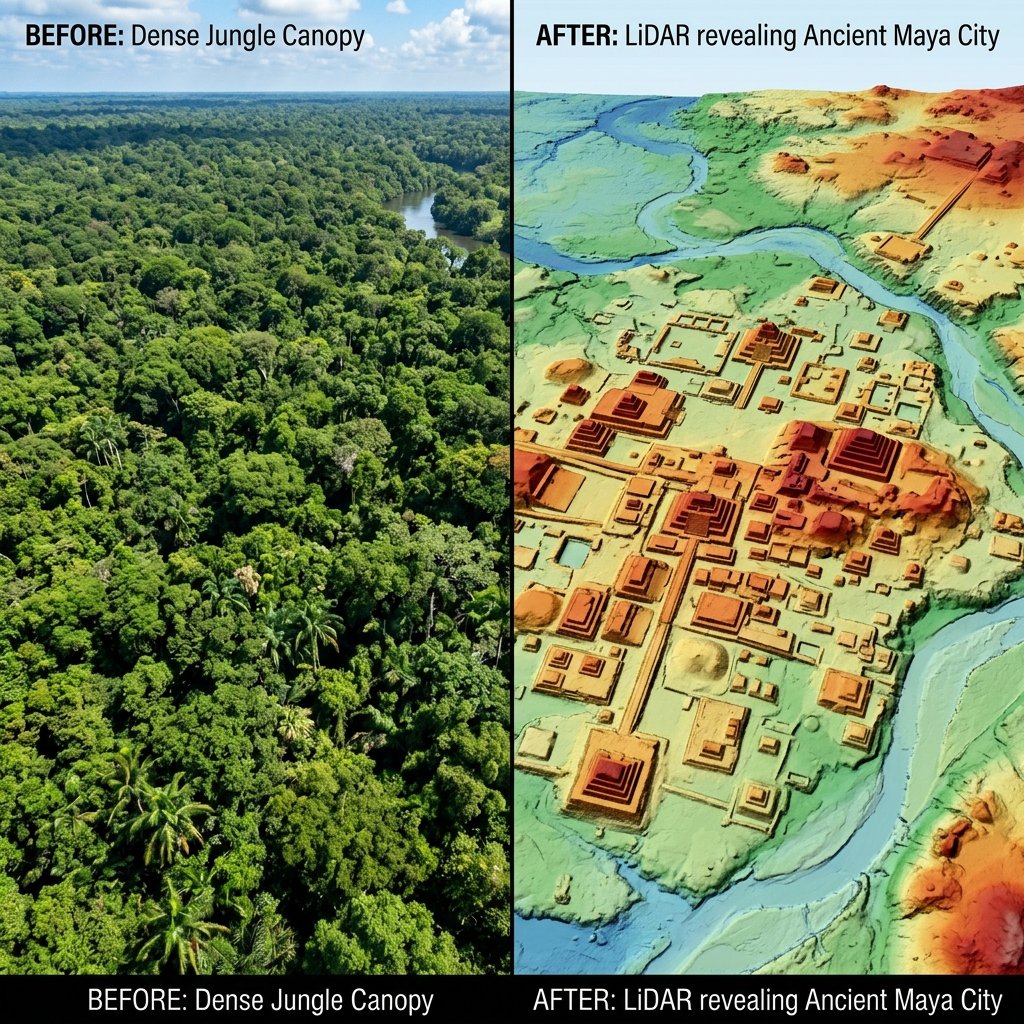
LiDAR technology stripped away the jungle canopy to reveal the staggering extent of Maya urbanism. The 2009 LiDAR survey of Caracol revealed over 11,000 agricultural terraces, 5 causeways, and thousands of previously unknown structures — transforming our understanding of the city from a minor site to one of the largest in the ancient Americas.
The result was catastrophic for Tikal. Their king, Wak Chan K'awiil ("Double Bird"), was captured and almost certainly sacrificed at Caracol. Tikal was sacked so thoroughly that it entered a 130-year "hiatus" where it erected almost no new monuments — the longest silence in its 1,500-year history. Caracol, flush with plunder and tribute, poured its new wealth into massive rapid expansions, including the final phases of Caana.
Engineering a Megacity
Sustaining over 100,000 people in a dense jungle environment far from major rivers required extraordinary civil engineering. Because Caracol possessed no permanent natural surface water sources, the city relied exclusively on rainfall.
Engineers constructed massive, plastered reservoirs (chultuns and aguadas) to catch and store millions of gallons of rainwater during the wet season. To feed the population, they built an extensive network of agricultural terracing covering tens of thousands of hectares of hillside. These stone-walled terraces prevented soil erosion and optimized water retention, essentially transforming the steep, hilly jungle into highly productive farmland (Chase et al., Journal of Archaeological Science, 2011).
The 2009 LiDAR survey revealed the breathtaking scope of this engineering: over 11,000 individual agricultural terraces, connected by a network of 5 massive causeways radiating outward from the city center. The implication is clear — Caracol was not a loosely settled jungle zone but a densely planned, intensively managed urban landscape rivaling any contemporary world city.
Visitor Comparison
| Feature | Caracol | Tikal | Calakmul |
|---|---|---|---|
| Tallest Structure | 43m (Caana) | 65m (Temple IV) | 45m (Structure II) |
| Peak Population | ~120,000 | ~100,000 | ~50,000 |
| Can climb? | ✅ Caana | ✅ Temple IV | ✅ Structure II |
| Crowd Level | Very low | Moderate | Very low |
| Access Difficulty | Hard (escort) | Moderate | Hard (remote) |
Practical Travel Guide: Visiting Caracol
Getting There
Caracol is located deep in the Chiquibul Forest Reserve in western Belize. The journey begins in San Ignacio (Cayo District). It requires a roughly 2.5-hour drive down a rugged, unpaved logging road that crosses the Mountain Pine Ridge Forest Reserve.
Safety Protocol
Because the ruins are situated very close to the porous Guatemalan border (an area historically known for illegal logging incursions), tourists must often travel in a military or police-escorted convoy that departs from the Augustine Pine Ridge checkpoint at specific times in the morning. Always check current Belizean Defence Force regulations before planning your trip.
The Experience
Because of its remote location, Caracol receives a fraction of the tourists that visit Chichén Itzá or Tikal. You can still climb to the very top of Caana, offering panoramic views stretching across the unbroken jungle canopy into Guatemala. The site feels incredibly raw, wild, and genuinely adventurous — this is real archaeological exploration, not a manicured tourist park.
Combine With
Many visitors combine Caracol with the nearby attractions of the Mountain Pine Ridge: the Rio On Pools, the Rio Frio Cave, and the Thousand Foot Falls (the tallest waterfall in Central America). San Ignacio also serves as a base for visiting the Maya sites of Xunantunich and Cahal Pech.
The Collapse
Despite its brilliant engineering and military might, Caracol was not immune to the systemic failure that swept the Classic Maya world in the 9th century. As extreme multi-decade droughts hit the region, Caracol's total reliance on rainwater reservoirs became a fatal vulnerability (Sharer & Traxler, The Ancient Maya, Stanford University Press, 2006).
Archaeological evidence in the epicenter shows signs of rapid, traumatic abandonment. Skeletons of unburied children and smashed elite jade artifacts found on the floors of the royal palaces suggest a violent end — possibly an internal uprising by a starving populace against a leadership that could no longer bring the rains. The last known monument at Caracol dates to 859 AD. By 1050 AD, the great metropolis of Oxwitza' was entirely silenced by the jungle.
Frequently Asked Questions
What is the tallest building in Belize?
The ancient Maya pyramid known as Caana ("Sky Palace") at Caracol remains the tallest man-made structure in the entirety of Belize, standing roughly 141 feet (43 meters) tall. No modern building in the country exceeds it.
Did Caracol really defeat Tikal?
Yes. In 562 AD, Caracol (allied with Calakmul) launched a devastating "Star War" against the superpower of Tikal. Caracol emerged victorious, capturing Tikal's king Wak Chan K'awiil and plunging Tikal into a 130-year "hiatus" where they erected no new monuments — the longest recorded silence in Tikal's history.
How large was ancient Caracol?
At its peak around 650 AD, Caracol covered nearly 200 square kilometers and housed an estimated 100,000 to 140,000 people. This is more than double the population of modern-day Belize City and makes Caracol one of the largest ancient cities ever discovered in the Americas.
Is Caracol safe to visit?
Yes. The archaeological site is professionally managed and guarded. Due to its proximity to the Guatemalan border, visitors typically travel with an organized tour or in a military/police-escorted convoy departing from the Mountain Pine Ridge area. Always check current Belizean tourism advisories before your trip.
What is a "Star War" in Maya archaeology?
A "Star War" (chak ch'ahb) is a term used by epigraphers for a total-war military campaign that was timed according to the movements of Venus (the Maya "war star"). These campaigns aimed for the complete defeat and humiliation of the enemy — including the capture and sacrifice of the opposing king. They represent the most devastating form of Maya interstate conflict.
References
- Chase, A. F., & Chase, D. Z. "A Mighty Maya Nation: How Caracol Built an Empire." Archaeology, vol. 49, no. 5, 1996, pp. 66–72.
- Chase, A. F., Chase, D. Z., et al. "Airborne LiDAR, archaeology, and the ancient Maya landscape at Caracol, Belize." Journal of Archaeological Science, vol. 38, no. 2, 2011, pp. 387-398.
- Martin, S., & Grube, N. Chronicle of the Maya Kings and Queens. Thames & Hudson, 2nd ed., 2008.
- Sharer, R. J., & Traxler, L. P. The Ancient Maya. Stanford University Press, 6th ed., 2006.