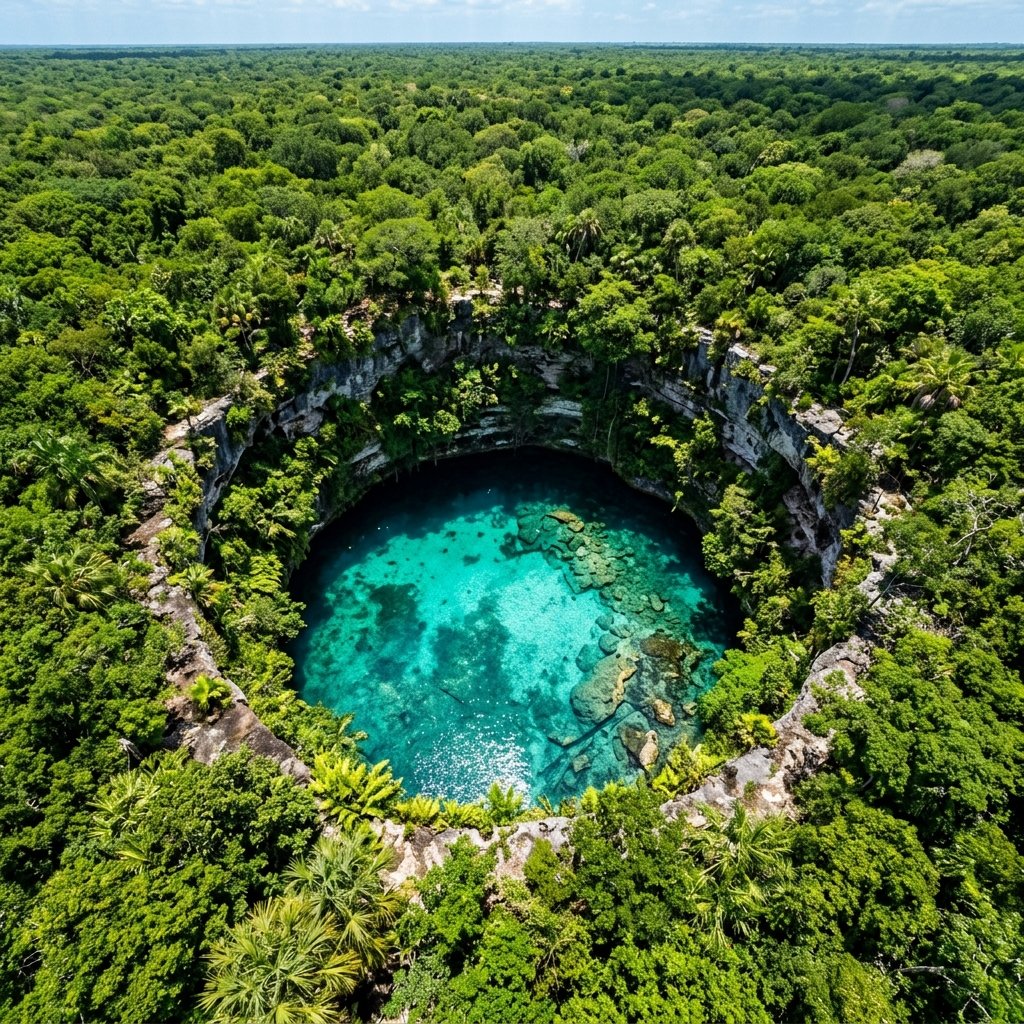
The Cenotes at a Glance
What Are Cenotes?
Cenotes (from the Yucatec Maya ts'onot) are natural sinkholes formed when the limestone bedrock of the Yucatán Peninsula collapses, exposing the underground freshwater aquifer below. The Yucatán's flat, porous limestone contains virtually no surface rivers — almost all freshwater exists underground, moving through a vast system of subterranean rivers and caverns.
There are over 6,000 documented cenotes across the Yucatán Peninsula, ranging from small pools a few meters across to massive formations 60 meters wide and over 100 meters deep. They occur in several forms:
- Open cenotes — fully exposed pools where the ceiling has entirely collapsed.
- Semi-open cenotes — partially collapsed, with a cave-like overhang sheltering part of the water.
- Cave cenotes — accessed through tunnels or narrow fissures, with the water hidden underground.
- Mature cenotes — ancient formations that have widened over millennia into broad lagoons.
The Mythology: Portals to Xibalba
For the ancient Maya, cenotes were far more than water sources. They were ch'en — sacred openings in the earth that served as literal portals between the Middle World (where humans live) and Xibalba (the underworld of the dead).
This belief was rooted in direct physical experience: cenotes are dark, deep, filled with water of uncertain origin, and lead to underground tunnels that disappear into blackness. To the Maya, descending into a cenote meant approaching the boundary between life and death.
Several mythological and cosmological associations emerge from the sources:
- Water as underworld substance: The standing water in cenotes was understood as the surface of the underworld ocean — the cosmic waters that existed before creation (Popol Vuh; Tedlock, 1996, pp. 64–65).
- Cenotes as mouths of the earth: The circular opening of a cenote was visualized as the open mouth of the Earth Monster — a supernatural being whose body constituted the surface of the earth. Entering the cenote meant being swallowed by the monster (Taube, K., The Major Gods of Ancient Yucatan, 1992, p. 69).
- Rain god connections: Chaac, the rain god, was believed to dwell in cenotes and caves. Offerings to Chaac were frequently deposited in cenotes to ensure rainfall for agriculture.
The Sacred Cenote at Chichen Itza
The most famous ceremonial cenote in the Maya world is the Cenote Sagrado (Sacred Cenote) at Chichen Itza. This massive natural sinkhole — approximately 60 meters (197 feet) in diameter and 27 meters (89 feet) to the water surface — was the single most important pilgrimage site in the Maya world during the Postclassic period.
Archaeological dredging of the cenote, begun by Edward Herbert Thompson in 1904 and continued by the National Geographic Society and INAH in the 1960s, recovered an extraordinary collection of offerings:
- Jade objects — pendants, beads, plaques, and ear spools, many carved with hieroglyphic texts.
- Gold discs — some imported from as far as Panama and Colombia, depicting warriors, gods, and mythological scenes (evidence of long-distance trade networks).
- Copal incense — ball-shaped lumps of burned resin, the standard Maya offering to the gods.
- Ceramics — vessels, figurines, and decorated pottery.
- Human remains — skeletal evidence of at least 200 individuals, including adults and children, deposited as sacrificial offerings over several centuries (Coggins & Shane, Cenote of Sacrifice, 1984).
Bishop Diego de Landa, writing in the 1560s, described the cenote as a place where the Maya "had the custom of throwing men alive as a sacrifice to the gods, in times of drought, and they believed that they did not die though they never saw them again. They also threw in many other things, like precious stones and things which they prized" (Tozzer, A.M., Landa's Relación, 1941, p. 179).
Cenotes and Maya Settlement
Because the Yucatán Peninsula has no surface rivers, cenotes were the primary source of fresh water for ancient Maya cities in the northern lowlands. The location of major settlements was directly determined by access to cenotes:
- Chichen Itza — whose name means "At the Mouth of the Well of the Itza" — was built around two major cenotes.
- Mayapán — the Postclassic capital — was centered on a large cenote.
- Dzibilchaltún — one of the oldest continuously occupied Maya sites — grew around the Cenote Xlakah.
The dual function of cenotes — as both practical water sources and sacred portals — means that the Maya relationship with these formations was never purely utilitarian or purely religious. Every act of drawing water was, to some degree, an interaction with the underworld.
The Chicxulub Connection
The geology of Yucatán's cenotes has a remarkable connection to deep time. The distribution of cenotes across the peninsula is not random — they cluster along a distinctive arc that traces the buried rim of the Chicxulub impact crater, the 180-kilometer-wide crater formed by the asteroid that struck the Yucatán 66 million years ago and caused the mass extinction that killed the dinosaurs.
The fractured limestone along the crater rim is more permeable to water, producing a higher density of cenote formation along this buried geological boundary. The Maya, unknowingly, built their civilization on the scar of the most catastrophic impact event in the last 100 million years of Earth's history (Pope, K.O. et al., "Surface Water Drainage and the Chicxulub Impact," Geology, 1996).
References
- Coggins, C. & Shane, O.C. (eds.) Cenote of Sacrifice: Maya Treasures from the Sacred Well at Chichen Itza. University of Texas Press, 1984.
- Tozzer, A.M. Landa's Relación de las Cosas de Yucatán: A Translation. Papers of the Peabody Museum, Vol. 18, 1941.
- Pope, K.O. et al. "Surface Water Drainage Features Associated with the Chicxulub Impact Crater." Geology, Vol. 24, No. 6, 1996, pp. 527–530.
- Tedlock, D. Popol Vuh: The Definitive Edition. Simon & Schuster, 1996.
- Brady, J.E. & Prufer, K.M. (eds.) In the Maw of the Earth Monster: Mesoamerican Ritual Cave Use. University of Texas Press, 2005.
Frequently Asked Questions
How many cenotes are in the Yucatán?
Over 6,000 cenotes have been documented across the Yucatán Peninsula, and many more likely remain undiscovered beneath the jungle. They range from small pools a few meters wide to massive formations like the Sacred Cenote at Chichen Itza (60 meters in diameter).
Did the Maya sacrifice people in cenotes?
Archaeological evidence confirms that human remains, along with jade, gold, pottery, and other offerings, were deposited in certain cenotes — most notably the Sacred Cenote at Chichen Itza. Colonial-era Spanish accounts also describe this practice. However, not all cenotes were sacrificial sites — most served primarily as water sources for daily life. The Sacred Cenote at Chichen Itza was exceptional in scale and ritual importance.
Can you swim in cenotes today?
Yes — many cenotes across the Yucatán are open for swimming and are popular tourist destinations. Some have developed infrastructure (stairs, platforms, changing rooms), while others remain wild and remote. The water is typically crystal-clear, cool (around 24°C/75°F year-round), and filtered through limestone, making it exceptionally pure.