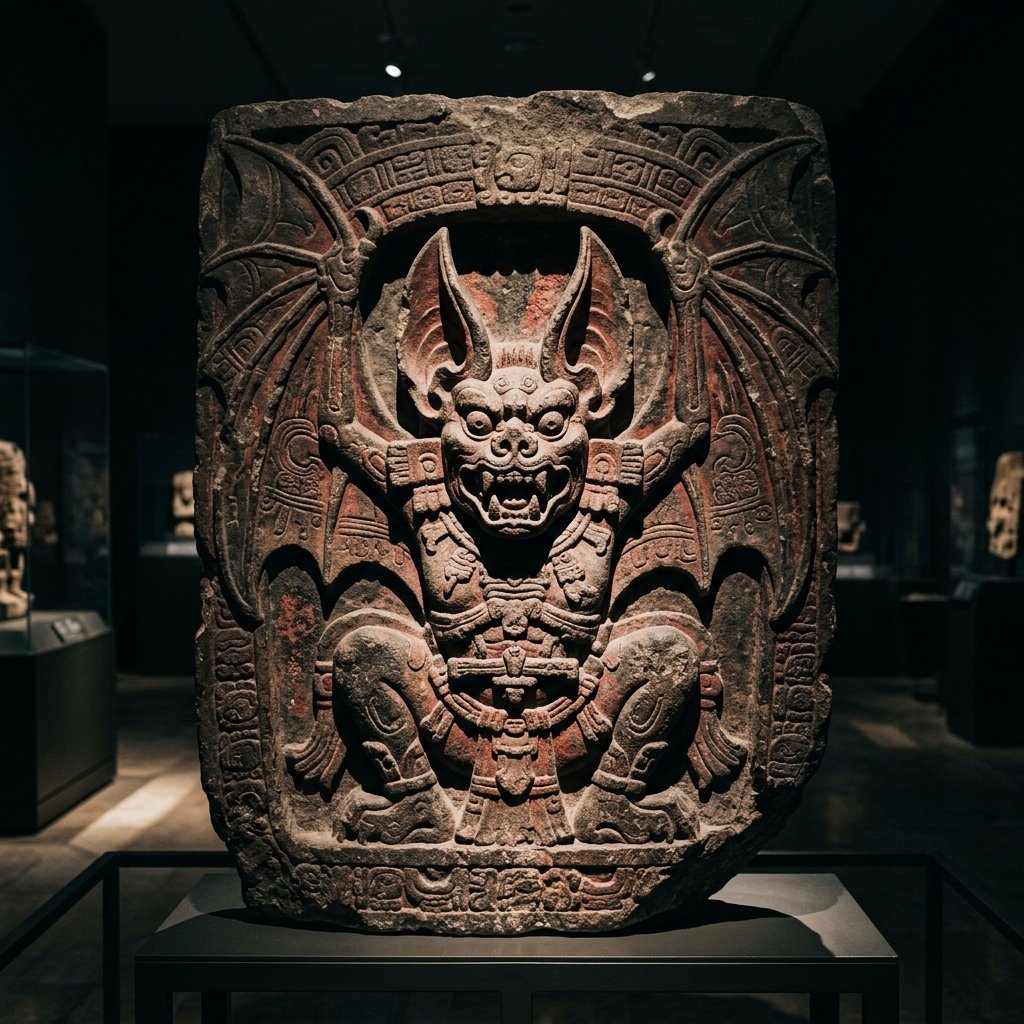
Camazotz at a Glance
The Bat House
In the Popol Vuh narrative, the Hero Twins — Hunahpu and Xbalanque — face six Houses of Terror during their ordeal in Xibalba. The last and most dangerous is the Zotz'il-ha — the Bat House.
The Bat House was filled with shrieking bats — not ordinary bats, but death bats, supernatural creatures with razor-sharp snouts that slashed anything they touched. The Twins survived by hiding inside their blowguns, curling up inside the hollow tubes to avoid the bats' attacks.
But Hunahpu made a fatal error. Wanting to check whether dawn had arrived, he peeked his head out of his blowgun. In that instant, Camazotz swooped down and severed his head from his body with a single strike of his wing-blade.
Hunahpu's head was taken by the Lords of Death and hung as a trophy in the ballcourt for the next day's game. Xbalanque, thinking quickly, carved a replacement head from a squash and placed it on his brother's body. During the ballgame, Xbalanque managed to recover the real head and restore Hunahpu — one of the most dramatic moments in the entire Popol Vuh.
The Name
The name Camazotz is K'iche' Maya. It derives from two roots:
- Kame — "death" (the same root as in the death-god names One Death/Hun Came and Seven Death/Vucub Came).
- Sotz' — "bat."
The name thus means "Death Bat" or, more vividly, "Snatch Bat" — evoking the sudden, violent swoop of a predator seizing its prey. The word sotz' also appears as the name of the fourth month in the Haab' calendar, and the bat was the emblem glyph of the important Classic-period site of Copán (in modern Honduras), whose ruling dynasty was associated with the bat lineage.
Archaeological Evidence
Camazotz is not merely a literary figure from the colonial-era Popol Vuh. Bat-god imagery appears extensively in the pre-Columbian archaeological record:
- Copán, Honduras: The emblem glyph of Copán includes a bat-head sign, and bat imagery is prominent throughout the site's sculpture. A remarkable full-figure bat sculpture was recovered from the site, showing a bat deity with outstretched wings and a prominent leaf-nose (Fash, W.L., Scribes, Warriors, and Kings, 2001).
- Zapotec bat god (Monte Albán): The Zapotec civilization of Oaxaca produced elaborate bat-god urns and masks, suggesting the bat deity concept predates the Maya and extends across Mesoamerica. These Zapotec bat figures often wear elaborate headdresses and hold severed heads — directly paralleling Camazotz's role in the Popol Vuh.
- Classic-period ceramics: Painted pottery from the Maya lowlands depicts bat figures in underworld scenes, often associated with sacrifice and decapitation imagery. These predate the written Popol Vuh by centuries (Coe, M.D., The Maya Vase Book, Vol. 1, 1989).
- Toniná, Chiapas: A stucco frieze at this site shows a bat figure associated with captive-taking and warfare symbolism.
The Real Bats
The Maya world is home to a remarkable diversity of bat species — over 100 species inhabit the forests and caves of Mesoamerica. Several species likely contributed to the Camazotz mythology:
- The spectral bat (Vampyrum spectrum) — the largest bat in the Americas, with a wingspan exceeding 80 centimeters (31 inches). Despite its genus name, it is not a blood-feeder — it hunts birds, small mammals, and other bats. Its size and predatory behavior make it a compelling candidate for the "death bat" concept.
- Leaf-nosed bats (family Phyllostomidae) — numerous species with prominent nose-leaves (fleshy structures on the snout) that are strikingly depicted in Maya bat-god sculpture. The characteristic "leaf nose" of Camazotz imagery matches these bats precisely.
- Common vampire bats (Desmodus rotundus) — the actual blood-feeding bats of the Americas. They inhabit caves throughout the Maya lowlands and feed on the blood of sleeping mammals (including, occasionally, humans). Their association with blood and night contributed to bat symbolism.
Maya ritual use of caves — where bats roost in enormous colonies, filling the darkness with ultrasonic shrieks and sudden swooping flight — would have made bat encounters a routine and viscerally terrifying part of entering the "underworld" (Brady & Prufer, In the Maw of the Earth Monster, 2005).
Camazotz in Popular Culture
Camazotz has attracted significant modern attention, particularly through comparisons to other bat-related cultural figures:
- Batman parallels: Some popular writers have drawn superficial comparisons between Camazotz and the DC Comics character Batman. While the visual similarity is striking, there is no evidence that Batman's creators (Bob Kane and Bill Finger, 1939) were aware of Maya bat mythology. The connection is coincidental — bats are universal symbols of darkness and night.
- Madeleine L'Engle's A Wrinkle in Time (1962): The planet "Camazotz" in L'Engle's novel is named directly after the Maya death bat, though her fictional planet bears little resemblance to the mythological figure.
- Video games and horror: Camazotz has appeared as a character or inspiration in various video games, horror fiction, and fantasy RPGs, typically as a bat-demon or underworld boss figure.
These modern adaptations, while culturally interesting, bear minimal relationship to the original Maya conception. In the Popol Vuh, Camazotz is not a villain to be defeated by a hero — he is a force of the underworld, a feature of the cosmic landscape that must be endured and outwitted.
References
- Tedlock, D. Popol Vuh: The Definitive Edition of the Mayan Book of the Dawn of Life. Simon & Schuster, 1996.
- Fash, W.L. Scribes, Warriors, and Kings: The City of Copán and the Ancient Maya. Thames & Hudson, 2001.
- Brady, J.E. & Prufer, K.M. (eds.) In the Maw of the Earth Monster: Mesoamerican Ritual Cave Use. University of Texas Press, 2005.
- Coe, M.D. The Maya Vase Book, Vol. 1. Kerr Associates, 1989.
- Miller, M.E. & Martin, S. Courtly Art of the Ancient Maya. Thames & Hudson, 2004.
Frequently Asked Questions
Is Camazotz related to Batman?
There is no historical connection. Batman was created in 1939 by Bob Kane and Bill Finger, inspired by characters like Zorro and The Shadow — not Maya mythology. The resemblance between a "bat man" in modern comics and the Maya "death bat" is coincidental. Bats are universal symbols of darkness and the night in many cultures, so independent cultural associations are expected.
Is Camazotz a god or a monster?
In the Popol Vuh, Camazotz functions as a supernatural force within Xibalba — he is the dominant creature of the Bat House, one of the underworld's trial chambers. Whether he qualifies as a "god" in the full Maya theological sense is debated. He does not receive worship or offerings in any known texts. He is better understood as a feature of the underworld landscape — dangerous, powerful, and non-negotiable.
Can I see real Camazotz sculptures?
Yes. Bat-deity sculptures and imagery can be seen at the archaeological site of Copán (Honduras), at the National Museum of Anthropology in Mexico City (which holds Zapotec bat-god urns from Monte Albán), and in various museum collections of Classic-period Maya ceramics. Copán's bat emblem glyph is visible on multiple stelae at the site.