
Pawahtun at a Glance
The Architect of the Cosmos
In the Classic period (c. 250–900 AD), the primary deities responsible for the structural integrity of the universe were known as Pawahtun (or God N in the Schellhas system). Much like the Bacabs described in later Yucatec sources, Pawahtun is a quadripartite god—he exists simultaneously as four entities positioned at the four cardinal directions.
His essential function is physical: he stands with his arms raised, pressing his weight against the sky to prevent it from collapsing onto the earth. Without the continuous effort of the four Pawahtuns, the Maya universe would crush itself.
The Wrinkled Face of the Sky-Bearer
Pawahtun is consistently depicted in Maya art with highly recognizable features:
- Extreme Age: He is an ancient man with a deeply wrinkled face, a prominent nose, and a toothless jaw (or only a single tooth remaining).
- The Netted Headdress: He wears a distinctive head covering made of netting, which is heavily associated with scribes and the elite.
- The Shell Carapace: Most uniquely, Pawahtun is often shown wearing the shell of a turtle or emerging from the opening of a large marine conch shell.
The association with the turtle and conch connects him to the earth and the underworld ocean, planting him firmly as the foundation upon which the sky rests.
Patron of Maya Knowledge
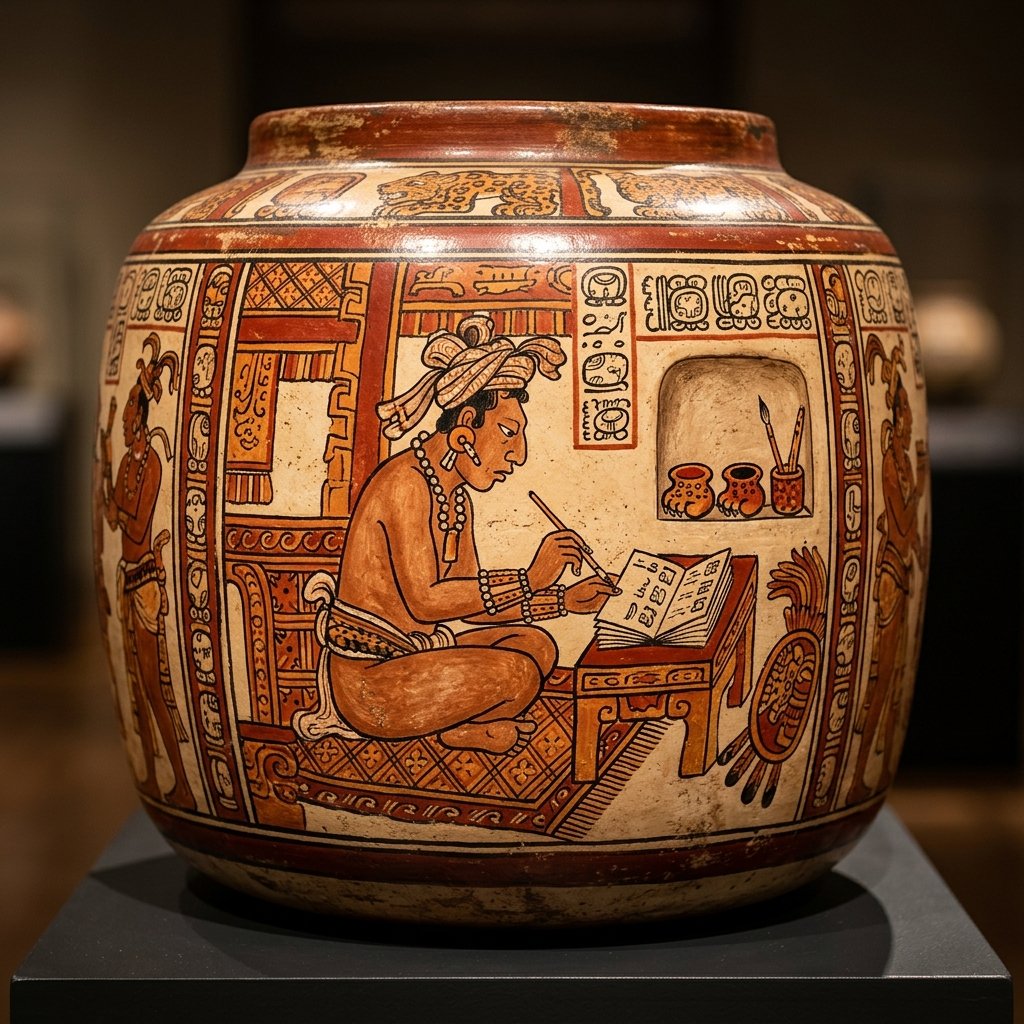
While supporting the sky was his cosmological job, Pawahtun had a crucial social role: he was the patron deity of scribes and painters.
In Maya society, writing and painting were not mere trades; they were sacred, elite activities. To write a glyph was to invoke its spiritual power. The scribes who painted the codices, carved the monuments, and decorated the polychrome ceramics were high-ranking nobles—sometimes even the younger brothers of kings (Coe, M.D. & Kerr, J., The Art of the Maya Scribe, 1998).
Because Pawahtun was their patron, scribes often depicted themselves wearing his netted headdress, sometimes inserting the aging face of the god directly into scenes of courtly writing. He is the divine source of calendrical knowledge, writing, and the esoteric secrets recorded in the books.
Are Pawahtun and the Bacabs the Same?
When Bishop Diego de Landa recorded the Maya pantheon in the 16th century, he described four sky-bearing gods called the Bacabs. However, in the earlier Classic-period hieroglyphic texts, the sky-bearers are named Pawahtun.
Are they the same deity? Most epigraphers and art historians believe they represent the same fundamental cosmological concept expressed in different language groups (Classic Ch'olan vs. Postclassic Yucatec) and time periods. Both are four-part gods, both hold up the sky, and both are intimately tied to the directional colors and the calendar (Taube, K., The Major Gods of Ancient Yucatan, 1992, pp. 92–99).
References
- Coe, M.D. & Kerr, J. The Art of the Maya Scribe. Harry N. Abrams, 1998.
- Taube, K. The Major Gods of Ancient Yucatan. Dumbarton Oaks, 1992.
- Reents-Budet, D. Painting the Maya Universe: Royal Ceramics of the Classic Period. Duke University Press, 1994.
- Miller, M. & Martin, S. Courtly Art of the Ancient Maya. Fine Arts Museum of San Francisco, 2004.
- Coe, M.D. The Maya. Thames & Hudson, 9th edition, 2015.
Frequently Asked Questions
Who is Pawahtun?
Pawahtun is the ancient Maya sky-bearer god and the patron deity of scribes and artists. Depicted as a very old man emerging from a turtle or conch shell, he existed as four distinct entities stationed at the cardinal directions to physically hold up the sky.
What is Pawahtun's connection to Maya writing?
Pawahtun is the patron and protector of scribes and painters. Maya scribes were elite nobles, and writing was considered a sacred act. Scribes are often depicted wearing Pawahtun's signature netted headdress, aligning themselves with his divine wisdom and calendrical knowledge.
Is Pawahtun the same as the Bacabs?
Yes, most scholars agree that Pawahtun is the Classic-period equivalent of the Bacabs. "Pawahtun" appears in older hieroglyphic texts, while "Bacab" was recorded by the Spanish in the 16th century, but both words describe the exact same concept: four gods standing at the corners of the world holding up the sky.