The Bacabs at a Glance
The Architecture of the Cosmos
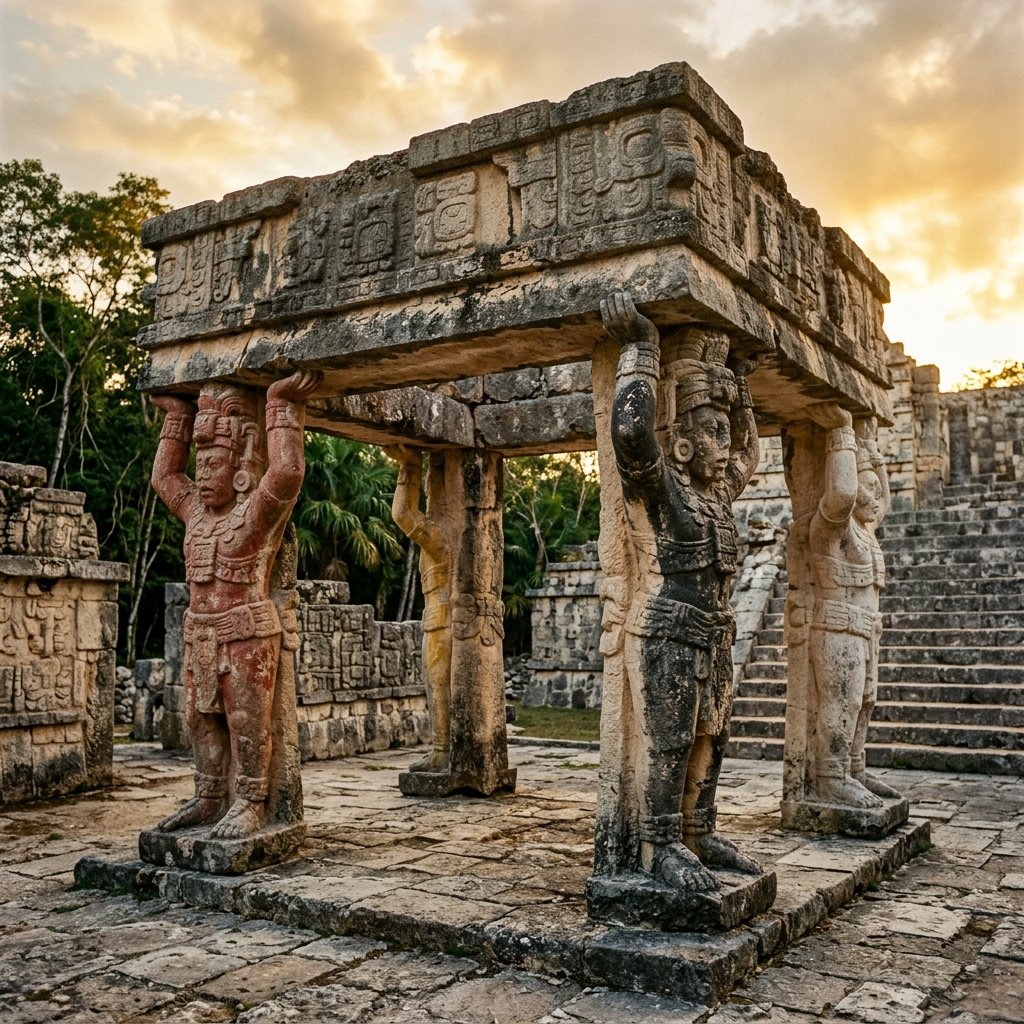
The Maya visualized the universe as an architectural structure — a building that required physical support. The sky was not merely "above" — it was a solid surface, a cosmic ceiling, that needed to be held up. Without the Bacabs, the sky would fall and the ordered world would collapse back into primordial chaos.
This is not just a metaphor. Maya art consistently depicts the sky as a band or border decorated with celestial signs (star glyphs, moon signs, planetary symbols) that functions as a physical structure. Below this sky-band, the Bacabs stand at the four corners, arms raised, bearing its weight — cosmic laborers performing the most essential task in the universe (Taube, K., "The Jade Hearth: Centrality, Rulership, and the Classic Maya Temple," in Function and Meaning in Classic Maya Architecture, 1998).
The Four Directions and Colors
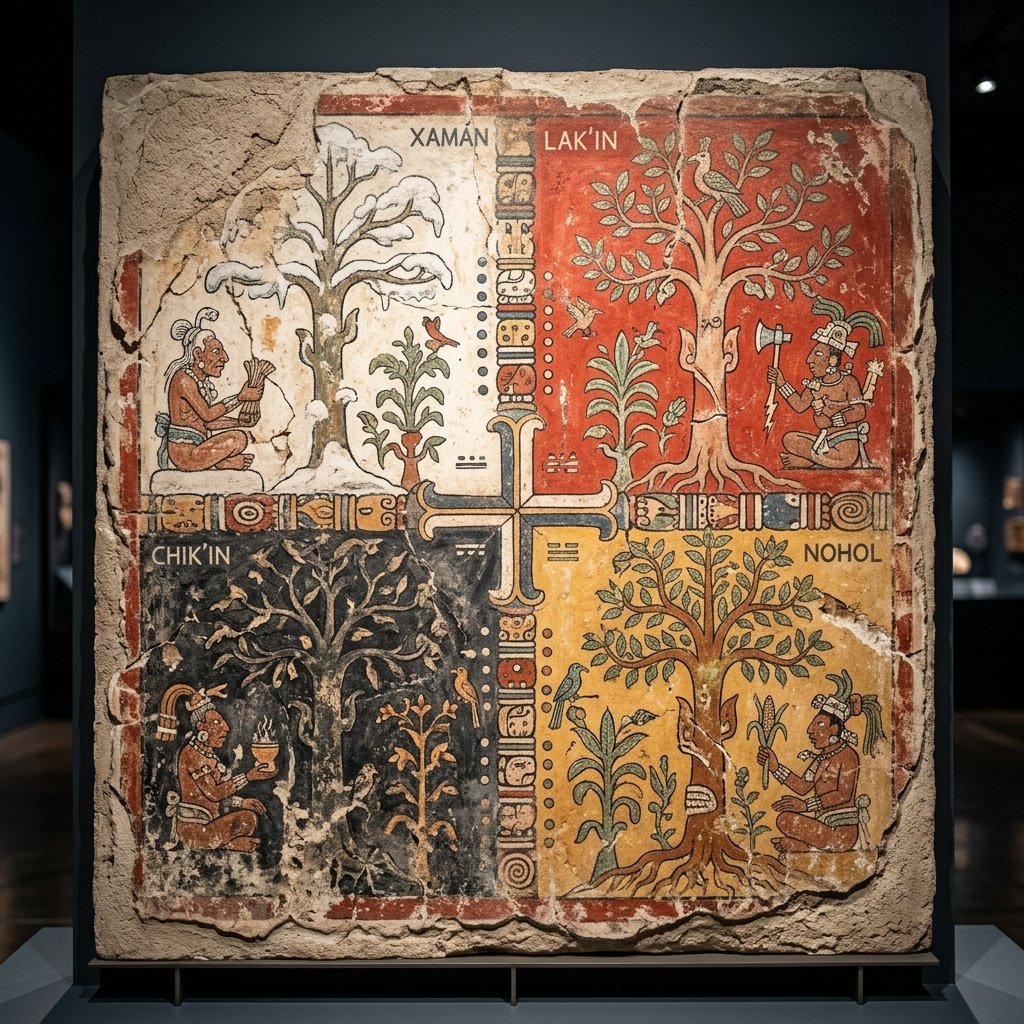
Each Bacab is assigned to one of the four cardinal directions, and each direction has a designated color. This directional color system was fundamental to Maya cosmology and pervaded every aspect of life — from ritual practice to architecture to agricultural planning:
East — Chac (Red)
Where the sun rises. Associated with blood, life force, and beginning. The ceiba tree of the east is red. The Bacab of the east presides over the year-bearer Kan.
North — Zac (White)
The direction of the ancestors and the afterlife. Associated with purity and the celestial realm. The ceiba tree of the north is white. The Bacab of the north presides over the year-bearer Muluc.
West — Ek (Black)
Where the sun dies. Associated with darkness, the underworld, and transformation. The ceiba tree of the west is black. The Bacab of the west presides over the year-bearer Ix.
South — Kan (Yellow)
Associated with ripeness, the maize harvest, and abundance. The ceiba tree of the south is yellow. The Bacab of the south presides over the year-bearer Cauac.
Landa's Account
The most detailed colonial-era description of the Bacabs comes from Bishop Diego de Landa, whose Relación de las cosas de Yucatán (c. 1566) provides the clearest textual account:
"Among the multitude of gods worshipped by these people, they adored four called Bacab... they said that these were four brothers whom God placed, when he created the world, at its four corners to hold up the sky so that it would not fall."
Landa further records that the Bacabs were associated with specific Haab' calendar ceremonies — the New Year rituals that occurred when one year-bearer day replaced another. Each Bacab "ruled" a particular year based on the year-bearer system, and the ceremonies associated with each year-bearer were conducted at a shrine facing the appropriate cardinal direction.
The Bacabs and the World Trees
At each of the four directional corners, the Bacabs were associated with a world tree — a great ceiba tree (Ceiba pentandra) that, like the Bacab himself, served as a pillar connecting the underworld, the earth's surface, and the sky. These four peripheral world trees surrounded a fifth, central ceiba — the axis mundi — creating a five-part cosmological structure that scholars call the quincunx.
This five-point pattern (four corners plus center) appears constantly in Maya art, architecture, and ritual. It is reflected in the layout of buildings, the arrangement of offerings, the structure of agricultural fields, and even the design of the milpa (cornfield), where four corner posts define the sacred space with a central altar.
Pawahtun: The Classic-Period Equivalent
In Classic-period Maya art (c. 250–900 AD), the sky-bearer concept is most often represented by a figure called Pawahtun (sometimes written Pawahtuun or Pauahtun). Like the Bacabs, Pawahtun is quadripartite — he exists simultaneously at all four cardinal points. He is typically depicted as an elderly man with a netted headdress, sometimes emerging from a turtle shell or a conch, supporting the sky-band above him.
Whether the Bacabs and Pawahtun are the same deities under different names (reflecting linguistic differences between Yucatec and Classic Ch'olan languages), or related but distinct concepts, remains debated. The general consensus is that they represent the same fundamental cosmological concept — the divine need for structural support of the sky (Taube, K., The Major Gods of Ancient Yucatan, Dumbarton Oaks, 1992, pp. 92–99).
References
- Tozzer, A.M. Landa's Relación de las cosas de Yucatán: A Translation. Harvard University, Peabody Museum Papers, Vol. 18, 1941.
- Taube, K. The Major Gods of Ancient Yucatan. Dumbarton Oaks, 1992.
- Taube, K. "The Jade Hearth: Centrality, Rulership, and the Classic Maya Temple." In Houston, S. (ed.), Function and Meaning in Classic Maya Architecture, Dumbarton Oaks, 1998.
- Coe, M.D. The Maya. Thames & Hudson, 9th edition, 2015.
- Thompson, J.E.S. Maya History and Religion. University of Oklahoma Press, 1970.
Frequently Asked Questions
What are the Bacabs?
The Bacabs are four gods in Maya religion who stand at the four corners of the world and physically hold up the sky to prevent it from collapsing. Each Bacab is associated with a cardinal direction and a specific color: red (east), white (north), black (west), and yellow (south). They are among the oldest and most structurally important deities in the Maya cosmos.
Why are directions associated with colors in Maya culture?
The Maya directional color system — red/east, white/north, black/west, yellow/south, plus green at the center — was a fundamental organizing principle of their cosmology. Each direction had its own world tree, Bacab, bird, and set of spiritual associations. This system influenced everything from the layout of cities to the arrangement of ritual offerings to the classification of plants and animals. Some modern Maya communities still use these directional color associations.
Are the Bacabs the same as Pawahtun?
They represent the same fundamental concept — gods who support the sky at the four directions. "Bacab" comes from colonial Yucatec Maya sources, while "Pawahtun" appears in Classic-period hieroglyphic texts. Whether they are literally the same deities or related but distinct figures is still debated by scholars. Most Mayanists treat them as variations of the same cosmological concept expressed in different time periods and languages.