Ek Chuaj at a Glance
"When a Maya merchant set out on the road, he carried a heavy pack on his back, a lance in his hand, and a prayer to Ek Chuaj on his lips. No other act in Maya daily life blurred the line between commerce and warfare quite like setting foot on a trade route — where a successful journey could make you wealthy, and an unsuccessful one could get you killed."
The Economics of Divinity
Ek Chuaj (pronounced "ek choo-AH") is the Maya god of commerce, cacao, and long-distance merchants — a deity who reminds us that the ancient Maya world was not merely a collection of pyramid-building theocracies but a sophisticated economic network connecting dozens of independent city-states across hundreds of thousands of square kilometers. In the Schellhas classification, he is designated God M, and his image in the codices — black-painted, pot-bellied, with a large merchant's pack on his back — is among the most distinctive in Maya iconography.
His name likely means "Black Scorpion" — a reference both to his body paint color and to the scorpion-tail attribute that appears in some of his depictions. The dual meaning is appropriate: the scorpion, like the merchant, is small, travels quietly, and carries a dangerous sting. As Karl Taube has noted, Ek Chuaj's iconography "combines the imagery of the trader and the warrior in a single figure, reflecting the reality that long-distance trade in Mesoamerica was inseparable from the threat of violence" (Taube, K., The Major Gods of Ancient Yucatan, Dumbarton Oaks, 1992, pp. 87–91).
Cacao: The Currency That Grows on Trees
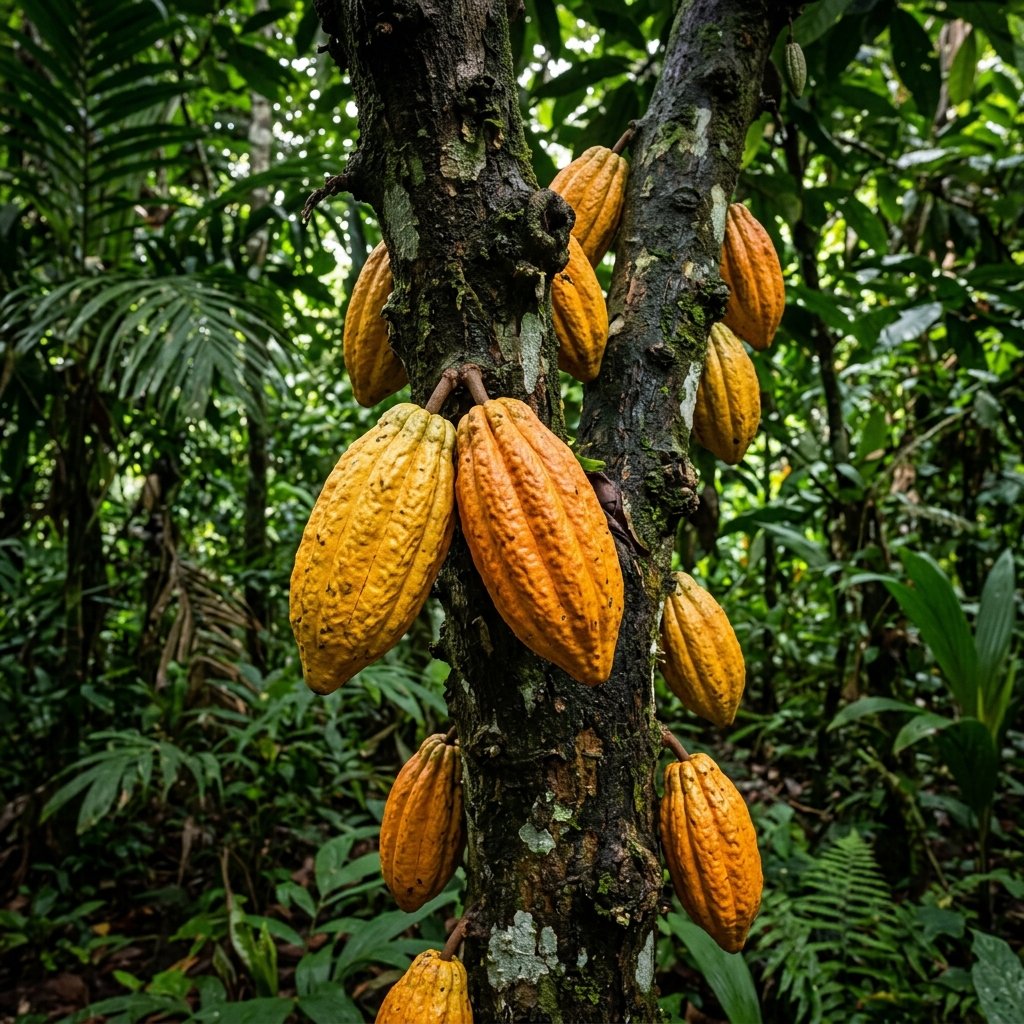
As patron of cacao (Theobroma cacao — literally "food of the gods"), Ek Chuaj governed the single most important commodity in the Maya economy. Cacao beans functioned simultaneously as currency, ceremonial drink, and luxury food — a triple function that made cacao plantations among the most valuable agricultural properties in the Maya world.
The economic role of cacao was remarkably sophisticated:
- Currency: Cacao beans served as money throughout Mesoamerica. A rabbit cost approximately 10 beans; a slave 100. Colonial-era sources provide exchange rates that suggest a remarkably stable currency system.
- Ceremonial drink: The Maya prepared cacao as a bitter, frothed beverage mixed with chili, vanilla, and honey — reserved for royalty, warriors, and ritual occasions. The ability to serve cacao was a mark of high social status.
- Trade commodity: Dried cacao beans were lightweight, durable, and universally valued — ideal for long-distance trade. Merchants carried them as both currency and cargo.
- Counterfeiting: The Maya even had a form of financial fraud: unscrupulous merchants would hollow out cacao beans, fill them with clay or avocado rind, and reseal them to pass as genuine currency. The Maya word for this practice has been preserved in colonial dictionaries.
Cacao plantation owners held special ceremonies to Ek Chuaj during harvest season, offering the first chocolate drink of the new crop to the god before any human drank. This "first fruits" ritual established the divine priority of cacao — it belonged to the gods before it belonged to commerce (Coe, S.D. & Coe, M.D., The True History of Chocolate, Thames & Hudson, 2013, pp. 42–58).
The Merchant Class: The Ppolom
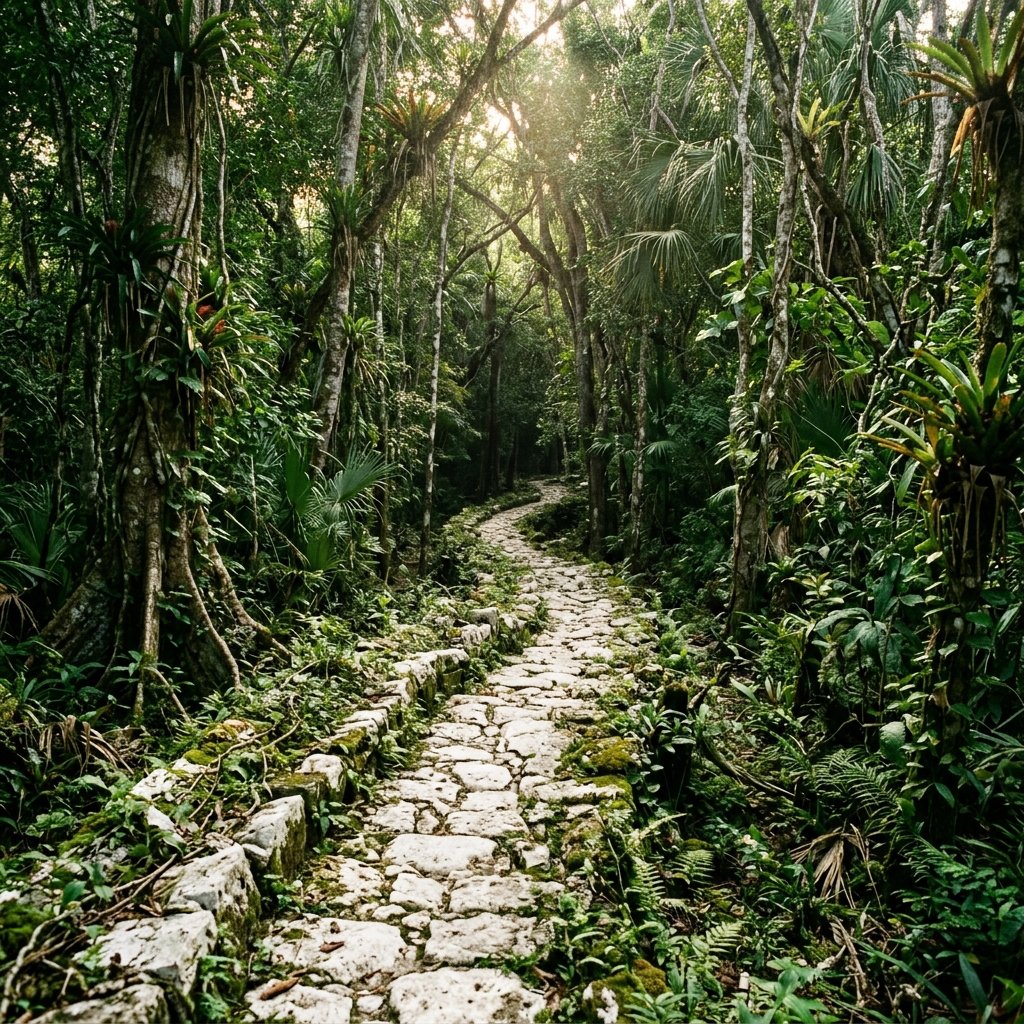
A Maya sacbe (raised stone causeway) — one of the ancient roads that connected Maya cities and served as arteries for long-distance trade. The word sacbe means "white road," referring to the white limestone surface. Major sacbeob could stretch over 100 km — the longest known runs from Cobá to Yaxuná, a distance of approximately 100 km through dense jungle. These roads were the domain of the ppolom — the merchant elite protected by Ek Chuaj.
Long-distance merchants — known as ppolom in Yucatec Maya — occupied a unique, semi-sacred position in Maya society. They were not mere traders but a elite professional class that combined the functions of merchant, diplomat, spy, and sometimes warrior. The ppolom traveled dangerous routes through jungle, coastline, and hostile territories carrying luxury goods:
Exported from the Lowlands
- Cacao — the universal currency and luxury beverage
- Salt — essential for food preservation, from the Yucatan coast
- Cotton textiles — elaborately woven and dyed fabrics
- Honey — from stingless bees (Melipona beecheii)
Imported to the Lowlands
- Obsidian — volcanic glass from the Guatemalan highlands, essential for tools and weapons
- Jade — the most precious substance, quarried in the Motagua Valley
- Quetzal feathers — from the cloud forests of Guatemala and Chiapas
- Volcanic stone — for grinding maize (metates)
The Dual Nature: Merchant and Warrior
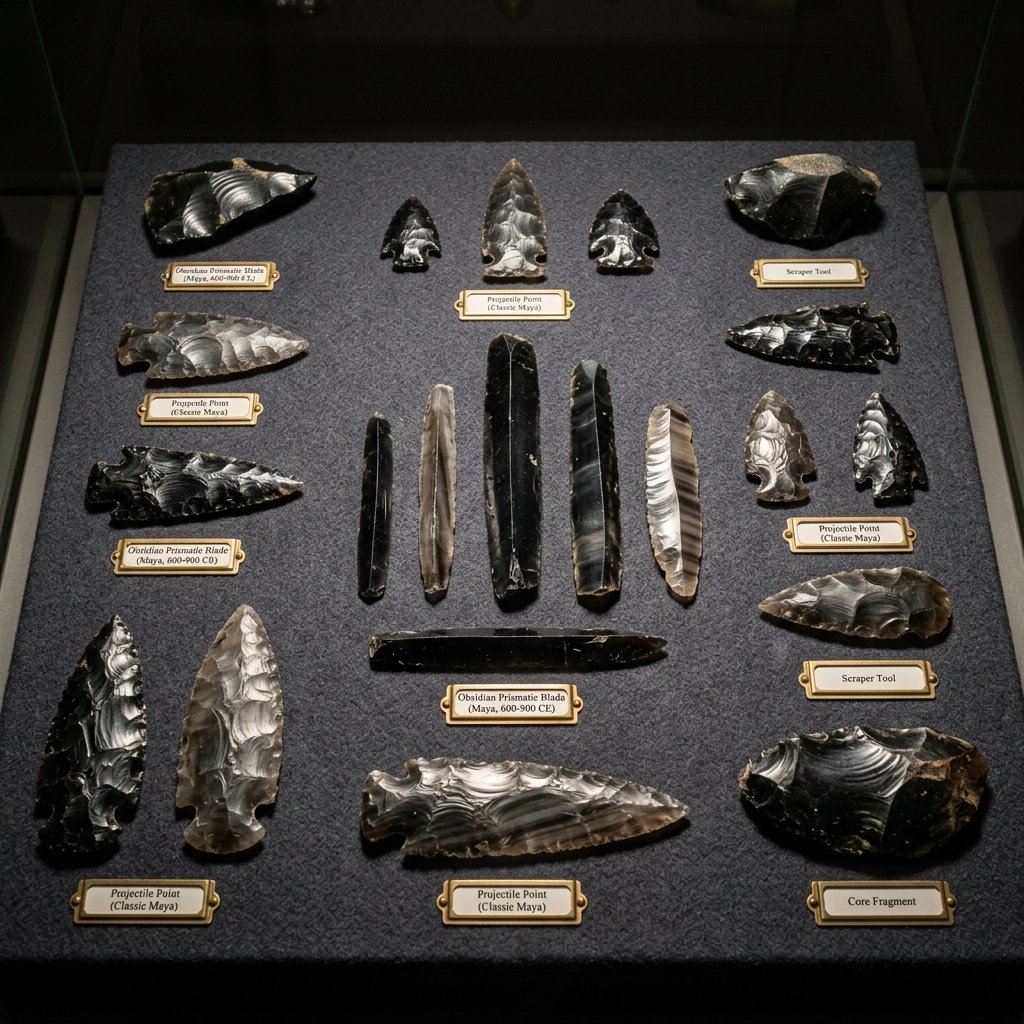
Ancient Mesoamerican obsidian blades — one of the most valuable trade goods in the Maya world. Obsidian (volcanic glass) does not occur naturally in the limestone lowlands where most Maya cities were built. It had to be imported from highland volcanic sources, primarily in Guatemala, making it both an essential commodity and a demonstration of trade network reach. Obsidian was simultaneously a tool, a weapon, and a trade good — mirroring Ek Chuaj's dual nature as patron of both commerce and warfare.
Ek Chuaj's association with both commerce and warfare is not contradictory — it reflects the reality of long-distance trade in ancient Mesoamerica. Merchant caravans traveled armed. Trade routes passed through territories controlled by rival polities. The cargo being carried — cacao, jade, obsidian, quetzal feathers — was enormously valuable and worth stealing. The line between a "merchant mission" and a "military expedition" was often deliberately blurred by Maya states that used commercial networks for intelligence gathering and political influence (Sharer, R.J. & Traxler, L.P., The Ancient Maya, 6th ed., Stanford University Press, 2006, pp. 91–95).
In this context, Ek Chuaj's dual iconography — carrying both a merchant's pack and a lance — is not a theological contradiction but a portrait of daily reality. The merchant who prayed to Ek Chuaj was asking for two things: profit and survival. Both required divine protection.
Maritime Trade: Canoes and Coastal Commerce
Maya long-distance trade was not limited to overland routes. Maritime trade — conducted in large ocean-going canoes — was a major component of the Maya commercial network. When Christopher Columbus encountered a Maya trading canoe off the coast of Honduras in 1502, he described a vessel "as long as a galley" carrying cacao, cotton textiles, obsidian tools, copper bells, and a full crew of approximately 25 people. This single encounter provided European eyes with their first glimpse of the sophisticated Maya commercial system that Ek Chuaj's cult sustained.
References
Frequently Asked Questions
Was Ek Chuaj important?
Enormously. Commerce was the lifeblood of Maya civilization — trade networks connected dozens of independent city-states across thousands of kilometers. Without merchants and the trade routes Ek Chuaj protected, Maya cities in the lowlands could not obtain obsidian for tools, jade for ritual, salt for food preservation, or quetzal feathers for royal regalia. Ek Chuaj's role was far more significant than the patronage of "shopping" — he governed the economic infrastructure that made Maya civilization possible.
Was cacao really used as money?
Yes — cacao beans functioned as currency throughout Mesoamerica. Colonial-era sources provide specific exchange rates: a rabbit cost approximately 10 cacao beans, a slave 100. Cacao was lightweight, durable, universally valued, and difficult to counterfeit (though some merchants tried, filling hollow beans with clay). It was perhaps the most practical pre-modern currency system in the Americas — a currency that also happened to be delicious when properly prepared.
Why is Ek Chuaj both a merchant and a war god?
In ancient Mesoamerica, long-distance trade was inherently dangerous. Merchant caravans traveled through hostile territories carrying enormously valuable cargo — cacao, jade, obsidian, quetzal feathers. The "merchant class" traveled armed and often served dual roles as traders and intelligence gatherers for their home polities. Ek Chuaj's dual nature as protector of both commerce and warfare reflects the lived reality of the Maya merchant class, for whom economic activity and military readiness were inseparable.