Maya Textiles at a Glance
The Invisible Art
Maya textiles are the great lost art of the ancient Americas. Classic Maya painted ceramics and carved reliefs show rulers wearing astonishingly complex garments — brocaded cloth with geometric patterns, feathered capes, jade-studded belts, and embroidered loincloths. But because organic fibers decompose in tropical conditions, virtually no ancient Maya textiles survive. What remains are the images of textiles in art, the tools in the archaeological record, and the living tradition in highland Guatemala.
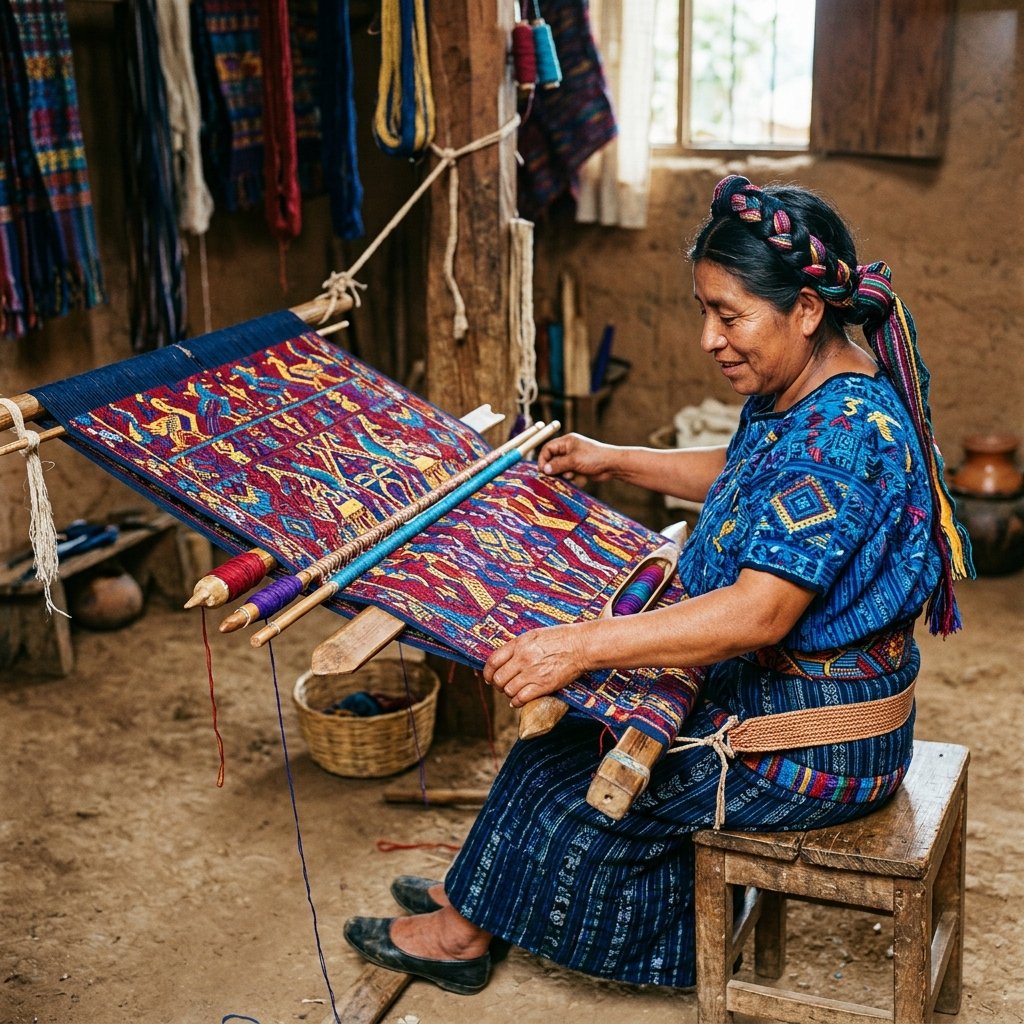
The continuity is remarkable. Modern K'iche' and Kaqchikel Maya women in Guatemala use the same backstrap loom depicted in Classic Maya art — a simple but extraordinarily versatile tool that allows a single weaver to create fabric of stunning complexity. The backstrap loom consists of two bars: one attached to a tree or post, the other to a strap around the weaver's lower back. By leaning forward or back, the weaver controls the tension of the warp threads. This body-loom connection means the weaver literally becomes part of the machine (Schevill, M.B., Maya Textiles of Guatemala, 1993).
Colors of the Maya World
- Maya Blue: The iconic turquoise pigment made from indigo dye bonded with palygorskite clay — chemically stable, fade-resistant, and unique to Mesoamerica. Still visible on murals 1,200+ years old.
- Cochineal Red: Brilliant crimson extracted from cochineal insects (Dactylopius coccus) that live on prickly pear cacti — later one of the most valuable export commodities from the Americas to Europe.
- Logwood Purple/Black: Extracted from the heartwood of the logwood tree (Haematoxylum campechianum), native to the Yucatán.
- Yellow: From various plant sources including annatto (achiote) seeds.
A Living Tradition
Today, Maya weaving in highland Guatemala represents one of the world's most vibrant living textile traditions. Each community has a distinctive traje (traditional dress) with specific patterns, colors, and techniques that identify the weaver's village of origin. The huipil (traditional blouse) can take weeks or months to complete and represents both personal identity and community belonging.
Frequently Asked Questions
Did the Maya weave textiles?
Yes — one of the most sophisticated textile traditions in the ancient Americas. Women used backstrap looms to create complex brocaded fabrics. But almost no ancient textiles survive because organic fibers decompose in the tropics.
Do Maya communities still weave today?
Yes — a living UNESCO-heritage tradition. Highland Guatemala communities produce hand-woven textiles on backstrap looms using techniques directly descended from ancient practice, with community-specific patterns identifying the weaver's village.
What materials did they use?
Cotton (primary), maguey fiber, bark cloth, and feathers (quetzal, macaw). Dyes included Maya Blue (indigo), cochineal (red), and logwood (purple/black).
Scholarly References
- Schevill, M.B. Maya Textiles of Guatemala. University of Texas Press, 1993.
- Morris, W.F. Living Maya. Abrams, 2000.
- Arnold, D.E. & Nieves, A.L. "Maya Blue Paint." Antiquity, vol. 78, 2004.