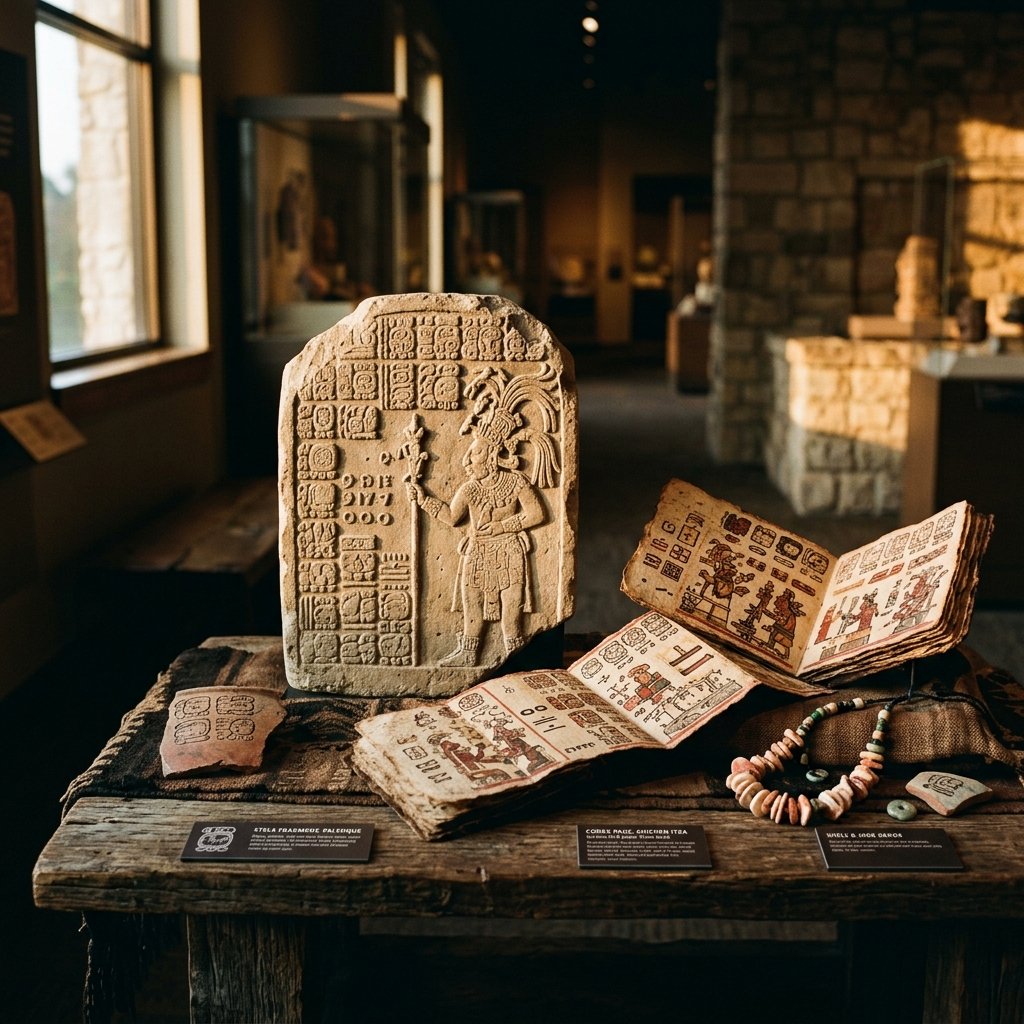
The Maya Time System at a Glance
"The genius of the Maya calendar is not one calendar. It is a stack of calendars, each solving a different problem."
One Date, Four Expressions
When we write a date today, like "July 4, 1776," we are using a single systemic calendar (the Gregorian calendar). When the ancient Maya recorded a date on a stone monument, they didn't just give the day and the month. They layered different calendrical systems on top of one another to produce an incredibly precise chronological timestamp.
The Smithsonian National Museum of the American Indian emphasizes that the Maya used multiple calendars simultaneously, rather than a single unified system (NMAI, "Living Maya Time," 2024).
A complete Classic Maya date looks like this:
9.15.6.14.6 6 Kimi 4 Sek
This translates to: The absolute day 9.15.6.14.6 since creation... falling on the sacred day 6 Kimi... which is the civic day 4 Sek.
1. The Tzolk'in (260 Days)
The Problem it Solved: Tracking sacred energy, destiny, and ritual timing.
The Tzolk'in is the sacred calendar. It consists of 260 days, formed by combining 20 day signs with 13 numbers. Because 20 and 13 share no common factors, it takes exactly 260 days for a specific combination (like "1 Imix") to repeat. This was the calendar used for divination, naming children, and determining when to go to war or plant crops. It is the only part of the calendar system that is still in widespread use among the Maya today.
2. The Haab (365 Days)
The Problem it Solved: Tracking the solar year for agriculture and civic administration.
The Haab is the closest equivalent to our modern year. It consists of 18 "months" of 20 days each, totaling 360 days. Because the Maya knew the solar year was roughly 365 days, they added a dangerously liminal five-day period called the Wayeb at the end to close the gap. The Maya did not use leap years; instead, the Haab slowly drifted through the true tropical year over centuries (Aveni, A. F., Skywatchers of Ancient Mexico, 2001).
3. The Calendar Round (52 Years)
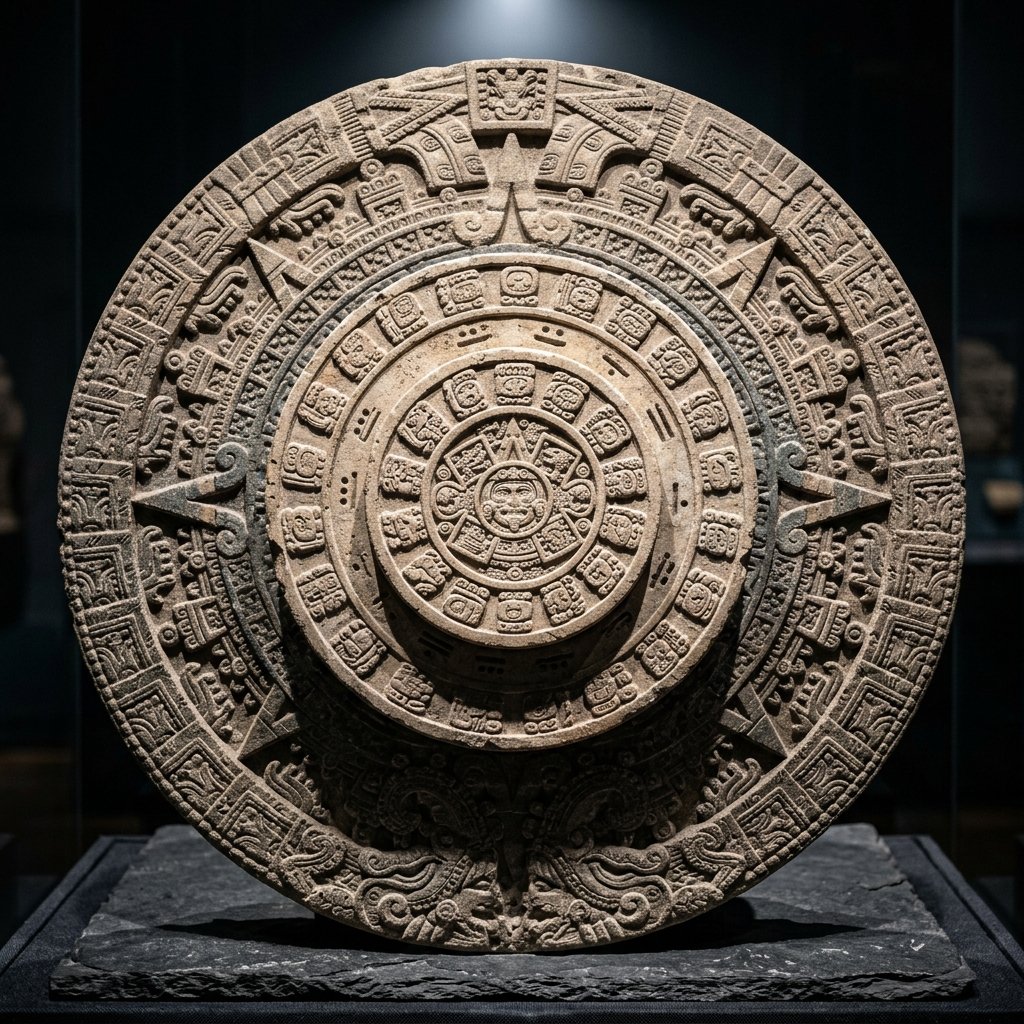
Visualizing the interlock. The Calendar Round is simply what happens when you run a 260-day gear alongside a 365-day gear.
The Problem it Solved: Creating a unique identity for a day within a human lifetime.
If you run the Tzolk'in and the Haab at the same time, any given combination of a Tzolk'in date and a Haab date (e.g., 6 Kimi 4 Sek) will not repeat for exactly 18,980 days, or roughly 52 solar years. This 52-year cycle was culturally profound, representing a generational lifespan. Surviving an entire Calendar Round to see your specific birth-date combination return was a major milestone.
4. The Long Count (Absolute Chronology)
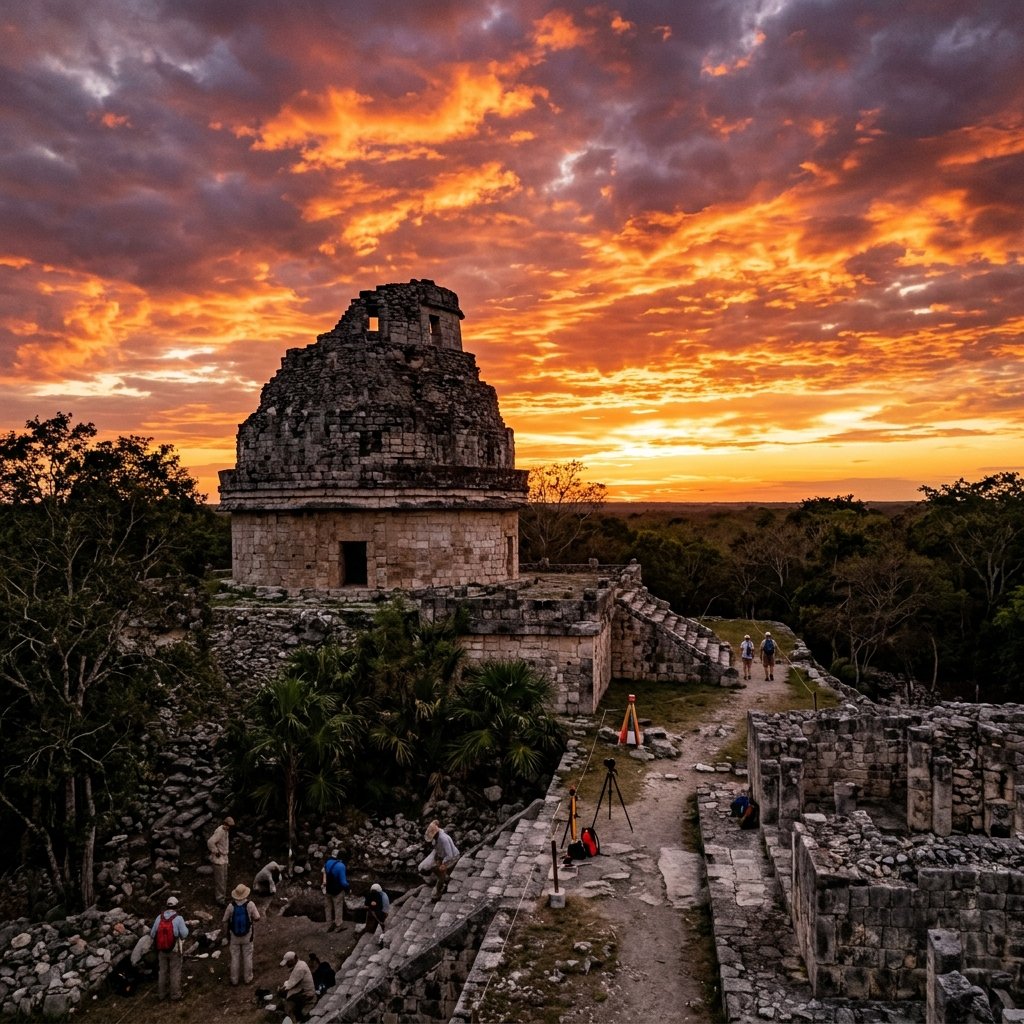
The Caracol observatory at Chichen Itza. While the Long Count handled linear history, the Maya also closely tracked the planetary cycles of Venus and Mars without optical instruments.
The Problem it Solved: Recording deep history and mythic time across thousands of years.
The Calendar Round repeats every 52 years, meaning it cannot distinguish an event in 500 AD from an event 52 years later. To record dynasty and history permanently without ambiguity, the Maya used the Long Count.
This is a linear, base-20 tally of all the days that have passed since a mythological creation date (August 11, 3114 BC in our calendar). A Long Count date like 9.15.6.14.6 reads as:
- 9 B'aktuns: (144,000 days each) = 1,296,000 days
- 15 K'atuns: (7,200 days each) = 108,000 days
- 6 Tuns: (360 days each) = 2,160 days
- 14 Winals: (20 days each) = 280 days
- 6 K'ins: (1 day each) = 6 days
This totals exactly 1,406,446 days since creation. The Long Count is the reason Maya history is the most precisely dated history in the ancient Americas.
Common Myths and Mistakes
Myth: The Maya Calendar Ended in 2012.
False. On December 21, 2012, the Long Count completed its 13th B'aktun cycle (reaching 13.0.0.0.0). Like a modern
odometer rolling over from 99,999 to 00,000, it simply marked the end of one cycle and the beginning of the next.
We are currently living in the 14th B'aktun.
Myth: The Maya Calendar is "More Accurate" Than Ours.
This is comparing apples to oranges. Our Gregorian calendar aims to keep the solstices locked to exact specific days
by using messy leap years. The Maya did not use leap years; they let the Haab drift through the seasons, but they
used supplementary astronomical tables (like the lunar series) to mathematically calculate the drift with staggering
precision (Coe, M. D. and Van Stone, M., Reading the Maya Glyphs, 2005).
Frequently Asked Questions
Was the Maya calendar "more accurate" than ours?
The Maya system pursued a different goal. Instead of using leap years to lock the calendar rigidly to the sun, they accepted temporal drift but calculated astronomcial anomalies with immense mathematical precision using observational tables. It was highly precise internally, but solved chronological problems differently than the Gregorian system.
How many calendars were there?
Functionally, the Maya used three major systems universally: the 260-day Tzolk'in, the 365-day Haab (which combined to form the 52-year Calendar Round), and the Long Count. They also utilized auxiliary cycles tracking lunar phases and the synodic periods of Venus and Mars.
Which one would a Maya person have used day to day?
Ordinary people were deeply tied to the Tzolk'in for spiritual and personal decisions, and the Haab for predicting the agricultural rains and harvests. The Long Count was largely the province of the royal court and state priests for monumental propaganda and dynastic record-keeping.
Scholarly References
- Aveni, A. F. (2001). Skywatchers of Ancient Mexico. University of Texas Press.
- Britannica. (2024). "Maya calendar." Encyclopædia Britannica.
- Coe, M. D. and Van Stone, M. (2005). Reading the Maya Glyphs. Thames & Hudson.
- NMAI / Smithsonian. (2024). "Living Maya Time: Calendar Overview."