Sek
The Sky · Month 5 of 19
Etymology & Name Origin
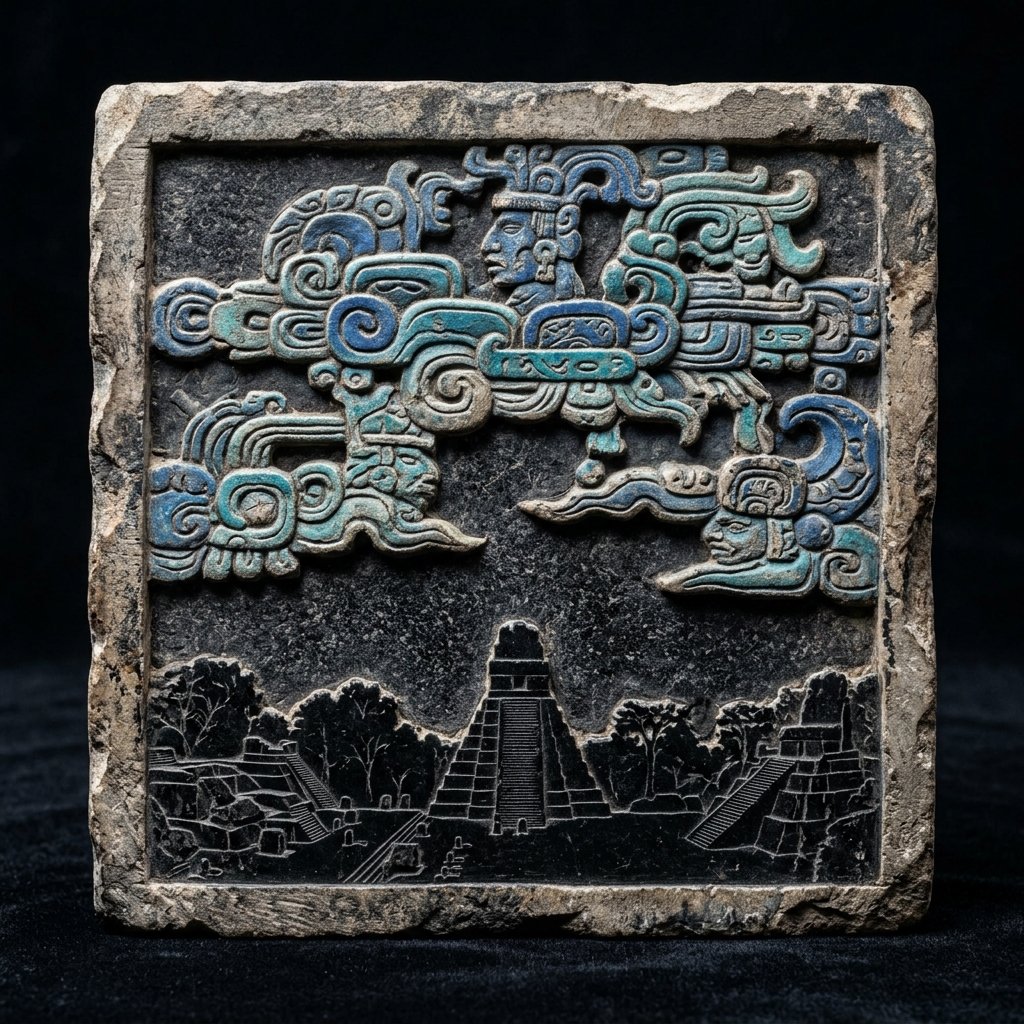
The name "Sek" (also "Tzec") is debated among scholars but is commonly associated with the sky, the celestial vault, and possibly a term meaning "to count" or "to order." This linguistic connection to both sky and counting reflects the deep Maya integration of astronomy and mathematics — the sky was not merely observed but measured, calculated, and ordered into a precise cosmological framework.
Cultural Significance
Sek represented the ordered canopy of the heavens — the structured sky that the Maya mapped with extraordinary precision. This was a month celebrating the cosmic order that made civilization possible: the predictable movements of sun, moon, Venus, and stars that allowed the Maya to construct their interlocking calendar systems. The sky during Sek was a visible proof of divine order.
Rituals & Ceremonies
Landa recorded that during Sek, bee-keepers held their principal festival, which was one of the most celebratory events in the Maya ceremonial calendar. Honey was a precious commodity — used as a sweetener, medicine, and offering — and the bees that produced it were considered sacred. Balché, a fermented honey drink, was prepared during Sek and consumed during ritual ceremonies to induce altered states of consciousness.
Agricultural Cycle
The celebrations of bee-keepers during Sek coincided with the period when hives were at their most productive in many regions. Honey harvesting was a skilled practice requiring knowledge of seasonal bee behavior. The connection between bees, honey, and the sky is not incidental — bees were associated with the celestial realm in Maya thought, and honey was considered a substance of divine origin.
Cosmological Role
The sky (ka'an) was the upper level of the three-tiered Maya cosmos: the celestial realm above, the earth in the middle, and Xibalba below. The sky was held up by four Bacab deities stationed at the cardinal directions, and penetrated by the great ceiba tree (yaxche) whose roots extended into the underworld and whose crown reached into the heavens. Sek honored this architecture of the cosmos.
Patron Deity
Ah Muzen Cab, the Bee God, was the primary deity honored during Sek. Depictions of this deity appear throughout the Madrid Codex, one of only four surviving Maya codices, which contains detailed almanacs related to beekeeping activities.
Key Takeaway
The Haab' month Sek ("Sky") is month 5 of the 19-part Maya solar calendar. Spanning 20 days, it represents month associated with the sky and celestial order. Together with the other 17 regular months and the 5-day Wayeb' period, Sek forms the 365-day Haab' cycle that tracked the solar year with remarkable precision.
Frequently Asked Questions
What does the Maya month name Sek mean?
The name "Sek" translates to "Sky" in the Haab' solar calendar. The name "Sek" (also "Tzec") is debated among scholars but is commonly associated with the sky, the celestial vault, and possibly a term meaning "to count" or "to order.
What ceremonies were performed during Sek?
Landa recorded that during Sek, bee-keepers held their principal festival, which was one of the most celebratory events in the Maya ceremonial calendar. Honey was a precious commodity — used as a sweetener, medicine, and offering — and the bees that produced it were considered sacred.
Which deity is the patron of Sek?
Ah Muzen Cab, the Bee God, was the primary deity honored during Sek. Depictions of this deity appear throughout the Madrid Codex, one of only four surviving Maya codices, which contains detailed almanacs related to beekeeping activities.
How does Sek fit into the Maya calendar system?
Sek is month 5 of 19 in the Haab' solar calendar. It spans 20 days (numbered 0-19 in the Maya system). The Haab' consists of 18 months of 20 days each (360 days) plus a 5-day Wayeb' period, totaling 365 days — almost exactly one solar year.
Scholarly References
- Landa, D. de. Relación de las Cosas de Yucatán. Translated by A. Tozzer. Peabody Museum, 1941, pp. 160-162.
- Vail, G. & Aveni, A. The Madrid Codex: New Approaches to Understanding an Ancient Maya Manuscript. University Press of Colorado, 2004, pp. 280-310.
- Źrałka, J. & Hermes, B. "In the Path of the Maize God: A Royal Tomb at Nakum." Antiquity, vol. 86, 2012, pp. 738-750.
- Coe, M.D. & Kerr, J. The Art of the Maya Scribe. Thames & Hudson, 1998, pp. 170-175.
 Sotz
Sotz