Pax
The Planting Time · Month 16 of 19
Etymology & Name Origin
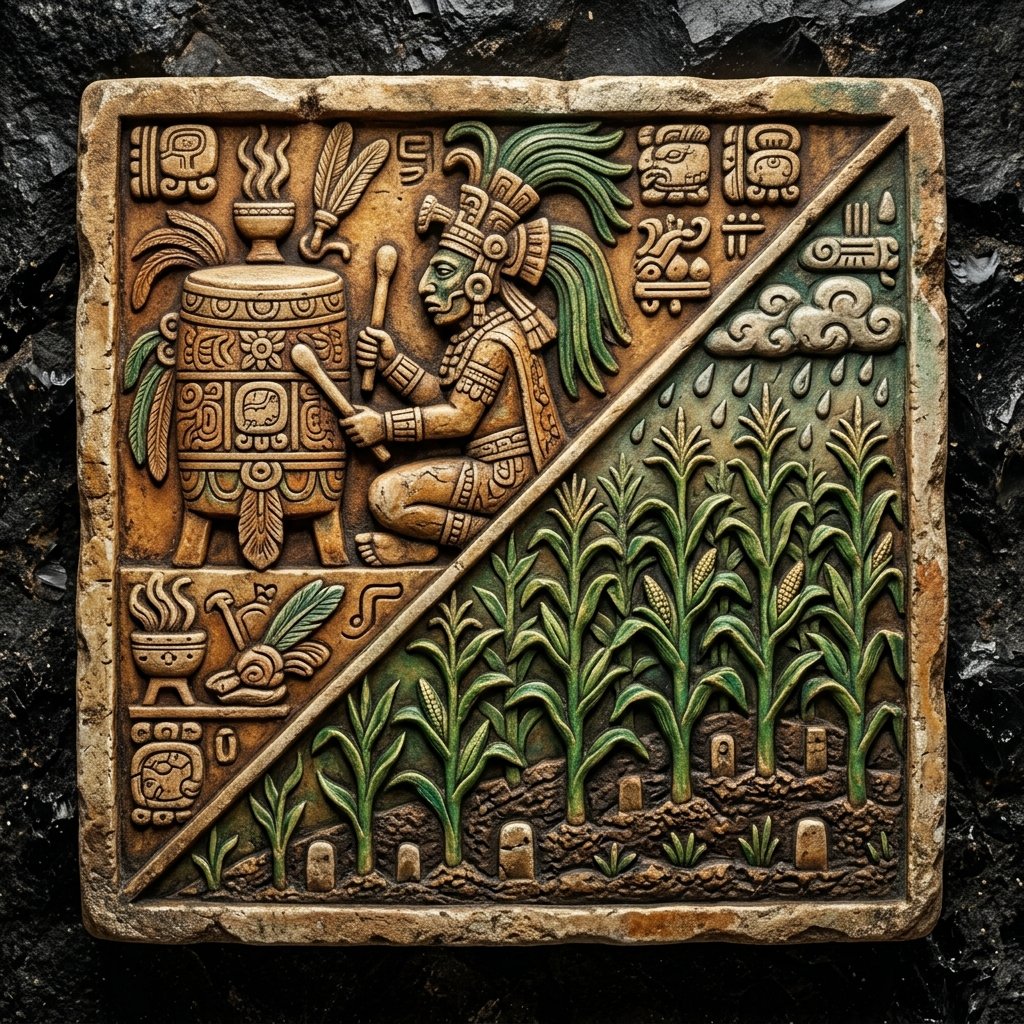
"Pax" means "planting time" or "planting drum" — connecting the agricultural cycle to the rhythm of ceremonial music. The great drums (tunkul) that accompanied Maya ceremonies were particularly prominent during Pax, their deep resonance carrying across the plazas and through the forest. The drum represented the heartbeat of the community, the rhythm that synchronized collective action for both planting and warfare.
Cultural Significance
Pax was one of the most ceremonially intense months in the Maya calendar. It marked the period when war captains were honored, military campaigns were blessed, and the great drums of ceremony were sounded. The connection between planting and warfare is not incidental — both activities required collective action, strategic timing, and the blessing of the gods. The stakes of both were life and death.
Rituals & Ceremonies
Landa recorded that during Pax, the great ceremony of the pacum chaak (a war-related rite) was performed. Warriors gathered in full regalia, drums were beaten for five consecutive nights, and the war captain (nacom) was honored with processions and fasting. The nacom was carried on a litter, incensed with copal, and given sacred drinks. The ceremony concluded with dances, feasting, and military dedications — preparing the community for both agricultural and military campaigns.
Agricultural Cycle
The "planting" in Pax referred to the preparation for the next agricultural cycle. While not the actual planting season (which came later), Pax was when strategic decisions about which fields to cultivate, where to clear new milpa, and how to allocate labor were made. The drumming ceremonies that accompanied these decisions reflected the gravity of agricultural planning — upon which the survival of the entire community depended.
Cosmological Role
The drum in Maya cosmology was the voice of the earth — the heartbeat of the living world. The great drums carved from hollowed tree trunks were themselves transformations of the world tree, converting the cosmic axis into sound. When the drums of Pax sounded across the plazas, they were not merely marking rhythm but announcing the community's engagement with the cosmic cycle of planting, growth, and harvest that mirrored the cycle of birth, death, and rebirth.
Patron Deity
Cit Chac Coh, the war deity associated with fire and combat, was honored during Pax alongside Kukulkán. The nacom (war captain) served as the human representative of this deity during the ceremonies.
Key Takeaway
The Haab' month Pax ("Planting Time") is month 16 of the 19-part Maya solar calendar. Spanning 20 days, it represents month of great ceremonies and drumming. Together with the other 17 regular months and the 5-day Wayeb' period, Pax forms the 365-day Haab' cycle that tracked the solar year with remarkable precision.
Frequently Asked Questions
What does the Maya month name Pax mean?
The name "Pax" translates to "Planting Time" in the Haab' solar calendar. "Pax" means "planting time" or "planting drum" — connecting the agricultural cycle to the rhythm of ceremonial music.
What ceremonies were performed during Pax?
Landa recorded that during Pax, the great ceremony of the pacum chaak (a war-related rite) was performed. Warriors gathered in full regalia, drums were beaten for five consecutive nights, and the war captain (nacom) was honored with processions and fasting.
Which deity is the patron of Pax?
Cit Chac Coh, the war deity associated with fire and combat, was honored during Pax alongside Kukulkán. The nacom (war captain) served as the human representative of this deity during the ceremonies.
How does Pax fit into the Maya calendar system?
Pax is month 16 of 19 in the Haab' solar calendar. It spans 20 days (numbered 0-19 in the Maya system). The Haab' consists of 18 months of 20 days each (360 days) plus a 5-day Wayeb' period, totaling 365 days — almost exactly one solar year.
Scholarly References
- Landa, D. de. Relación de las Cosas de Yucatán. Translated by A. Tozzer. Peabody Museum, 1941, pp. 175-178.
- Sharer, R. & Traxler, L. The Ancient Maya. Stanford University Press, 6th ed., 2006, pp. 740-745.
- Schele, L. & Freidel, D. A Forest of Kings: The Untold Story of the Ancient Maya. William Morrow, 1990, pp. 142-165.
- Martin, S. & Grube, N. Chronicle of the Maya Kings and Queens. Thames & Hudson, 2nd ed., 2008, pp. 20-25.
 Muwan
Muwan