Muwan
The Owl · Month 15 of 19
Etymology & Name Origin
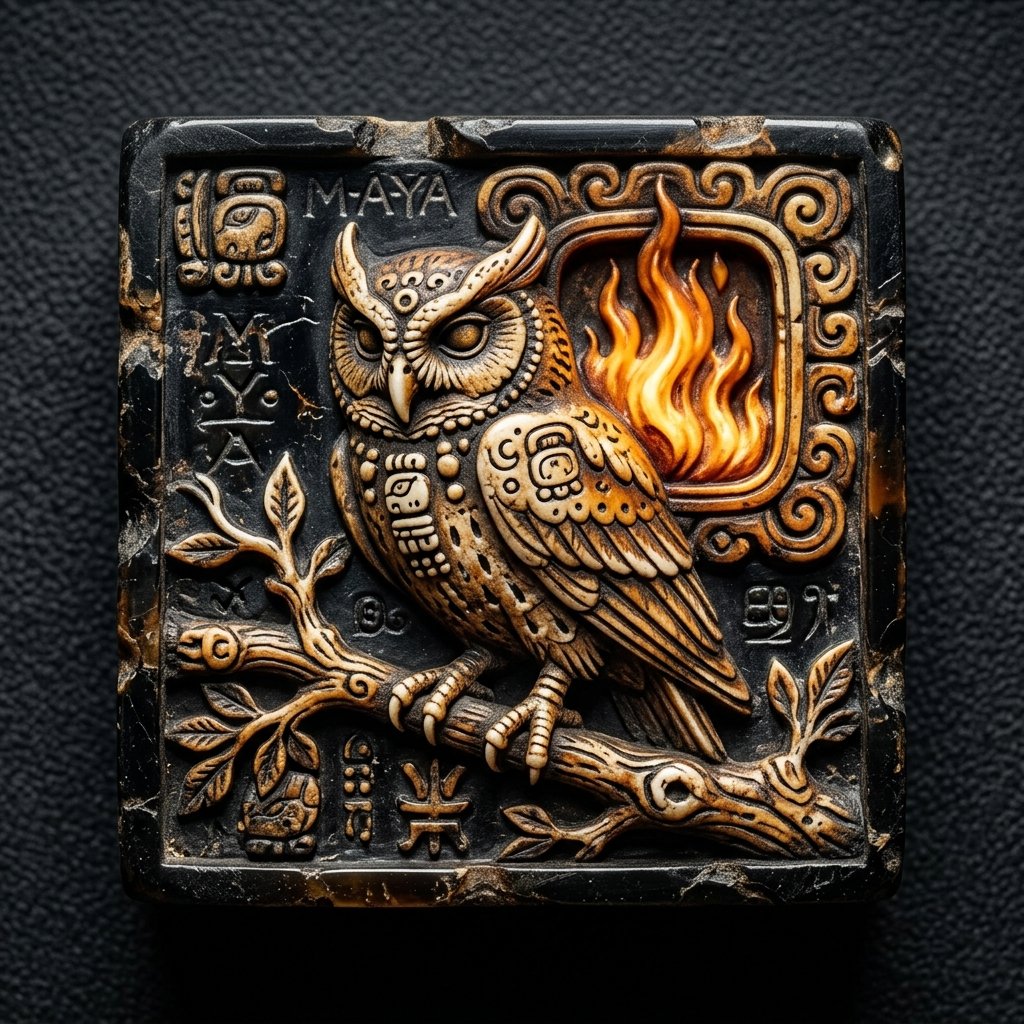
"Muwan" (also "Muan") directly translates to "screech owl" — specifically the great horned owl or barn owl whose nocturnal call echoed through the Maya forest. Owls were considered messengers of the underworld, and their calls were omens of death or supernatural communication. The Popol Vuh names four owl messengers who serve the Lords of Xibalba, establishing the owl as the premier supernatural courier.
Cultural Significance
Muwan was a month of supernatural communication and prophetic power. The owl, as messenger of the death lords, brought information from the realm of the dead to the world of the living. This was not uniformly negative — the owl's message could be a warning, a prophecy, or even an invitation to spiritual knowledge. The fire association reflects both the hearth-fire that guarded against darkness and the sacrificial fire that sent offerings to the gods.
Rituals & Ceremonies
During Muwan, cacao planters performed their most important ceremonies. Cacao was one of the most valuable commodities in the Maya economy — used as currency, medicine, and ritual drink. The ceremonies involved sacrificial offerings to Ek Chuaj (God of Merchants and Cacao), burning of copal, and the preparation of sacred chocolate beverages. The connection between owls, the underworld, and cacao reflects the reality that cacao grows best in the shaded understory — the dark, hidden places associated with Xibalba.
Agricultural Cycle
Cacao cultivation required specific conditions — shade, moisture, and warm temperatures — that concentrated it in certain lowland regions. The Muwan ceremonies ensured spiritual protection for this economically critical crop. Beyond cacao, Muwan coincided with the maintenance period when perennial crops and orchards were tended and protected from pests.
Cosmological Role
The four owl messengers of the Popol Vuh — Chabi Tucur (Arrow Owl), Huracán Tucur (One-Leg Owl), Caquix Tucur (Macaw Owl), and Holom Tucur (Head Owl) — represent the fourfold supernatural courier system of Xibalba. Their role in summoning the Hero Twins' father to the underworld establishes the owl as the bridge between the world of the living and the dead. Muwan honored this bridge-function and the terrifying but essential communication it enabled.
Patron Deity
Ek Chuaj, the black-faced God of Merchants and Cacao, was the primary deity honored during Muwan. His ceremonies coincided with the cacao harvest in many regions, and his blackened appearance associated him with the commercial and nocturnal energies of this month.
Key Takeaway
The Haab' month Muwan ("Owl") is month 15 of the 19-part Maya solar calendar. Spanning 20 days, it represents month of the screech owl and fire. Together with the other 17 regular months and the 5-day Wayeb' period, Muwan forms the 365-day Haab' cycle that tracked the solar year with remarkable precision.
Frequently Asked Questions
What does the Maya month name Muwan mean?
The name "Muwan" translates to "Owl" in the Haab' solar calendar. "Muwan" (also "Muan") directly translates to "screech owl" — specifically the great horned owl or barn owl whose nocturnal call echoed through the Maya forest.
What ceremonies were performed during Muwan?
During Muwan, cacao planters performed their most important ceremonies. Cacao was one of the most valuable commodities in the Maya economy — used as currency, medicine, and ritual drink.
Which deity is the patron of Muwan?
Ek Chuaj, the black-faced God of Merchants and Cacao, was the primary deity honored during Muwan. His ceremonies coincided with the cacao harvest in many regions, and his blackened appearance associated him with the commercial and nocturnal energies of this month.
How does Muwan fit into the Maya calendar system?
Muwan is month 15 of 19 in the Haab' solar calendar. It spans 20 days (numbered 0-19 in the Maya system). The Haab' consists of 18 months of 20 days each (360 days) plus a 5-day Wayeb' period, totaling 365 days — almost exactly one solar year.
Scholarly References
- Landa, D. de. Relación de las Cosas de Yucatán. Translated by A. Tozzer. Peabody Museum, 1941, pp. 174-175.
- Tedlock, D. Popol Vuh: The Definitive Edition. Simon & Schuster, 1996, pp. 97-101.
- McNeil, C. Chocolate in Mesoamerica: A Cultural History of Cacao. University Press of Florida, 2006, pp. 184-210.
- Martin, S. & Grube, N. Chronicle of the Maya Kings and Queens. Thames & Hudson, 2nd ed., 2008, pp. 14-18.
 Kankin