Kumku
The Granary · Month 18 of 19
Etymology & Name Origin
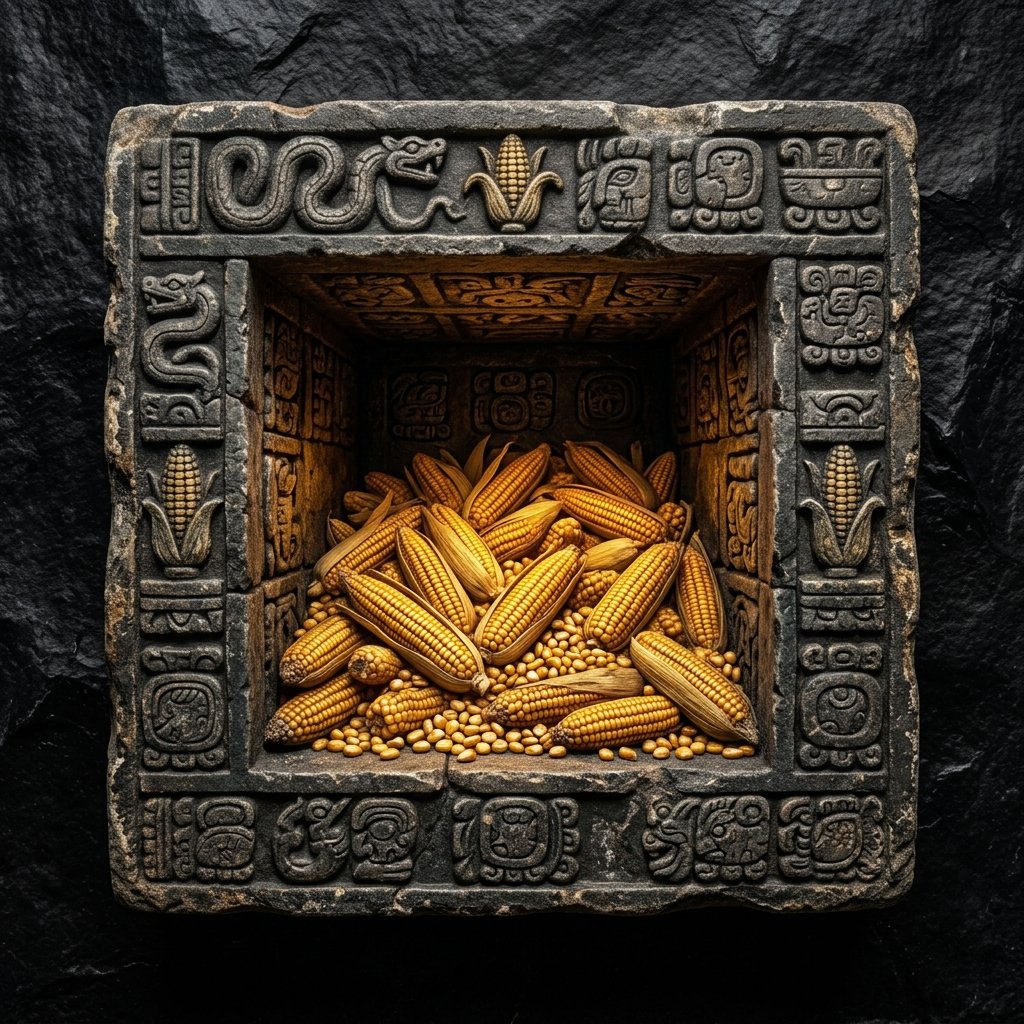
"Kumku" (also "Cumku") means "granary" or "storage place for grain" — the dark, enclosed space where the community's most vital resource was preserved. The name carries associations of both darkness and abundance: the granary is dark inside, but it holds the seed of future life. The Long Count creation date (4 Ahau 8 Kumku) falls in this month, indicating the Maya placed the origin of the current world-age in the month of stored potential.
Cultural Significance
Kumku held extraordinary cosmological weight because the Maya creation date — August 11, 3114 BC in the Gregorian calendar — was recorded as 4 Ahau 8 Kumku in the Haab'. The current world was literally born in the month of the Granary. This was not accidental: the Maya understood creation as an act of stored potential being released — the seed in the dark granary bursting forth into light and life. Kumku was the month of the unborn universe.
Rituals & Ceremonies
The creation date association made Kumku profoundly sacred. Ceremonies during this month reflected its role as the cosmic container of origin. Offerings to the creators (Itzamná, the Maize God, and the assembled deities of the Popol Vuh creation narrative) were particularly important. The granary itself was ritually cleansed and blessed, and the first seeds for the coming planting season were ceremonially placed within it.
Agricultural Cycle
As the literal granary-month, Kumku was when stored grain was at its most critical. The dry season had consumed much of the previous harvest, and the remaining kernels needed to serve both as food and as seed stock for the coming planting season. The management of these reserves — knowing how much to eat and how much to save — was one of the most important decisions in Maya agricultural life.
Cosmological Role
The creation date 4 Ahau 8 Kumku establishes this month as the temporal origin of the current Fifth Sun (the present world-age). The three stones of creation were set in the cosmic hearth on this date, fire was drilled, and the sky was raised above the earth. All of this happened "in the granary" — in the dark container of compressed potential. Kumku teaches that creation begins not in light but in darkness, not in expression but in storage, not in the open but in the enclosed.
Patron Deity
Itzamná, the supreme creator deity, and the Paddler Gods (who transported the gods to the place of creation in their celestial canoe) are associated with Kumku through the creation narrative. The stela at Quiriguá that records the creation date 4 Ahau 8 Kumku is one of the most important inscriptions in all of Maya epigraphy.
Key Takeaway
The Haab' month Kumku ("Granary") is month 18 of the 19-part Maya solar calendar. Spanning 20 days, it represents month of darkness and grain. Together with the other 17 regular months and the 5-day Wayeb' period, Kumku forms the 365-day Haab' cycle that tracked the solar year with remarkable precision.
Frequently Asked Questions
What does the Maya month name Kumku mean?
The name "Kumku" translates to "Granary" in the Haab' solar calendar. "Kumku" (also "Cumku") means "granary" or "storage place for grain" — the dark, enclosed space where the community's most vital resource was preserved.
What ceremonies were performed during Kumku?
The creation date association made Kumku profoundly sacred. Ceremonies during this month reflected its role as the cosmic container of origin.
Which deity is the patron of Kumku?
Itzamná, the supreme creator deity, and the Paddler Gods (who transported the gods to the place of creation in their celestial canoe) are associated with Kumku through the creation narrative. The stela at Quiriguá that records the creation date 4 Ahau 8 Kumku is one of the most important inscriptions in all of Maya epigraphy.
How does Kumku fit into the Maya calendar system?
Kumku is month 18 of 19 in the Haab' solar calendar. It spans 20 days (numbered 0-19 in the Maya system). The Haab' consists of 18 months of 20 days each (360 days) plus a 5-day Wayeb' period, totaling 365 days — almost exactly one solar year.
Scholarly References
- Stuart, D. The Order of Days: Unlocking the Secrets of the Ancient Maya. Harmony Books, 2011, pp. 220-245.
- Freidel, D., Schele, L. & Parker, J. Maya Cosmos. William Morrow, 1993, pp. 59-122.
- Landa, D. de. Relación de las Cosas de Yucatán. Translated by A. Tozzer. Peabody Museum, 1941, pp. 179-180.
- Looper, M.G. Lightning Warrior: Maya Art and Kingship at Quiriguá. University of Texas Press, 2003, pp. 150-175.
 Kayab
Kayab