The Calendar Round at a Glance
Two Calendars, One System
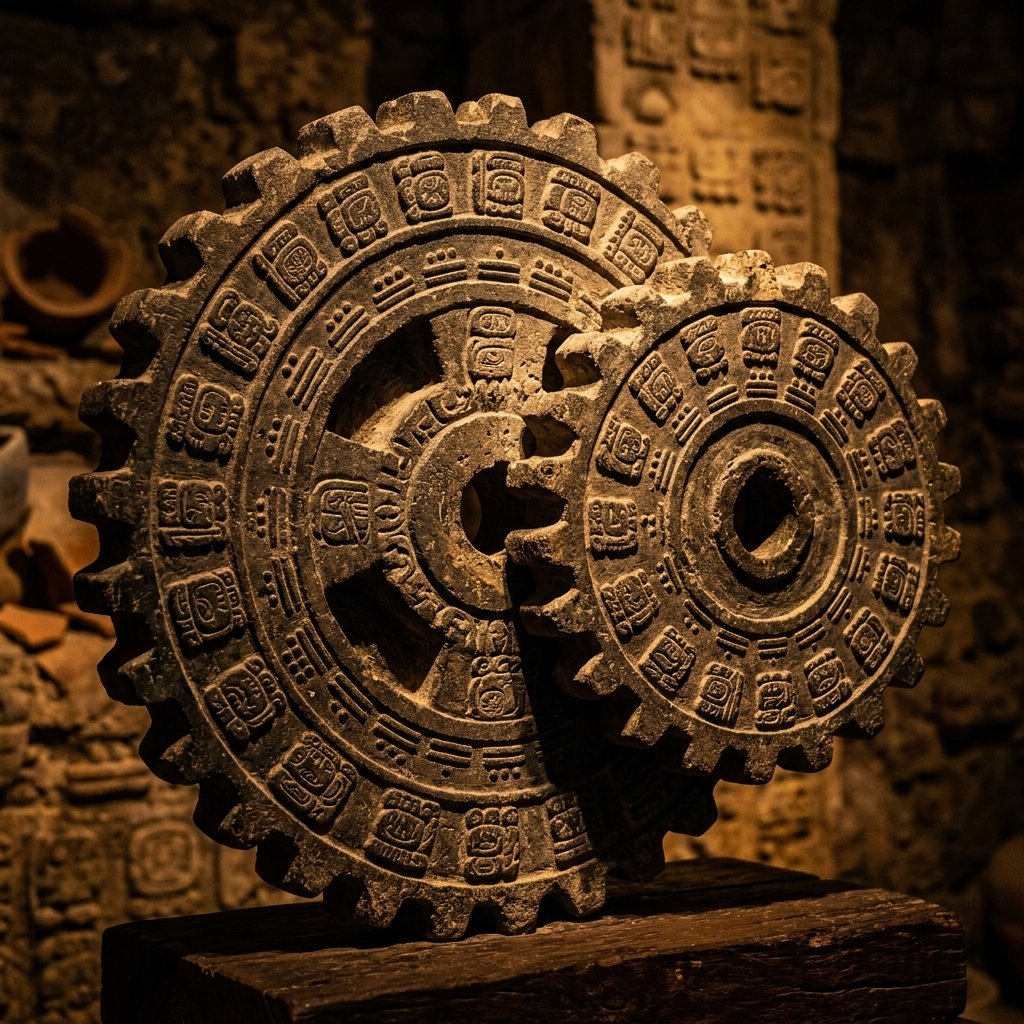
The Maya Calendar Round is what happens when you run two calendars simultaneously. Imagine two interlocking gears of different sizes:
- The Tzolk'in — a gear with 260 teeth (13 numbers × 20 day signs). This is the sacred calendar, used for divination, ceremony, and personal identity.
- The Haab' — a gear with 365 teeth (18 months of 20 days + 5 unlucky Wayeb' days). This is the solar calendar, tracking agricultural seasons.
Every day, both gears advance by one position. Today might be 4 Ahau in the Tzolk'in and 8 Kumk'u in the Haab', producing the Calendar Round date 4 Ahau 8 Kumk'u. Tomorrow, the Tzolk'in advances to 5 Imix and the Haab' advances to 9 Kumk'u.
The question is: how long until the exact combination 4 Ahau 8 Kumk'u comes around again? The answer is the least common multiple of 260 and 365: 18,980 days — approximately 52 solar years. This is the Calendar Round.
The Mathematics
Why 18,980? Because 260 and 365 share only one common factor: 5.
- 260 = 4 × 5 × 13
- 365 = 5 × 73
- LCM(260, 365) = 4 × 5 × 13 × 73 = 18,980
This means 18,980 days = 73 Tzolk'in cycles = 52 Haab' years. Both calendars return to their starting positions simultaneously — a complete reset.
Of the theoretically possible combinations (260 × 365 = 94,900), only 18,980 actually occur — because only certain Tzolk'in days can pair with certain Haab' positions. This is due to the fact that 20 (number of day signs) divides evenly into 360 (18 months × 20 days) but not into the 5 Wayeb' days. The result is that only 4 of the 20 day signs can ever fall on the first day of any Haab' month — a mathematical constraint that the Maya called the Year Bearers (Aveni, A., Skywatchers of Ancient Mexico, 2001, pp. 141–145).
The Limitation — and the Solution
The Calendar Round has a significant limitation: it cannot distinguish between events more than 52 years apart. If a monument records the date "4 Ahau 8 Kumk'u," that date occurs once every 52 years — so which cycle does it refer to? Without additional information, it's ambiguous.
The Maya solved this with the Long Count — a linear count of days from a fixed starting point (the creation date of August 11, 3114 BC). The Long Count provides an absolute date that never repeats. A complete Maya date typically includes all three systems: Long Count + Tzolk'in + Haab', as in 9.15.6.14.6, 6 Kimi 4 Sek — unambiguous across millions of years.
The 52-Year Cycle in Maya Life
The completion of a Calendar Round cycle — 52 Haab' years — was a significant milestone. It meant that every possible combination of Tzolk'in and Haab' had occurred exactly once, and the calendar was about to begin again. The Maya marked these completions with:
- Monument dedication: New stelae and altars were often erected at Calendar Round completions.
- Temple renovation: Existing temples were enlarged by building new structures over them — the characteristic Maya practice of entombing older buildings inside newer ones.
- Renewal ceremonies: Fire-drilling rituals symbolized the rekindling of time itself.
Frequently Asked Questions
What is the Maya Calendar Round?
The 52-year cycle created by the interlocking of the 260-day Tzolk'in and 365-day Haab'. A specific day combination (like 4 Ahau 8 Kumk'u) repeats every 18,980 days — about 52 years. It was the primary dating system across all of Mesoamerica.
How do the Tzolk'in and Haab' work together?
Like two interlocking gears of different sizes. Every day has both a Tzolk'in name and a Haab' position. They advance simultaneously, and because 260 and 365 share only the factor 5, it takes 18,980 days for both to align exactly as before.
Why was the 52-year cycle important?
A Calendar Round completion meant every possible day combination had occurred once — time itself was resetting. The Maya marked these milestones with new monuments, temple renovations, and fire-drilling renewal ceremonies. The Long Count extended dating beyond this 52-year limit.
Scholarly References
- Aveni, A. Skywatchers of Ancient Mexico. University of Texas Press, revised edition, 2001.
- Lounsbury, F. "Maya Numeration, Computation, and Calendrical Astronomy." In Dictionary of Scientific Biography, vol. 15, 1978.
- Rice, P.M. Maya Calendar Origins. University of Texas Press, 2007.
- Sharer, R. & Traxler, L. The Ancient Maya. Stanford University Press, 6th edition, 2006.