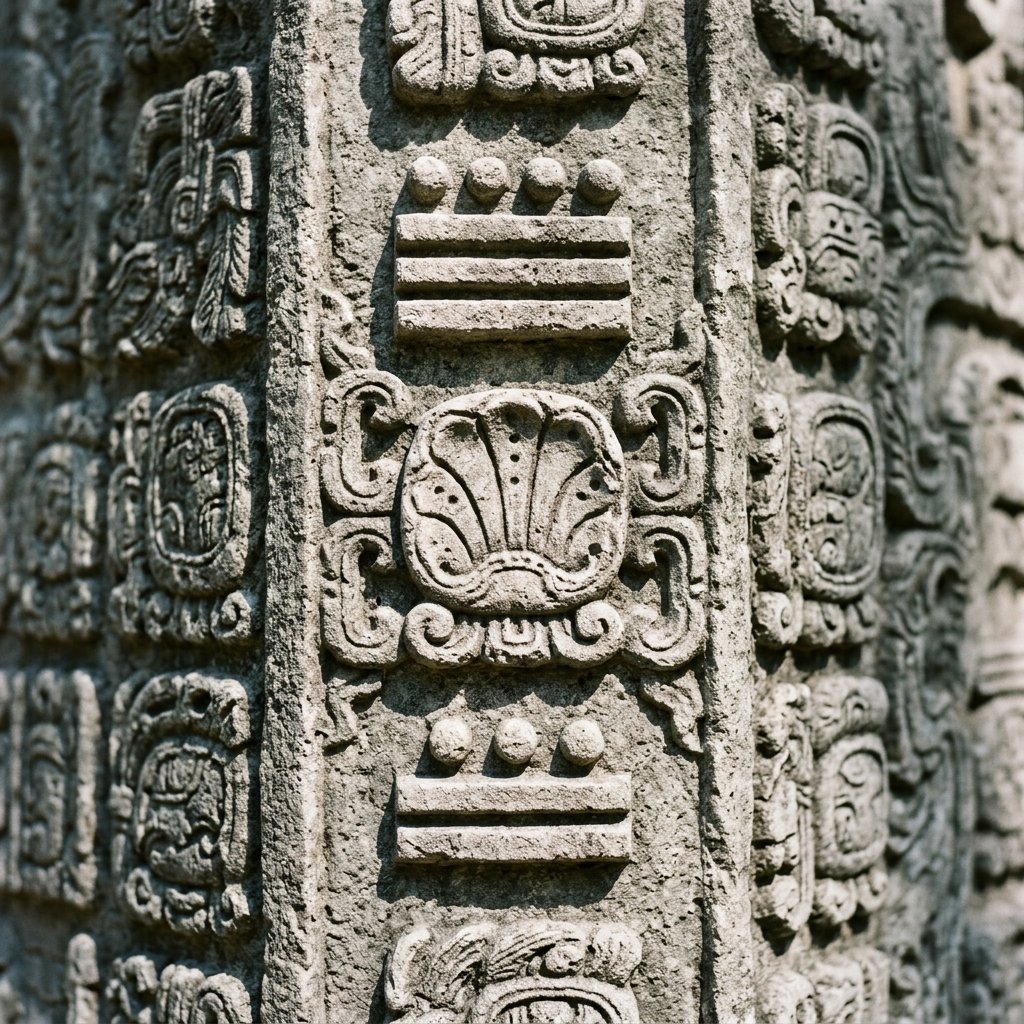
Maya Numbers at a Glance
An Unmatched Mathematical Elegance
The mathematical system developed by the ancient Maya is a masterpiece of intellectual efficiency. While the ancient Romans were struggling with clumsy letters to write numbers (where 1988 becomes MCMLXXXVIII), the Maya could write the same number, or numbers infinitely larger, using just three simple symbols and a positional grid.
The system is built on three visual building blocks:
- A Dot: Represents the value of 1. (Up to four dots can be used together).
- A Bar: Represents the value of 5. (Up to three bars can be used together).
- A Stylized Shell: Represents the value of 0.
By combining dots and bars, the Maya could quickly write any number from 1 to 19. For example, three dots over two bars equals 13. But the true genius of the system lies in how it handles larger numbers.
The Base-20 (Vigesimal) System
Unlike our decimal (base-10) system, which relies on multiples of ten (presumably because we have ten fingers), the Maya used a vigesimal (base-20) system (presumably because they counted on both fingers and toes).
In our base-10 system, as numbers move to the left, their value increases by a power of 10 (ones, tens, hundreds, thousands).
In the Maya system, numbers were written vertically, from bottom to top. As a number moved up a tier, its value increased by a power of 20:
- Bottom tier: Units of 1 (1 to 19)
- Second tier: Units of 20 (20 to 399)
- Third tier: Units of 400 (400 to 7,999)
- Fourth tier: Units of 8,000 (8,000 to 159,999)
Using this stacked positional system, a scribe could write a number in the millions using only a small column of dots and bars on a stone stela or a page in a folded bark-paper book.
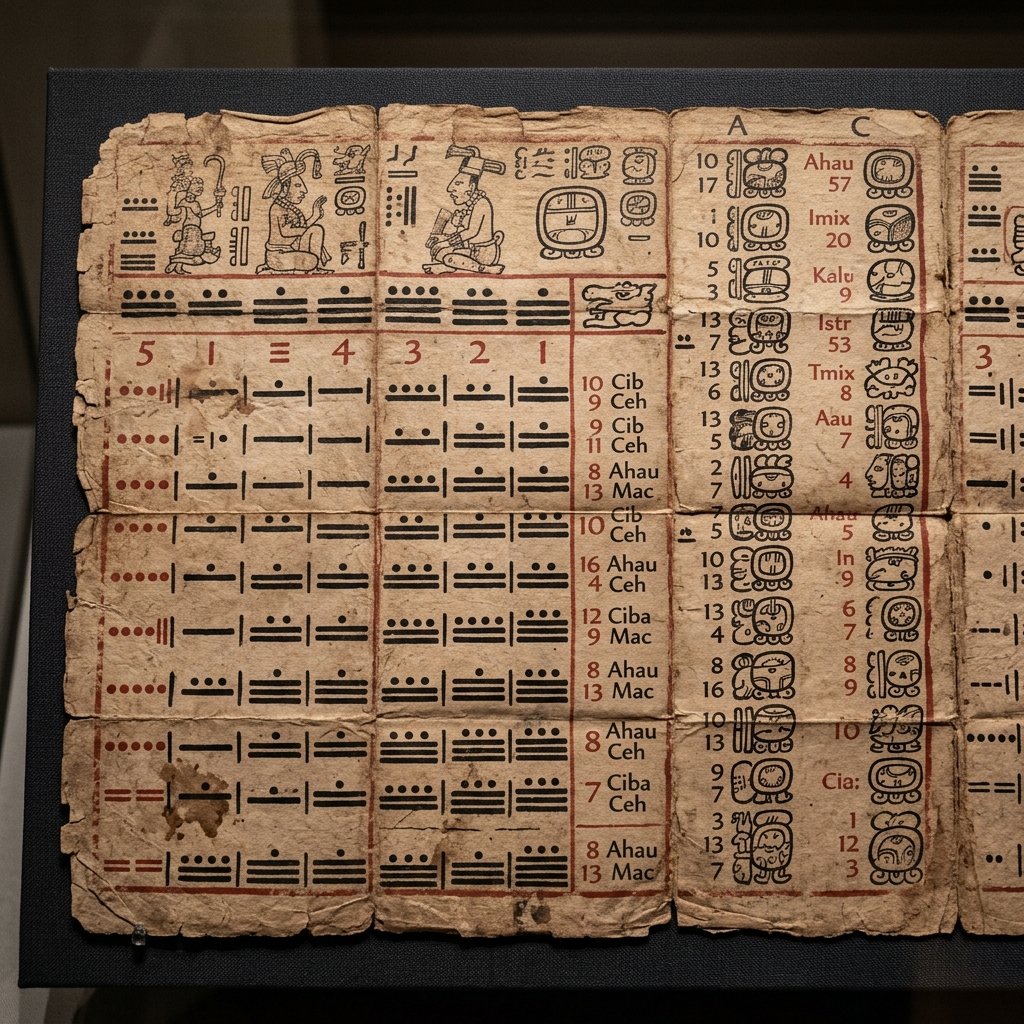
The Discovery of Zero
The most profound element of Maya mathematics was their independent invention of zero.
The concept of zero—as both an empty placeholder in a positional system and a mathematical value in its own right—is conceptually difficult. The ancient Greeks did not have it. The Romans did not have it. In the Old World, it was invented in India around the 5th century AD, and eventually brought to Europe by Arab mathematicians.
The Maya (or perhaps their Olmec/Epi-Olmec predecessors) invented zero centuries earlier. The oldest known use of a zero placeholder in Mesoamerica dates to 36 BC, though the concept was likely older. The Maya represented zero visually most often as a stylized marine shell, though a specialized "flower" glyph was also sometimes used.
Without zero, positional math breaks down. How do you differentiate between 21 and 201 if you have no way to indicate an empty "tens" column? The shell glyph allowed the Maya to record extraordinarily precise astronomical cycles and historical dates spanning thousands of years (Aveni, A., Skywatchers of Ancient Mesoamerica, 1980).
Head Variants: When Numbers Are Gods
While the dot-and-bar system was perfect for complex astronomical calculations, the Maya often wanted to elevate the visual prestige of their numbers, particularly when recording the dates of royal accessions or military victories on stone monuments.
For these formal occasions, scribes used Head Variant numerals. Instead of writing the number 9 as four dots over a bar, they would carve the profile portrait of the God of Nine (the youthful Maize God, identifiable by his sloping forehead and jaguar-pelt markings).
Every number from 0 to 13 had its own patron deity. To write numbers 14 through 19, the scribe would take the deity portrait for 4 through 9 and add the skeletal jawbone of the Death God (who represented 10). It was a brilliant, artistic way to make mathematics a deeply theological exercise (Coe, M.D., Reading the Maya Glyphs, 2005).
References
- Aveni, A.F. Skywatchers of Ancient Mesoamerica. University of Texas Press, 1980.
- Coe, M.D. & Van Stone, M. Reading the Maya Glyphs. Thames & Hudson, 2nd edition, 2005.
- Houston, S., Chinchilla, O., & Stuart, D. The Decipherment of Ancient Maya Writing. University of Oklahoma Press, 2001.
- Sharer, R.J. & Traxler, L.P. The Ancient Maya. Stanford University Press, 6th edition, 2006.
Frequently Asked Questions
How did the Maya write the number 20?
Because they used a base-20 system, the number 20 was written exactly like we write "10" in a base-10 system: a 1 in the second position, and a zero in the first position. Visually, a scribe would draw one dot in the upper tier (representing 1 unit of twenty), and the shell zero symbol in the bottom tier.
Did the Maya invent zero before anyone else?
Yes, based on current archaeological evidence. Mesoamerican civilization (specifically the Maya or Epi-Olmec) invented the mathematical concept of zero around the 1st century BC, several centuries before its first documented use in India (from which the European concept derives).
Why did the Maya use a base-20 system?
It is widely accepted by anthropologists that the base-20 (vigesimal) system originated because early Mesoamerican peoples counted using both their 10 fingers and their 10 toes. In fact, in many Maya languages today, the word for "twenty" (winaq) is intimately related to the word for "human being."