The Feathered Serpent at a Glance
The Union of Opposites
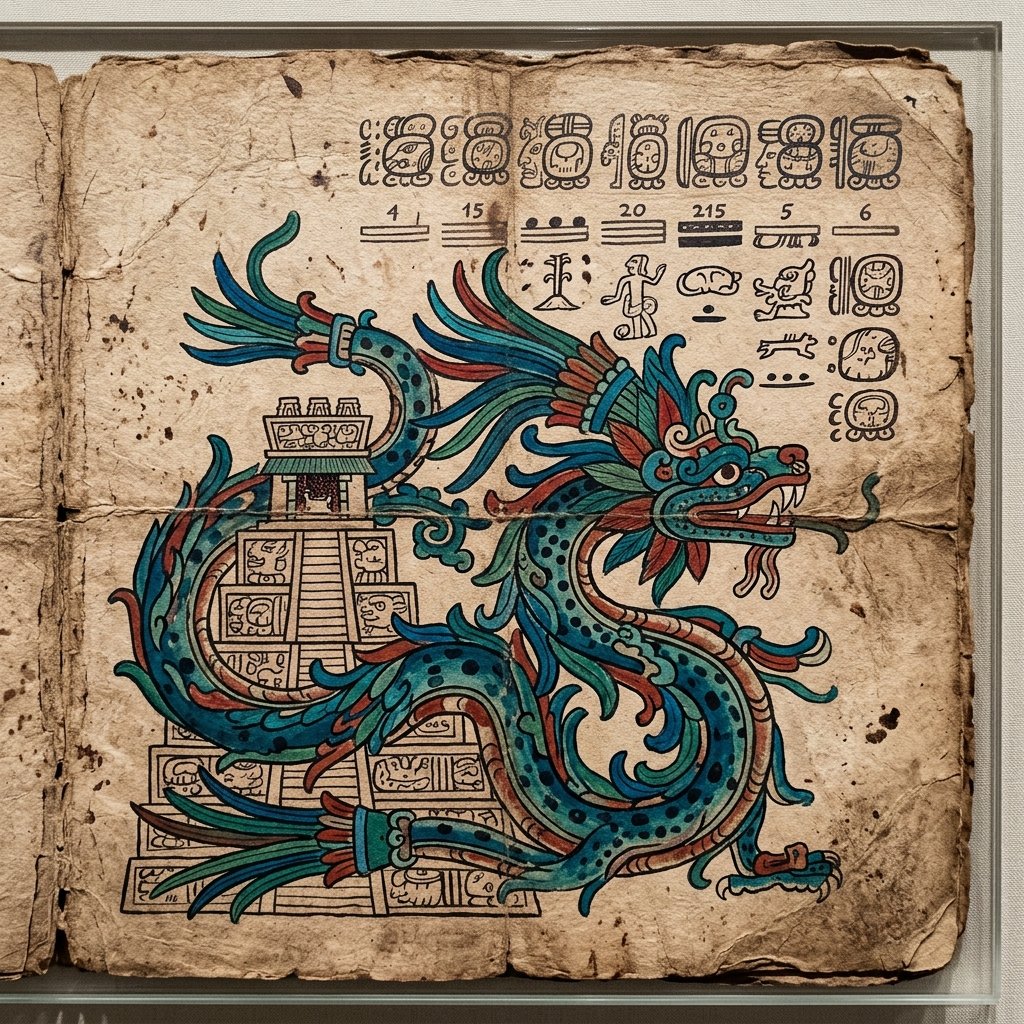
Few religious symbols in human history encode their theological meaning as elegantly as the Feathered Serpent. By combining the snake—a creature that slithers on its belly, burrows into the earth, and lives in water—with the feathers of the quetzal bird, a creature of the sky, the wind, and the heavens, ancient Mesoamerican theologians created a profound symbol of duality and unification.
The Feathered Serpent represents the meeting point of opposites: the earth and the sky, matter and spirit, the underworld and the heavens. It bridges the gap between the mundane and the divine.
Not Just a Maya Symbol
While the Feathered Serpent is famous in the Maya world as Kukulkán, the symbol itself did not originate with the Maya. It is a Pan-Mesoamerican concept with deep roots.
Representations of snakes with bird-like characteristics appear in Olmec iconography as early as 900 BC. The symbol reached spectacular prominence in the great central Mexican metropolis of Teotihuacan around 200 AD, where the massive Temple of the Feathered Serpent displays hundreds of enormous sculpted serpent heads emerging from feathered collars. Because Teotihuacan deeply influenced the Classic Maya (c. 250–900 AD), the feathered serpent motif entered the Maya lowlands as a symbol of foreign military prowess, political legitimacy, and sacred war (Martin, S. & Grube, N., Chronicle of the Maya Kings and Queens, 2008).
The Power of Kukulkán at Chichén Itzá
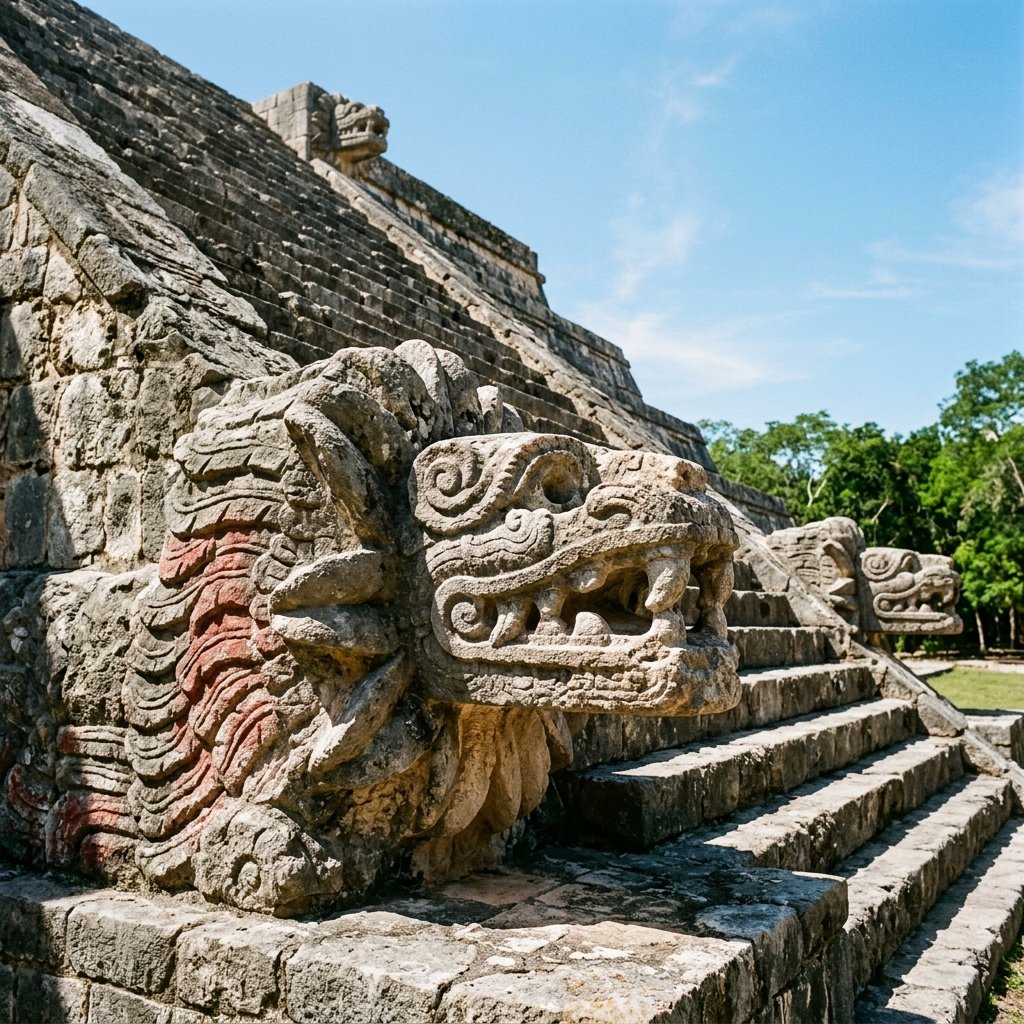
The symbol found its highest architectural expression in the Postclassic period (c. 900–1200 AD) at the Yucatec Maya city of Chichén Itzá. At the center of the city stands El Castillo ("The Castle"), a massive step pyramid dedicated to Kukulkán.
This pyramid encodes the Maya calendar in its stone geometry (with 365 steps overall), but its most famous feature involves the play of sunlight. During the spring and autumn equinoxes, the late afternoon sun strikes the northwestern edge of the pyramid, casting a series of triangular shadows against the western balustrade of the north staircase. These shadows connect perfectly to the massive carved stone serpent heads at the base, creating the illusion of a massive, undulating serpent descending from the heavens to the earth.
This alignment demonstrates that the Feathered Serpent was not merely an abstract artistic motif—it was a visible reality, a divine force manifesting in light and shadow, intimately tied to the agricultural calendar and the coming of the rains.
The God of Wind and Knowledge
As a deity, the Feathered Serpent was strongly associated with wind (which sweeps the path for the rain clouds), creation, and the giving of culture. In various Mesoamerican traditions, Quetzalcoatl/Kukulkán is credited with giving humanity calendars, writing, and the knowledge of cultivating maize.
Because he was a creator figure and a patron of civilization, the symbol of the Feathered Serpent was closely linked to rulership. Maya kings (and later Aztec emperors) claimed the backing of the Feathered Serpent to justify their authority, using the emblem as a sign that their reign was ordained by the cosmos.
References
- Carrasco, D. Quetzalcoatl and the Irony of Empire. University Press of Colorado, 2000.
- Miller, M. & Taube, K. The Gods and Symbols of Ancient Mexico and the Maya. Thames & Hudson, 1993.
- Martin, S. & Grube, N. Chronicle of the Maya Kings and Queens. Thames & Hudson, 2nd edition, 2008.
- Ringle, W.M., Gallareta Negrón, T., & Bey, G.J. "The Return of Quetzalcoatl: Evidence for the Spread of a World Religion during the Epiclassic Period." Ancient Mesoamerica, 9(2), 1998, pp. 183–232.
Frequently Asked Questions
What does the Feathered Serpent symbolize?
The Feathered Serpent symbolizes the union of opposites. The serpent represents the earth, water, and the underworld, while the feathers represent the sky, wind, and heavens. Together, they form a creature that bridges the mortal and divine worlds.
Are Kukulkán and Quetzalcoatl the same?
Yes, they are the same basic cosmological concept adopted by different cultures. Kukulkán is the Yucatec Maya name, while Quetzalcoatl is the Nahuatl (Aztec/Toltec) name. However, depending on the specific time period and city, the roles and myths surrounding the deity varied significantly.
Did the Maya invent the Feathered Serpent?
No. The concept of a feathered or plumed serpent predates the Maya by centuries, originating with the Olmec culture and reaching prominence in the central Mexican city of Teotihuacan. The Maya adopted and adapted the symbol, eventually making it a central feature of Postclassic sites like Chichén Itzá.