The Wayob at a Glance
What Is a Way?
In Maya belief, every person possessed a way (sometimes written wahy) — a supernatural alter-ego or spirit companion that existed as a parallel being. The way was not simply a "spirit animal" in the modern popular sense. It was a co-essence — a part of the person's very being that could separate from the body during sleep, trance, or ritual, take animal or supernatural form, and act independently in the spirit world.
What happened to the way happened to the person. If the way was injured, the person fell ill. If the way was killed, the person died. This concept is documented across Mesoamerica and is known as nagualism in Nahuatl-speaking traditions — but among Mayanists, the term way is preferred because it derives directly from the Maya hieroglyphic evidence.
The Discovery of the Way Glyph
The breakthrough in understanding wayob came in 1989, when epigraphers Stephen Houston and David Stuart identified a specific hieroglyph — the "way" glyph — that appeared as a caption on hundreds of Classic-period painted ceramics. The glyph consists of a half-darkened face (representing the division between waking and sleeping/dreaming) paired with phonetic signs spelling wa-ya.
This glyph appeared alongside images of supernatural creatures on polychrome vessels, identifying them as specific wayob belonging to named individuals or polities. The decipherment opened up an entire category of Maya supernatural belief that had been largely invisible to scholars (Houston, S. & Stuart, D., "The Way Glyph: Evidence for 'Co-essences' among the Classic Maya," Research Reports on Ancient Maya Writing, No. 30, 1989).
Types of Wayob
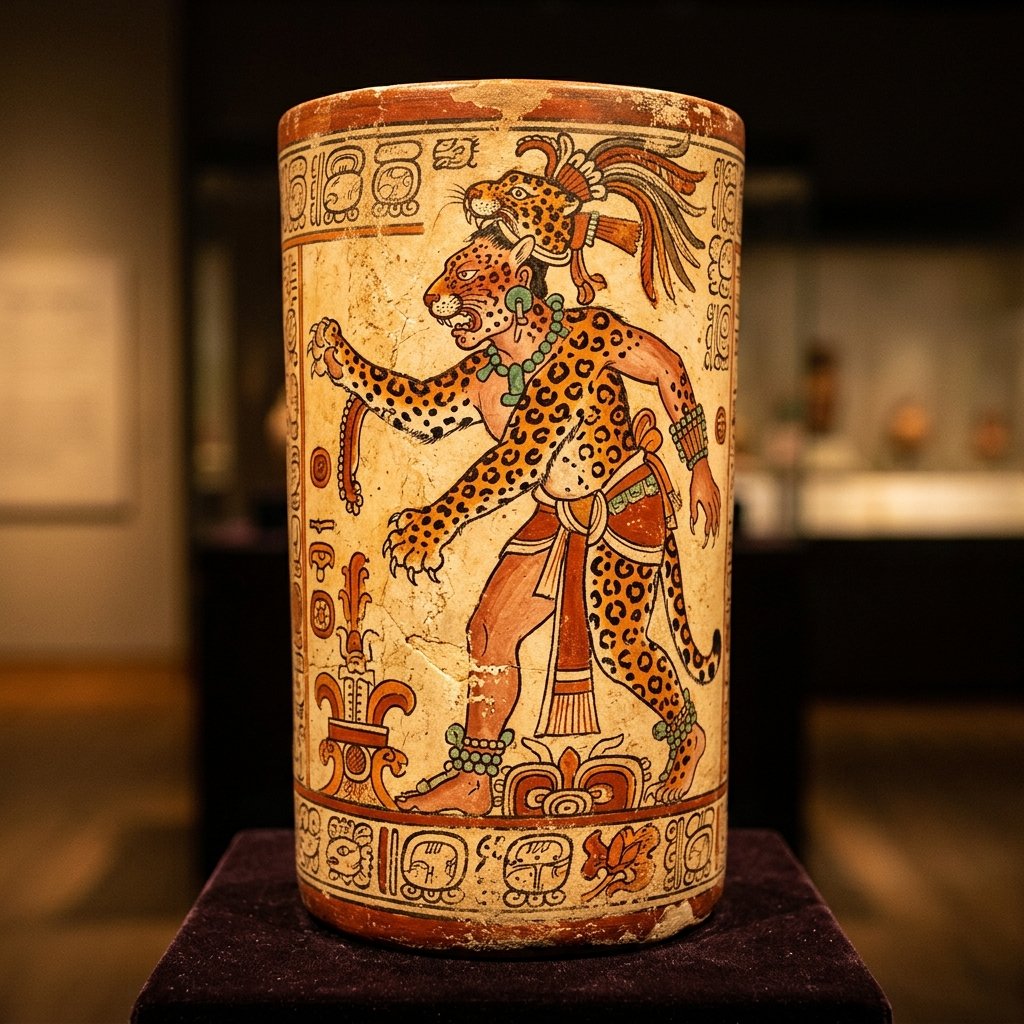
The wayob depicted on Classic-period ceramics take a remarkable range of forms. Mayanist Nikolai Grube and Werner Nahm catalogued over 40 distinct types. Some of the most common include:
Animal Wayob
- Jaguar (Balam) — the most prestigious way form, associated with royalty and military power. Jaguars were the supreme predators of the Maya forest, and a jaguar way signified dominance.
- Owl (Kuy) — associated with death and the underworld. Owls were messengers of Xibalba in the Popol Vuh.
- Deer (Keh) — sometimes associated with hunting and forest knowledge.
- Serpent (Kan) — fire serpents and vision serpents associated with royal spiritual authority.
Supernatural Wayob
- Skeletal beings — death-related wayob depicted as animated skeletons, often shown engaged in sinister activities.
- Fire creatures — beings wreathed in flame, sometimes with insect-like features.
- Composite monsters — hybrid creatures combining features of multiple animals — part deer, part serpent, part bird — that have no counterpart in the natural world.
- The "water-lily jaguar" — a jaguar with water-lily pads on its head, associated with the watery underworld.
Wayob and Power
Not all wayob were equal. A commoner's way might be a small forest animal — a rabbit or a mouse. But a king's way was a fearsome supernatural creature — a flaming jaguar, a feathered serpent, or a skeletal death god. The power of the way reflected and reinforced the social hierarchy.
Ceramic paintings suggest that wayob were deployed in spiritual warfare. Maya sorcerers (aj way — "the way-person") could send their wayob to attack enemies, cause illness, or steal the life-force of rivals. Several ceramics depict wayob in combat — skeletal jaguars clashing with fire serpents — which scholars interpret as visual metaphors for sorcerous conflict between rival polities (Grube & Nahm, "A Census of Xibalba," in The Maya Vase Book, Vol. 4, 1994).
Dreams and the Way
The way was particularly active during sleep. The half-darkened face in the way glyph has been interpreted as representing the boundary between waking consciousness and the dream state. During sleep, the way separated from the body and roamed — encountering other wayob, visiting the underworld, or receiving prophetic visions.
This explains why dreams were taken extremely seriously in Maya culture. A bad dream might indicate that one's way had been attacked. Colonial-era ethnographic sources describe Maya communities where dream interpretation was a formal role performed by specialists.
Modern Survival
The way concept survives today among various Maya-speaking communities, though often blended with Catholic folk traditions:
- Among the Tzotzil Maya of Chiapas, every person is believed to have a chanul (animal companion spirit) kept in a corral inside a mountain by ancestral deities. If the chanul escapes or is harmed, the person falls ill (Vogt, E.Z., Tortillas for the Gods, 1976).
- Among the K'iche' Maya of Guatemala, the concept of nahual (derived from the Nahuatl) persists, with each person's birth day-sign determining their spiritual companion animal.
- Stories of shapeshifting sorcerers who transform into animals at night remain widespread in rural communities across the Maya world.
References
- Houston, S. & Stuart, D. "The Way Glyph: Evidence for 'Co-essences' among the Classic Maya." Research Reports on Ancient Maya Writing, No. 30, Center for Maya Research, 1989.
- Grube, N. & Nahm, W. "A Census of Xibalba: A Complete Inventory of Way Characters on Maya Ceramics." In Kerr, J. (ed.), The Maya Vase Book, Vol. 4, Kerr Associates, 1994, pp. 686–715.
- Vogt, E.Z. Tortillas for the Gods: A Symbolic Analysis of Zinacanteco Rituals. Harvard University Press, 1976.
- Helmke, C. & Nielsen, J. "The Way of the Cross: Wayob Beings in Maya Art and Texts." Ketzalcalli, Vol. 2, 2009, pp. 01–26.
- Coe, M.D. & Kerr, J. The Art of the Maya Scribe. Harry N. Abrams, 1997.
Frequently Asked Questions
Is a way the same as a "spirit animal"?
Not exactly. The modern popular concept of a "spirit animal" is a loose, often decontextualized borrowing from various indigenous traditions. The Maya way is a specific, well-documented concept: a co-essence — a part of the individual's being that could take animal or supernatural form, separate from the body during sleep, and whose fate was directly linked to the person's health and life. It is more intimate and consequential than the popular "spirit animal" concept suggests.
Could anyone control their way?
Ordinary people had wayob but generally did not control them consciously. Sorcerers (aj way) and rulers, however, were believed to have the ability to deliberately send their wayob to act in the spirit world — including attacking enemies. This ability was part of what made rulers supernaturally powerful and sorcerers feared.
How do we know about wayob from archaeology?
Hundreds of Classic-period painted ceramic vessels (c. 600–900 AD) depict supernatural creatures labeled with the way glyph — a hieroglyphic sign deciphered in 1989 by Stephen Houston and David Stuart. These painted scenes show wayob in action: transforming, fighting, visiting the underworld, and engaging in rituals. The ceramics are our primary visual evidence for the way belief system.