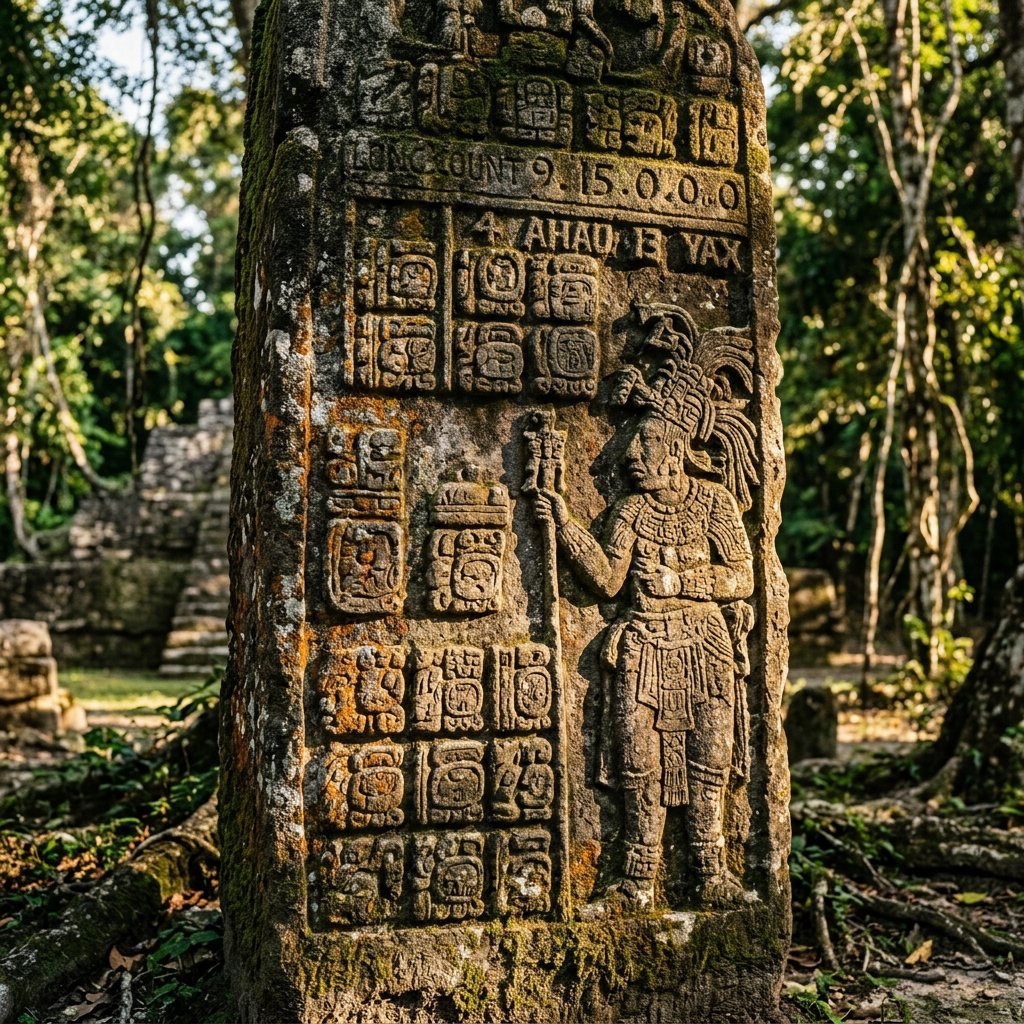
The K'atun System at a Glance
Cyclical vs. Linear Time
The modern Western world generally understands time as a line — events move from past to present to future in a single, unrepeatable sequence. The Maya understood time as a wheel. Events did not simply happen once and recede into history; they belonged to categories of time that repeated, and when a given period came around again, its characteristic qualities returned with it.
This is not mysticism — it is a fundamentally different philosophical framework for understanding causality. Where Western history asks "what caused this specific event?", Maya historical thinking asked "what kind of time are we in, and what does history tell us about what happens during this kind of time?"
The K'atun Period
The K'atun (also written k'atun or katun) is a unit of the Maya Long Count calendar consisting of 20 tuns (a tun = 360 days), equaling 7,200 days or approximately 19.7 solar years.
Each K'atun was named by its ending day in the Tzolk'in (260-day sacred calendar). Because the mathematics of the system produce exactly 13 possible K'atun names, the K'atuns cycle through a repeating sequence of 13 — the K'atun Wheel — completing a full rotation every approximately 256 years.
The 13 K'atuns of the Wheel
11 Ahau → 9 Ahau → 7 Ahau → 5 Ahau → 3 Ahau → 1 Ahau → 12 Ahau → 10 Ahau → 8 Ahau → 6 Ahau → 4 Ahau → 2 Ahau → 13 Ahau → (cycle repeats)
Each K'atun in the wheel carried specific prophetic associations — recorded in the Books of Chilam Balam.
The Books of Chilam Balam
The primary source for K'atun prophecy is the collection known as the Books of Chilam Balam — a series of Yucatec Maya manuscripts written in the Maya language using Latin script during the colonial period (16th–18th centuries). The name means "Books of the Jaguar Prophet" — chilam being a Maya priestly title and balam meaning jaguar.
Several versions survive, named after the towns where they were kept:
- The Chilam Balam of Chumayel — the most complete and most studied, translated by Ralph Roys (1933).
- The Chilam Balam of Tizimín — contains extensive K'atun prophecies and historical chronicles.
- The Chilam Balam of Maní — includes agricultural and medical information alongside prophecy.
- Additional versions from Kaua, Ixil, Tekax, Nah, and other towns.
These texts blend historical chronicle with prophecy in a way that is unfamiliar to Western readers. Because time is cyclical, describing what happened in a past K'atun 4 Ahau is simultaneously a prophecy about what will happen in the next K'atun 4 Ahau. History is prophecy.
How K'atun Prophecy Works
Each K'atun in the wheel carries characteristic qualities — a "personality" composed of historical associations, mythological symbolism, and priestly interpretation. For example:
- K'atun 8 Ahau: A time of political upheaval and change of rulership. The Chilam Balam of Chumayel records: "There is an end of greed; there is an end to causing vexation... It was during this K'atun that the Itza were driven from their homes" (Roys, 1933, p. 144).
- K'atun 4 Ahau: Associated with the arrival of Kukulkan and the founding of new cities. Also the K'atun during which the Spanish arrived — a coincidence the Maya chroniclers noted with bitter irony.
- K'atun 11 Ahau: Described as a time of "harsh rule" and excessive taxation.
- K'atun 13 Ahau: Generally considered an auspicious time — associated with abundance and peaceful governance.
The Maya priests (ah k'in) used these associations to counsel rulers. A newly installed king who began his reign during K'atun 8 Ahau, for example, would be warned that political instability was characteristic of this period and should prepare accordingly. The prophecy was not fatalistic — it was advisory.
The 2012 Connection
The popular "2012 prophecy" was a misunderstanding of Maya calendrical thinking, conflating two different concepts:
- December 21, 2012 marked the completion of 13 B'ak'tuns (the Long Count reaching 13.0.0.0.0) — a major cycle of approximately 5,125 years. This is a Long Count anniversary, not a K'atun event.
- The K'atun prophecy system operates on a different scale (256-year cycles) and does not predict "end of the world" events. No K'atun prophecy in the Books of Chilam Balam describes universal destruction.
The Tortuguero Monument 6 — the only known Classic-period inscription that references the 2012 Long Count date — is damaged at the critical passage, but what survives describes the "descent" of a deity (possibly Bolon Yokte' K'uh) in language consistent with a ceremony of cosmic renewal, not apocalypse (Stuart, D., The Order of Days, 2011, pp. 218–235).
Living Tradition
K'atun awareness has not entirely disappeared. In some highland Guatemala communities, Maya aj q'ij (daykeepers) continue to track calendrical cycles, including K'atun transitions. The most recent K'atun transition occurred in 2012 (K'atun 4 Ahau, by some reckonings), and the next significant K'atun shift will occur around 2032.
References
- Roys, R.L. The Book of Chilam Balam of Chumayel. Carnegie Institution of Washington, 1933. (University of Oklahoma Press reprint, 1967.)
- Edmonson, M.S. The Ancient Future of the Itza: The Book of Chilam Balam of Tizimin. University of Texas Press, 1982.
- Stuart, D. The Order of Days: The Maya World and the Truth About 2012. Harmony Books, 2011.
- Thompson, J.E.S. Maya History and Religion. University of Oklahoma Press, 1970.
- Rice, P.M. Maya Political Science: Time, Astronomy, and the Cosmos. University of Texas Press, 2004.
Frequently Asked Questions
Did the K'atun prophecies actually predict the future?
The K'atun prophecies described the qualities of time periods based on what had happened in previous cycles of the same K'atun name. They were advisory — similar to how a meteorologist uses past weather patterns to forecast future conditions. Whether specific events repeated as predicted is debatable, but the system was taken seriously enough to influence political and religious decision-making for centuries.
How is the K'atun wheel different from the Long Count?
The Long Count is a linear calendar that counts days from a fixed starting point (August 11, 3114 BC). The K'atun Wheel is a cyclical system of 13 repeating K'atun periods, each approximately 19.7 years long. Think of the Long Count as a serial number (unique to each day) and the K'atun Wheel as a seasonal calendar (repeating patterns). Both were used simultaneously.
What's the next K'atun transition?
K'atun transitions depend on the specific correlation used between the Maya and Western calendars. Using the widely accepted GMT correlation, the next significant transition will occur around 2032. Some Maya communities in Guatemala continue to mark these transitions with ceremony.