The Myth at a Glance
The Feathered Serpent Concept
The Feathered Serpent is one of the oldest and most widespread religious symbols in Mesoamerica. The concept — a serpent adorned with the bright green feathers of the quetzal bird — combines two of the most powerful symbols in the indigenous worldview: the serpent (representing earth, water, and regeneration) and the quetzal feather (representing sky, wind, and divinity). Their fusion represents the union of earth and sky — the fundamental axis of Mesoamerican cosmology.
The earliest known depictions of a feathered serpent appear at Teotihuacan (central Mexico) on the Temple of the Feathered Serpent, dated to approximately 200 AD. The concept then radiated outward across Mesoamerica over the following centuries, being adopted and adapted by the Maya, Zapotec, Mixtec, Toltec, and Aztec civilizations (Ringle, W.M. et al., "The Return of Quetzalcoatl," Ancient Mesoamerica, 1998).
Kukulkan in Maya Tradition
Among the Yucatec Maya, the Feathered Serpent was known as K'uk'ulkan (sometimes written Kukulcan or Kukulkan). The name is a direct translation: k'uk' means "quetzal feather" and kan means "serpent" in Yucatec Maya.
Kukulkan occupies a complex position in Maya religion. In some texts, he appears as a deity — a divine being associated with wind, rain, and the planet Venus. In other sources, he appears as a historical or semi-historical figure — a foreign leader or priest who arrived in Yucatán and introduced new religious practices, political structures, and architectural traditions.
The Books of Chilam Balam describe K'uk'ulkan as a ruler who arrived in Yucatán during the K'atun 4 Ahau (a calendrical period corresponding roughly to the late 10th century AD). He is credited with founding the city of Chichen Itza's later phase and establishing a new political order (Roys, R.L., The Book of Chilam Balam of Chumayel, 1967, pp. 83–84).
The Gifts of the Feathered Serpent
Across multiple Mesoamerican traditions, the Feathered Serpent is credited with bringing the fundamental elements of civilization to humanity:
- Writing and the calendar — The systems of hieroglyphic notation and astronomical timekeeping that the Maya refined to extraordinary precision.
- Agriculture — Particularly the cultivation of maize, which the Feathered Serpent is sometimes credited with discovering or revealing to humans (though in the Popol Vuh, this role belongs to the animals).
- Law and governance — Political structures, tribute systems, and the concept of divine kingship.
- Arts and craftsmanship — Metalworking, featherwork, and stonecraft.
- Religious ceremony — Ritual practices, temple construction, and the priesthood.
It is important to note that these attributions vary across sources and traditions. The Maya version is not identical to the Aztec version (Quetzalcoatl), and scholars caution against treating them as a single unified myth (Taube, K., "The Iconography of Mirrors at Teotihuacan," in Art, Ideology, and the City of Teotihuacan, 1992).
The Architecture of Kukulkan
The most famous architectural monument to Kukulkan is the Temple of Kukulkan (El Castillo) at Chichen Itza. This 24-meter (79-foot) step-pyramid encodes deep calendrical and astronomical symbolism:
- 91 steps on each of 4 sides, plus the platform = 365 — matching the days of the solar year.
- 52 panels on each face — matching the 52-year Calendar Round cycle.
- 9 terraces, divided by a stairway = 18 — matching the 18 months of the Haab' calendar.
The Equinox Serpent
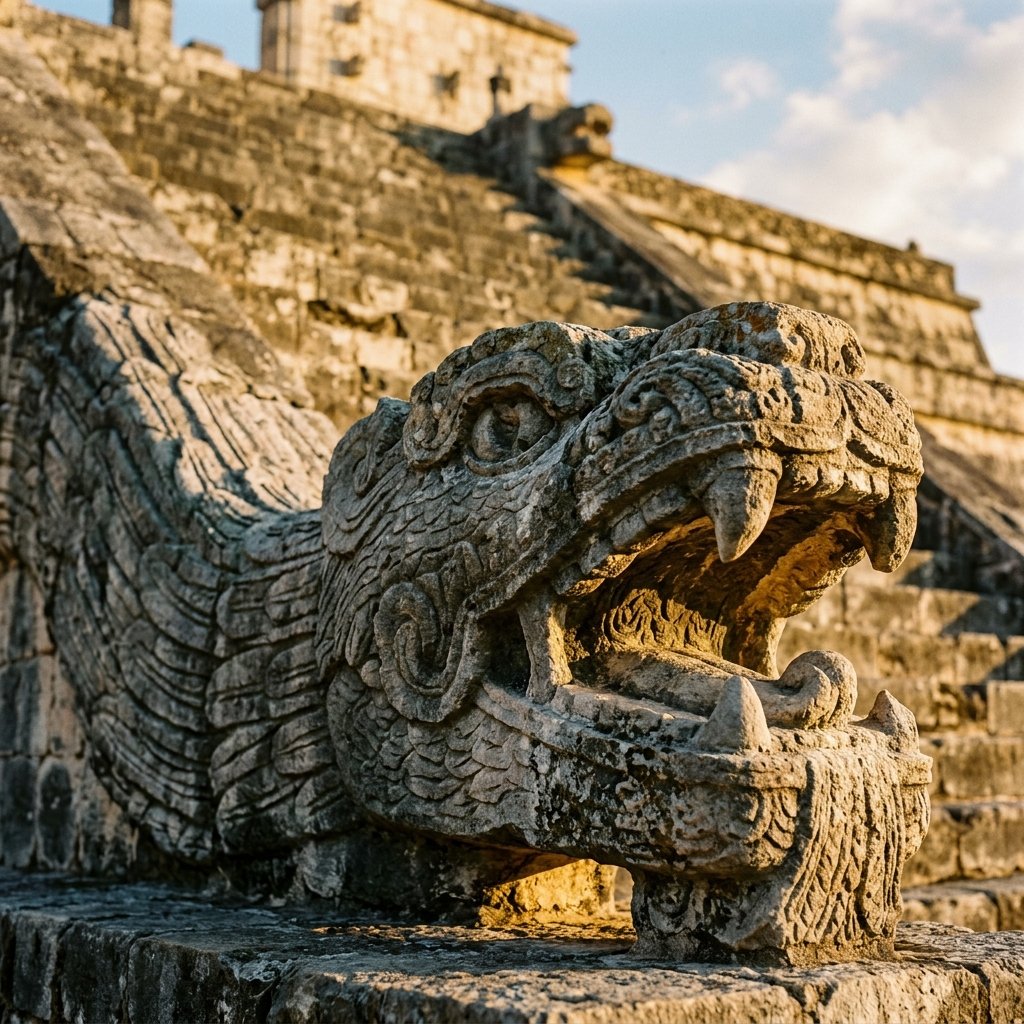
During the spring and fall equinoxes (March 20–21 and September 22–23), the afternoon sun creates a pattern of triangular shadows along the northern stairway that resemble a serpent's body descending the pyramid. The shadows connect to the carved serpent head at the base, creating the illusion of a massive feathered serpent crawling down the structure.
Whether this effect was intentionally designed by the Maya architects or is a happy coincidence of the pyramid's geometry remains debated among scholars. The archaeoastronomer Anthony Aveni has noted that while the light-and-shadow effect is real and visually striking, there is no colonial-era Maya text specifically describing it as an intentional feature. Nevertheless, the pyramid's orientation is clearly aligned to calendrically significant directions (Aveni, A., Skywatchers of Ancient Mexico, University of Texas Press, 2001, pp. 278–282).
Kukulkan vs. Quetzalcoatl: Important Distinctions
While Kukulkan and Quetzalcoatl share the "feathered serpent" symbolism, they are not the same deity. Key differences include:
- Chronology: The Maya version (Kukulkan) appears prominently in the Terminal Classic and Postclassic periods (c. 900–1500 AD), while the Aztec version (Quetzalcoatl) belongs primarily to the Postclassic (c. 1300–1521 AD).
- Cultural context: Kukulkan is embedded in Maya political history as a possible historical figure; Quetzalcoatl is more deeply mythologized in Aztec sources, particularly around his departure and prophesied return.
- Theological emphasis: The Maya Kukulkan is primarily associated with wind, rulership, and architectural innovation. The Aztec Quetzalcoatl carries additional associations with self-sacrifice, priestly celibacy, and opposition to human sacrifice.
References
- Ringle, W.M., Gallareta Negrón, T. & Bey, G.J. "The Return of Quetzalcoatl: Evidence for the Spread of a World Religion during the Epiclassic Period." Ancient Mesoamerica, Vol. 9, 1998, pp. 183–232.
- Roys, R.L. The Book of Chilam Balam of Chumayel. University of Oklahoma Press, 1967.
- Aveni, A.F. Skywatchers of Ancient Mexico. University of Texas Press, 2001.
- Taube, K. "The Temple of Quetzalcoatl and the Cult of Sacred War at Teotihuacan." RES: Anthropology and Aesthetics, No. 21, 1992, pp. 53–87.
- Tozzer, A.M. Landa's Relación de las Cosas de Yucatán: A Translation. Papers of the Peabody Museum, Vol. 18, 1941.
Frequently Asked Questions
Is Kukulkan the same as Quetzalcoatl?
Not exactly. Both are "Feathered Serpent" deities from Mesoamerican traditions, and they share a common symbolic ancestor. However, Kukulkan is specifically the Maya version, embedded in Maya political history and Yucatec religious practice, while Quetzalcoatl is the Aztec version with distinct theological emphases. They should be understood as related but culturally distinct expressions of a shared Mesoamerican concept.
Was Kukulkan a real person or a god?
The sources are ambiguous. The Books of Chilam Balam describe K'uk'ulkan as a historical leader who arrived in Yucatán in the late 10th century. In art and iconography, he appears as a deity associated with wind and the planet Venus. Many scholars believe the tradition may combine a real historical figure (a foreign ruler or priest) with an older, pan-Mesoamerican deity — a common pattern in Mesoamerican religion where rulers claimed divine identities.
Can you see the serpent shadow at Chichen Itza?
Yes. During the spring equinox (around March 20–21) and fall equinox (around September 22–23), the afternoon sun creates triangular shadows along the northern stairway of El Castillo that resemble a serpent descending the pyramid. The effect is visible for several days around each equinox. Tens of thousands of visitors gather at Chichen Itza to witness it each year.