The Legend at a Glance
The Legend
In the city of Uxmal, there lived an old woman — a chilam (prophetess) — who had never been able to have children. One day, she found a large egg in the forest and took it home. She kept it warm, and from it hatched a small being — a dwarf — who grew rapidly but never reached normal human size.
The old woman raised the dwarf as her son. She knew, through her prophetic gifts, that he was destined for greatness — and she knew that the king of Uxmal would one day be overthrown by a being "not born of woman."
When the dwarf reached adulthood (still very small), he challenged the king. The king, amused, set him a series of impossible tasks:
- Build a pyramid taller than any in Uxmal — in a single night. By morning, the Pyramid of the Magician stood complete. The king was astonished.
- A test of strength: The king ordered that cocoyol nuts (extremely hard palm nuts) be broken on the dwarf's head. But the old woman had placed a tortilla of stone on the dwarf's head beneath his hat, and the nuts shattered harmlessly. When the same test was applied to the king, he was killed.
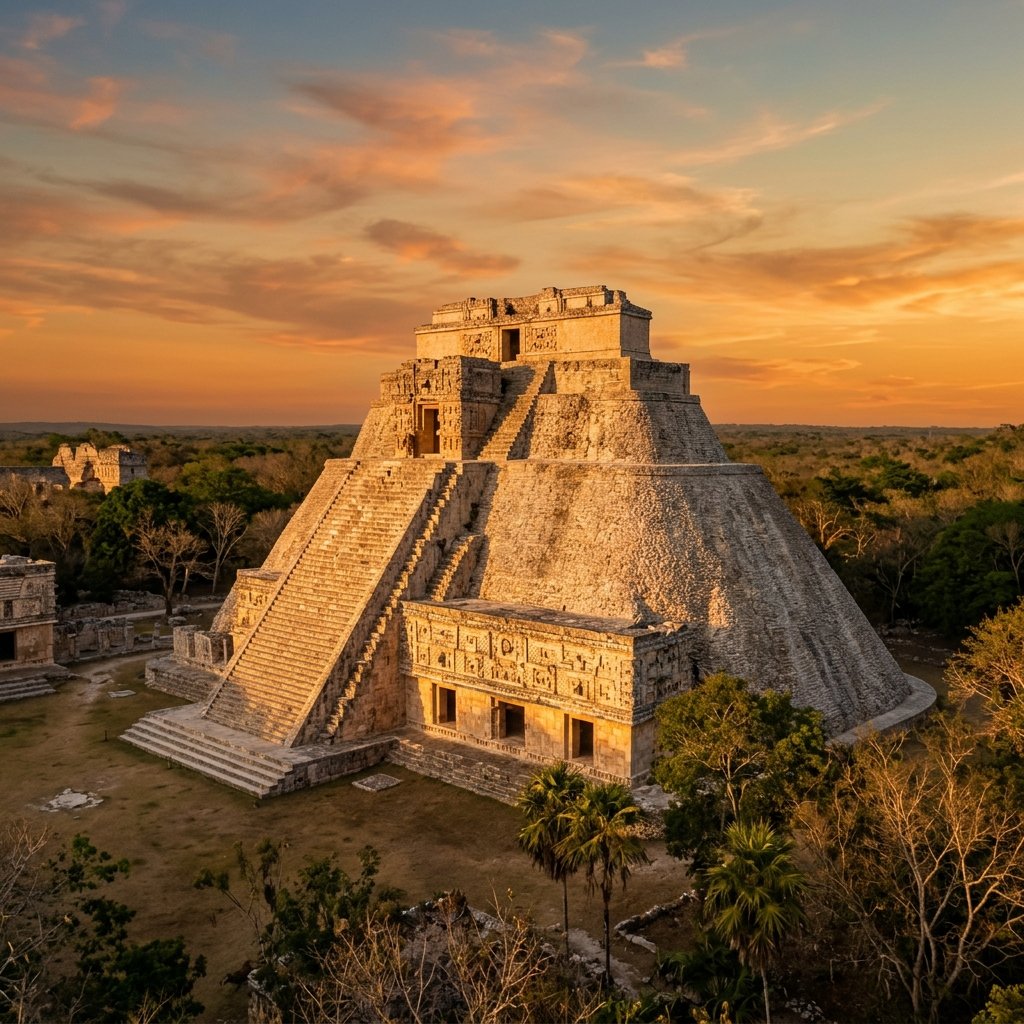
The dwarf became the new ruler of Uxmal. The pyramid he built — the Pyramid of the Magician (Pirámide del Adivino) — still stands today, one of the most distinctive structures in all of Mesoamerican architecture.
Variations of the Legend
Like all oral traditions, the legend of the Dwarf of Uxmal exists in multiple versions. The earliest written account was recorded by the American explorer John Lloyd Stephens during his travels through Yucatán in 1841–1842, published in Incidents of Travel in Yucatan (1843). Stephens heard the story from local Maya guides at the site.
Later versions were collected by the antiquarian Augustus Le Plongeon in the 1870s and by the ethnographer Sylvanus Morley in the early 20th century. The details vary — in some versions the dwarf is a hunchback, in others he is a full dwarf; the number and nature of the challenges differ — but the core elements remain consistent: the egg, the supernatural birth, the challenge to royal authority, and the overnight construction of the pyramid.
The Real Pyramid
The Pyramid of the Magician is one of the most architecturally unusual structures in the Maya world. Unlike most Maya pyramids, which have angular, straight-edged profiles, the Pyramid of the Magician has rounded corners and an elliptical base — giving it an organic, almost sculpted appearance that is unique among known Maya buildings.
Archaeological investigation has revealed that the pyramid was built in five phases over approximately 400 years (c. 500–900 AD), with each new phase encasing the previous structure. This is typical of Maya construction practice — old temples were rarely demolished; instead, they were carefully entombed within larger successors, preserving the sacred energy of the earlier building (Kowalski, J.K., "The Puuc: New Perspectives," in Arquitectura Puuc, 2003).
The pyramid reaches approximately 35 meters (115 feet) in height. Its western staircase is extremely steep — among the steepest of any Maya pyramid — and the Chenes-style doorway at the summit is designed as the open mouth of a giant earth monster, so that entering the temple means symbolically entering the body of the earth.
Uxmal: The Archaeological Context
Uxmal (pronounced "oosh-MAHL") was a major Maya city in the Puuc Hills region of northwestern Yucatán. It flourished during the Terminal Classic period (c. 800–1000 AD) and was one of the most powerful cities in the Yucatán at that time. The site is renowned for its Puuc-style architecture — characterized by smooth lower walls and elaborately decorated upper facades with geometric patterns, lattice-work, and stacked Chaac (rain god) masks.
Key structures at Uxmal include the Governor's Palace (which the American architect Frank Lloyd Wright called "the most beautiful building in the Americas"), the Nunnery Quadrangle, the Great Pyramid, and the Pyramid of the Magician. The site was designated a UNESCO World Heritage Site in 1996.
Folklore and Architecture
The legend of the Dwarf of Uxmal belongs to a widespread Mesoamerican pattern of attributing monumental architecture to supernatural beings. Similar legends exist at other sites:
- The Pyramid of the Sun at Teotihuacan was said to have been built by giants.
- At Toniná, legends credit a race of dwarves with constructing the massive acropolis.
- The Maya word for ancient ruins — uxi — is related to concepts of "before-time" and "the old ones."
These legends may reflect a genuine cultural response to encountering monumental architecture whose construction history had been forgotten. When the later inhabitants of Uxmal saw the Pyramid of the Magician — with its unusual rounded form and impossible steepness — they created a story to explain how such a thing could exist. The answer: it must have been built by magic.
References
- Stephens, J.L. Incidents of Travel in Yucatan. 2 vols. Harper & Brothers, 1843. (Dover reprint, 1963.)
- Kowalski, J.K. & Dunning, N.P. "The Architecture of Uxmal: The Symbolics of Statemaking at a Puuc Maya Regional Capital." In Mesoamerican Architecture as a Cultural Symbol, Oxford University Press, 1999, pp. 274–297.
- Coe, M.D. The Maya. Thames & Hudson, 9th edition, 2015, pp. 182–186.
- Roys, R.L. The Book of Chilam Balam of Chumayel. University of Oklahoma Press, 1967.
Frequently Asked Questions
Is the Pyramid of the Magician a real place?
Yes. The Pyramid of the Magician (Pirámide del Adivino) is a real archaeological structure at the UNESCO World Heritage Site of Uxmal in Yucatán, Mexico. It stands approximately 35 meters (115 feet) tall and is one of the most visited Maya ruins in the world. The legend of the dwarf is a folktale that locals have associated with the pyramid for centuries.
Was the pyramid really built in one night?
No. Archaeological investigation shows the pyramid was constructed in five phases over approximately 400 years (c. 500–900 AD). Each new construction phase enclosed the previous structure. The "one night" element is a folklore motif found across Mesoamerica to explain seemingly impossible feats of engineering.
Can you visit the Pyramid of the Magician?
Yes — Uxmal is open to visitors. It is located approximately 80 km (50 miles) south of Mérida, Yucatán, Mexico. Climbing the pyramid itself is no longer permitted (for conservation reasons), but visitors can walk around the base and explore the surrounding structures, including the Governor's Palace and the Nunnery Quadrangle.