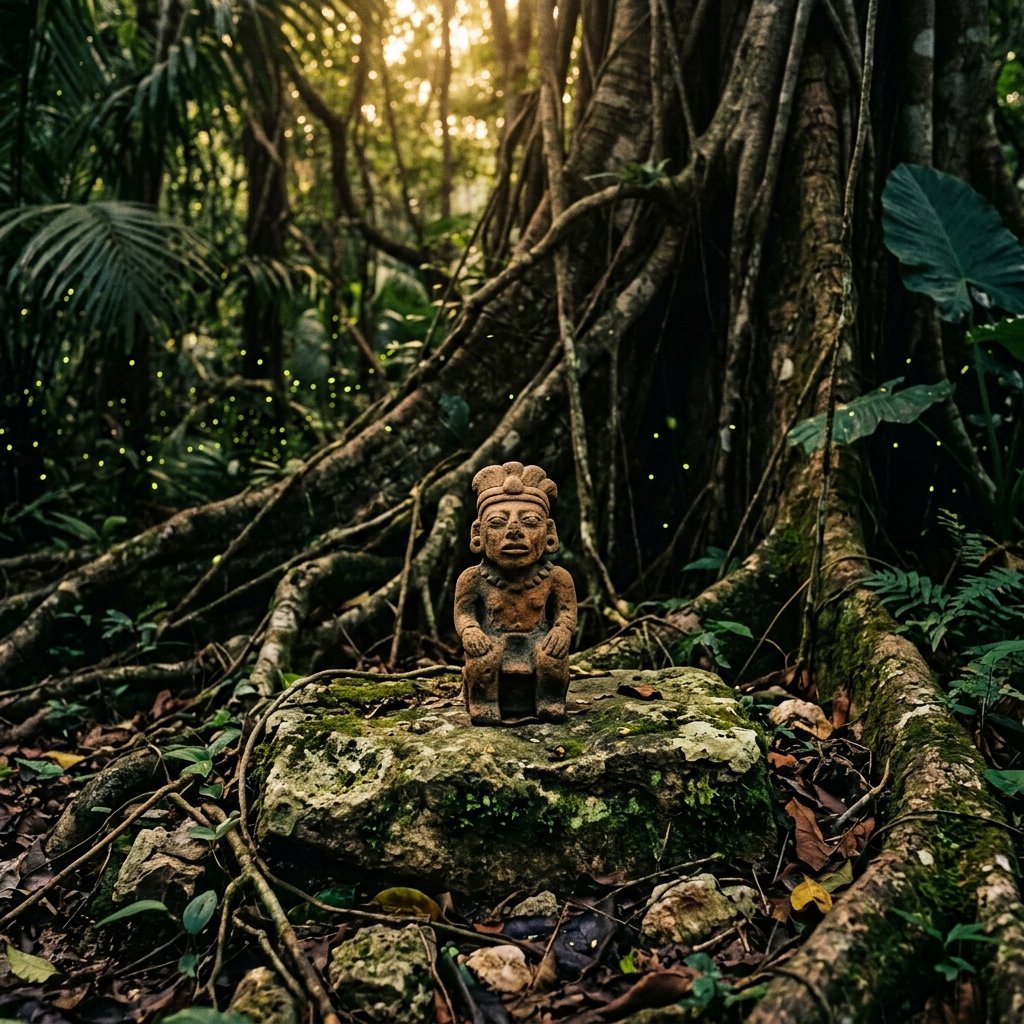
The Legend at a Glance
What Are the Aluxes?
The Aluxes (Yucatec Maya: aluxo'ob, singular alux) are small supernatural beings in Maya folklore — typically described as knee-high figures resembling miniature humans or children. They are said to be invisible most of the time, revealing themselves only when they choose to, and are associated with forests, milpas (cornfields), cenotes, caves, and ancient ruins.
Aluxes occupy a unique space in Maya belief: they are neither gods nor ghosts. They are nature spirits — guardians of specific places who must be acknowledged and respected by anyone who enters or works upon their territory. They are tricksters who can be benevolent or malicious depending on how they are treated.
Origins: How Aluxes Are Made
According to traditional belief, aluxes are not born naturally — they are created by a shaman (j-men) from clay or stone. The process has been documented by several ethnographers:
- A j-men shapes a small clay figurine and performs rituals over it for a specific number of days.
- The figurine is then placed on the landowner's property — typically in a small stone house (kahtal alux, "alux house") built for the purpose.
- Once activated through ceremony, the alux comes to life and guards the property — protecting crops from animals, warding off thieves, and ensuring good harvests.
- The alux is bound to serve for seven years. After seven years, the shaman must seal the alux's house, trapping it inside. If this is not done, the alux becomes wild and dangerous.
This tradition was documented in detail by the ethnographer Alfonso Villa Rojas in his fieldwork among the eastern Yucatec Maya of Quintana Roo in the 1930s and 1940s (Villa Rojas, A., The Maya of East Central Quintana Roo, Carnegie Institution, 1945).
Behavior and Character
Aluxes are fundamentally reciprocal beings. Their behavior toward humans depends entirely on how humans treat them:
If Respected
- They guard milpas and ensure healthy corn harvests.
- They call rain clouds to irrigate crops.
- They chase away animals that would damage fields.
- They protect the property from thieves and trespassers.
If Ignored or Disrespected
- They cause illness — particularly fevers and stomach ailments in children.
- They steal food, tools, and household items.
- They harass travelers at night with stones, strange noises, and disorientation.
- They sabotage construction projects — cracking foundations, toppling walls, causing accidents.
What They Want
The traditional offerings for aluxes are simple: food (particularly corn-based), honey, cigarettes, and balché (a traditional Maya alcoholic drink made from fermented bark). These offerings are placed at the base of trees, at the entrance to milpas, or inside small stone alux houses.
Modern Belief
Unlike many elements of pre-Columbian Maya religion, the belief in aluxes is not historical — it is ongoing. In rural communities across Yucatán, Quintana Roo, Campeche, and Belize, aluxes are treated as a present reality.
Several well-documented modern examples include:
- Highway construction: In the 1990s and 2000s, road construction crews in the Yucatán Peninsula reportedly encountered repeated equipment failures and accidents that local workers attributed to aluxes. In several documented cases, construction was halted until a j-men was brought in to perform ceremonies appeasing the spirits (Gubler, R., "Yucatec Maya Religiosity," Latin American Indian Literatures Journal, 2001).
- Resort development: Along the Riviera Maya coast, hotel and resort developers have — in some cases — incorporated small alux shrines into their properties, either out of genuine belief or as a concession to their Maya construction workers' concerns.
- Agricultural practice: Maya farmers in traditional communities still build kahtal alux at the corners of their milpas and make offerings before planting and after harvest.
Archaeological Connection
Some scholars have suggested a connection between the alux tradition and the small clay figurines found at many Maya archaeological sites. Thousands of miniature clay figures — often depicting humans, animals, or supernatural beings — have been recovered from Classic-period sites across the Maya lowlands. While there is no direct evidence linking these specific artifacts to the alux tradition (which is documented only in post-contact sources), the formal resemblance is notable.
The figurines from Jaina Island, Campeche — famous for their extraordinary detail and artistry — depict a wide range of human and supernatural types, including small, dwarf-like figures that bear some resemblance to descriptions of aluxes (Piña Chán, R., Jaina: La Casa en el Agua, INAH, 1968).
Parallels in World Folklore
The alux tradition has structural parallels in folklore traditions worldwide — though these similarities reflect common human responses to the natural world rather than any historical connection:
- European fairies — particularly the Irish sídhe and Scandinavian nisse/tomte, who guard farmsteads and demand offerings.
- Japanese kodama — tree spirits who must be respected before trees are felled.
- Andean apus — mountain spirits who protect communities and require ritual acknowledgment.
What makes the alux tradition distinctive is its active, living status. While belief in fairies has largely become literary and nostalgic in Europe, the alux tradition continues to shape real-world decisions in the Yucatán — from agricultural practice to urban development.
References
- Villa Rojas, A. The Maya of East Central Quintana Roo. Carnegie Institution of Washington, Publication 559, 1945.
- Redfield, R. & Villa Rojas, A. Chan Kom: A Maya Village. University of Chicago Press, 1934.
- Gubler, R. "Yucatec Maya Religiosity in the Context of Globalization." Latin American Indian Literatures Journal, Vol. 17, No. 2, 2001.
- Piña Chán, R. Jaina: La Casa en el Agua. INAH, México, 1968.
- Boccara, M. "Alux et Laj Alux: Esprits de la Nature et de la Civilisation au Yucatan." L'Homme, Tome 30, No. 114, 1990, pp. 105–120.
Frequently Asked Questions
Are aluxes real?
Aluxes are real as a living belief system. They are part of the active folk religion of the Yucatec Maya, documented by ethnographers since the 1930s and still influencing decisions in rural communities today. Whether they have an independent physical existence is a matter of cultural perspective — to the communities that maintain the tradition, they are as real as any other part of the natural world.
Can you see an alux?
According to tradition, aluxes are normally invisible. They reveal themselves only when they choose to — typically to children, to shamans (j-men), or to people who have either earned their favor or provoked their anger. Sightings are described as brief, often occurring at the edges of vision in forests, milpas, or near ruins at dusk or dawn.
Are aluxes dangerous?
They can be, if disrespected. The traditional belief is that aluxes who are ignored or whose territory is violated without proper offering will cause illness (especially in children), steal belongings, and cause general misfortune. However, aluxes who receive proper offerings and acknowledgment are protective and beneficial — guarding crops and property.